Definitions of the terms used in towel specifications, mill reports, test reports and quotations, written from the production side. Each entry explains what a term means, how it is measured or controlled, and what it changes in a finished towel.
The entries describe general industry practice. Standards are cited by number; check the publisher’s page for the current edition. Statements about Mira Towels’ own production are marked and limited to what we publish elsewhere on this site.
A towel’s fibres decide how quickly it takes up water, how it survives laundering, which dyes and prints it accepts and what its label may say. These entries cover the natural, regenerated and synthetic fibres used in towels and how cotton quality is measured.
A natural seed-hair fibre from plants of the genus Gossypium, made almost entirely of cellulose. Its affinity for water, wet strength and dyeability make it the standard fibre for terry towels.
Each fibre is a single elongated cell growing from the seed coat. A thin primary wall forms first; over the following weeks the cell deposits layers of almost pure cellulose on the inside of that wall, building the secondary wall, until the mature fibre is more than 90 percent cellulose by weight[120]. When the boll opens and the fibre dries, the central canal (the lumen) collapses and the fibre flattens into a twisted ribbon whose convolutions help fibres cling together in spinning. How far the secondary wall has developed is described under fibre maturity.
Each glucose unit of cellulose carries three hydroxyl groups. They attract water, so cotton wets out readily once scouring has removed its natural waxes, and under alkaline conditions they are the sites where reactive dyes bond covalently to the fibre[121]. Cotton is stronger wet than dry, which suits repeated hot laundering. It does not melt but scorches and degrades at high temperature, so processes that depend on softening a thermoplastic fibre, such as heat setting or sublimation, have no equivalent on cotton.
Commercial cotton comes mainly from two species. Gossypium hirsutum, upland cotton, supplies most of the world’s fibre[120]; G. barbadense supplies the longer, finer cottons traded as Pima, Giza or extra-long staple. Variety and origin names say which plant was grown and where, not what length, strength or fineness a bale has. Those are measured, and US classing records them for every bale with high-volume instruments[122].
In a towel, cotton holds water inside the swollen fibre and between fibres and stays soft through laundering; against that, it dries more slowly than synthetics and shrinks unless the fabric is relaxed in finishing. Fibre quality shows most in the pile yarn, which forms the absorbent surface; ground yarns are chosen mainly for strength.
Also called: Pima cotton, Egyptian cotton, Giza cotton
Cotton with an unusually long, fine and strong fibre, grown mainly from Gossypium barbadense varieties such as American Pima and some Egyptian Giza types. The term names a class of fibre, not a guaranteed specification.
Longer fibres overlap more along the yarn, so they spin into finer, stronger and smoother yarns with less twist and less hairiness; in a towel that means a smooth, lustrous pile that sheds less. There is no single world definition. US commodity rules define extra-long staple by species and ginning rather than by a measured length: American Pima and other G. barbadense varieties or their hybrids, ginned on a roller gin[86]. Egypt sorts its crop into a long-staple and an extra-long-staple class, the latter covering roughly 34.3–36 mm[123].
Trade names need care. Pima is a type of G. barbadense, not a test result; Supima is a trademark licensed for products made from American Pima cotton; Egyptian cotton is an origin that includes long-staple as well as extra-long-staple varieties[123]. An ELS pile may also sit on a ground of other cotton, or ELS may be blended with shorter cotton. A specification should therefore name the yarn required, for example a combed ring-spun pile yarn of stated count, and the documents that support any origin claim, rather than rely on the name.
Staple fibres are discontinuous fibres of limited length, natural or cut, that must be twisted together to make a spun yarn. Filaments are continuous strands, produced by extrusion, that can form a yarn without spinning.
All natural fibres except silk are staple fibres; cotton fibres are typically a few centimetres long. Man-made fibres are extruded as continuous filaments and then either used as filament yarn or crimped and cut to a staple length, often matched to cotton so that the two can be blended on cotton spinning machinery. Staple and filament polyester are the same polymer; they differ in the yarn they make.
Protruding fibre ends give spun yarns a softer, more matt and warmer hand, but they shed lint and, with strong synthetic fibres, form pills. Filament yarns are smoother, more lustrous and practically lint-free, though they feel slippery and cool unless textured. Sublimation print faces are frequently built from filament or textured filament polyester, because a smooth, dense surface takes a sharper image, though spun polyester faces exist. Cotton yarns are always spun.
Also called: fibre length, upper half mean length, length uniformity
The characteristic fibre length of a cotton sample, reported in instrument classing as upper half mean length (UHML) in hundredths of an inch and as trade staple in 32nds of an inch.
High-volume instruments (HVI) measure a combed beard of fibres and report the upper half mean length, the mean length of the longer half of the fibres, in hundredths of an inch; the US classing record also converts it to staple in 32nds, where staple 36 corresponds to 1.11–1.13 inch for upland cotton[122]. Length uniformity index is 100 × mean length ÷ UHML[124]; USDA describes 79.5–82.4 as average and above 85.4 as very high[122].
Longer fibres overlap more, so a yarn of given count needs less twist, is stronger and less hairy, and the finest counts need long, uniform cotton. Poor uniformity means more short fibre, which raises waste in carding and combing, weakens the yarn and increases hairiness and lint. In towels, staple length matters most in the pile yarn, for softness, lint and loop shape after laundering. It is a property of the raw cotton and should not be confused with the cut length of man-made staple fibre.
The proportion of fibres in a cotton sample shorter than a reference length, most often 12.7 mm (0.5 inch), expressed by weight or by number of fibres.
The usual basis is the percentage by weight of fibres of 12.7 mm or less[125]. Single-fibre instruments such as AFIS can also report it by number, which gives a higher figure for the same cotton because short fibres weigh little. The Suter-Webb array, AFIS and the HVI short fibre index correlate well but do not agree in absolute value[125], so the basis and the instrument must be stated whenever SFC is specified or compared.
Short fibres add little strength and tend to lie at the yarn surface; in excess they increase waste, spinning end breaks and yarn defects[125]. Combing removes much of them as noil, one reason combed pile yarns shed less lint, while aggressive ginning and lint cleaning raise SFC by breaking fibres[126].
An airflow measurement on a cotton sample that reflects fibre fineness and maturity together, reported in micronaire units to one decimal place.
A weighed plug of fibre is compressed in a chamber and air is forced through it; the resistance to airflow per unit mass is converted into a micronaire reading[122]. Fibres with a small cross-section, whether naturally fine or thin-walled and immature, read low; coarse or thick-walled fibres read high. The reading cannot separate those causes, so it is best interpreted within one variety, where micronaire and maturity are highly correlated[122].
Very low values warn of immature fibre, with more neps and uneven dye uptake; very high values mean coarse fibre and a harsher, weaker yarn at a given count. Cotton markets attach premiums and discounts to readings outside a preferred middle band, set in each market’s loan or contract rules. For a towel mill, consistency within a yarn lot matters as much as the level, because cottons of different micronaire can dye to different depths.
The degree to which a cotton fibre’s secondary cell wall has thickened by the time the boll opens, usually expressed as a maturity ratio or as the percentage of immature fibres.
A mature fibre has a thick cellulose wall and a small lumen; an immature one has a thin wall, collapses into a flat ribbon and bends easily. Single-fibre instruments such as AFIS report a maturity ratio and an immature fibre content, and Cotton Incorporated’s fibre chart rates a maturity ratio of 0.8–1.0 as mature and 0.7–0.8 as immature[124]. Routine classing does not report maturity directly, but within a variety it is closely reflected in micronaire[122].
Immature fibres are the main source of neps, small entanglements of fibre formed in the field, in ginning and in processing; across 200 breeding lines in a USDA study, nep count correlated closely with immature fibre content[127]. Neps take up dye poorly and appear as light spots or undyed white specks in dyed fabric[127]. Very thin-walled fibres of this kind are known in the trade as dead cotton. Carding and combing remove only part of them.
The linear density or diameter of a single fibre, stated for cotton in millitex (milligrams per kilometre) and for man-made fibres in decitex or denier per filament.
Fineness sets how many fibres lie in the cross-section of a yarn of given count. More fibres give a stronger, more even yarn and allow finer counts, and thin fibres bend easily, which is felt as a softer hand. Cotton fineness is measured on single fibres, for example by AFIS in mg/km[127]; Cotton Incorporated rates 135–175 millitex as fine and 175–200 as average[124]. Man-made fibres are produced to a chosen fineness, and those below about 1 dtex are classed as microfibres[128].
Fineness is not micronaire, which mixes fineness with maturity, and not yarn count, which describes the yarn. In cotton the two fibre properties are entangled: a low fineness value can mean a genuinely fine fibre or an immature one, and in breeding data the finer lines were neppier, an association the authors traced largely to maturity[127].
The force needed to break a fibre or a bundle of fibres, normally expressed as tenacity: breaking force divided by linear density, in grams-force per tex or centinewtons per tex.
Dividing force by linear density lets fibres of different fineness be compared. In cotton classing the HVI breaks a bundle of fibres clamped with 1/8-inch spacing between the jaws and reports grams per tex; USDA describes 25.5–28.4 g/tex as average and 30.5 g/tex and above as very strong[122]. One gram-force per tex is 0.98 cN/tex, so the units are close but not interchangeable. The same test records elongation at break.
Water acts differently on different fibres. Cotton gains strength when wet; standard viscose loses about half of it, whereas lyocell retains much more[129], and EU law defines modal by minimum values of breaking force and wet modulus[87]. Polyester is largely unaffected. Fibre strength sets the potential for yarn strength; length, twist and evenness decide how much of it the yarn realises.
The first processing step after harvest, in which cotton fibre (lint) is separated from the seed, cleaned of plant trash and pressed into bales.
Seed cotton is dried or conditioned as needed, cleaned and ginned. Saw gins pull the fibre through a grid with toothed saws and handle the throughput needed for upland cotton; roller gins grip the fibre against a roller and strip it from the seed more gently. US rules require extra-long-staple cotton to be roller ginned[86], and in a USDA comparison roller ginning kept noticeably more long fibre than saw ginning of the same upland cotton[126].
Lint cleaners then remove leaf, bark and seed-coat fragments, which classing reports as leaf grade and extraneous matter[122]. Each cleaning stage improves the grade but breaks fibres: in the same trial, extra saw-type lint cleaning shortened the fibre, raised short fibre content and gave yarns with more neps, more imperfections and more spinning end breaks[126]. Seed-coat fragments that survive into the yarn are a main source of yarn irregularity[127]. This is one reason why cottons of the same origin can spin very differently.
Cotton grown under certified organic farming rules. The term describes the agricultural system and its documented supply chain, not a measurable property of the fibre.
Organic farming rules restrict synthetic pesticides and fertilisers and exclude genetically modified seed, and compliance is certified at farm level under national or regional organic regulations. The fibre performs like conventional cotton of similar grade and cannot be recognised in a finished towel, so an organic claim rests on documentation that follows the material through ginning, spinning, weaving, dyeing and making-up.
GOTS certifies processing along the whole textile chain and adds environmental and social criteria[103]. The Organic Content Standard (OCS) verifies only the presence and amount of organic material through the chain, without criteria for chemicals or for social and environmental aspects of production[104]. In both, the processing and trading stages are certified and transaction certificates document the shipments; the exact scope rules are set by each standard. Organic status says nothing about absorbency, softness or durability, which belong in the specification separately.
At Mira Towels: Mira can support towel programs where OEKO-TEX®, GOTS, ISO 9001 or ISO 14001 documentation is required; scope is confirmed during quotation.
Also called: reclaimed cotton, mechanically recycled cotton
Cotton fibre recovered from pre-consumer waste, such as spinning, weaving and cutting waste, or from post-consumer textiles and returned to yarn production, usually by mechanical shredding.
Pre-consumer waste is clean and of known composition; post-consumer textiles must first be collected, sorted by fibre and colour and stripped of trims. Mechanical recycling tears fabric back into fibre and breaks fibres in the process, so recycled cotton has a high short-fibre content. It is widely spun on rotor machines and usually blended with virgin cotton or other fibres to keep yarn strength and spinning stable; one recent study found that combing and compact ring spinning can raise the usable recycled share[130].
For towels this generally means coarser counts, more lint and lower yarn strength than a virgin combed yarn, so recycled content is easier to use in ground and weft yarns, in flat-woven products or as part of a pile blend than as a fine pure pile yarn. Coloured waste sorted by shade can give coloured yarn without dyeing, though shade consistency then depends on the sorting. The claim cannot be read from the towel itself; it needs chain-of-custody certification such as GRS or RCS, with matching transaction certificates.
A synthetic fibre made from linear polymers of an ester of a diol and terephthalic acid, in textiles almost always polyethylene terephthalate (PET). It is thermoplastic, hydrophobic and dyed with disperse dyes.
PET is made by polymerising ethylene glycol with terephthalic acid; the EU fibre name polyester covers fibres with at least 85 percent by mass of such ester units in the chain[87]. The molten polymer is extruded through spinnerets and drawn to orient its molecules, giving a strong, dimensionally stable filament.
Two properties dominate its behaviour in towels. Polyester is hydrophobic: it takes very little water into the fibre, and EU fibre analysis assigns it an agreed moisture allowance of 1.5 percent against 8.5 percent for cotton[87]. A polyester fabric can wick liquid along its surface, but it does not hold water the way cotton terry does. Polyester is also thermoplastic. Its amorphous regions become mobile above the glass transition temperature, around 70 °C in calorimetric measurements, and the polymer melts at about 250 °C[131]; exact values depend on crystallinity, orientation and test method. Heat setting, high-temperature dyeing and sublimation all exploit that mobility.
Conventional PET has no ionic dye sites, so it is dyed and printed with disperse dyes that diffuse into the fibre at high temperature. This is why sublimation works on polyester and not on untreated cotton. Cationic-dyeable modified polyesters exist as separate products.
In towels polyester serves as the print face of sublimation-printed towels, as microfibre in quick-drying sport and travel towels, and occasionally in ground or blended yarns that add strength and reduce shrinkage. It attracts and holds oily soil, pills when spun from staple, builds static in dry air and can glaze or deform under an iron or a hot press.
At Mira Towels: Our stock all-over printed towel is a 250 GSM construction with a polyester print face and a cotton reverse face; only the polyester face is printed.
Polyester made from recovered PET, most often post-consumer bottles and increasingly textile waste, by mechanical re-melting or by chemical depolymerisation and repolymerisation.
Mechanical recycling washes, flakes and re-melts PET, usually bottles, into fibre; each melt cycle can shorten the polymer chains, so quality depends on the purity of the feedstock. Chemical recycling breaks PET down to its monomers or intermediates and rebuilds the polymer, which allows colour and contaminants to be removed and textile waste to be used as feedstock. Either way the product is PET, with the same disperse dyeing, sublimation and thermal behaviour as virgin polyester of an equivalent grade.
Since recycled and virgin PET of the same grade behave alike, evidence of recycled content comes from chain-of-custody certification such as GRS or RCS, with transaction certificates for the shipment, rather than from fabric tests. Bottle-derived rPET does not make the towel itself recyclable, and any claimed environmental benefit needs its own support.
Also called: microfiber, split microfibre, microfilament
A fibre or filament finer than about 1 decitex, most commonly polyester or polyamide, used to make soft, dense fabrics with a very large fibre surface area.
The threshold of about 1 dtex is a long-standing convention rather than a limit fixed in a standard[128]. Microfilaments are either spun directly as very fine filaments or spun as bicomponent filaments, typically of polyester and polyamide segments, that are split in finishing into finer wedge-shaped fibres. Split microfibre fabrics have a very large internal surface and many fine capillaries, so they pick up water and oil quickly, spread liquid over a wide area and dry fast, because the fibres themselves absorb little.
In cotton terry, by contrast, water also enters the fibre. Microfibre towels are thin, light and quick-drying, which suits sport, travel and cleaning, but they have a different hand from cotton and retain oily soil. Their large fibre surface also means more dye is needed for a given depth of shade[128]. The shedding of fibre fragments in washing is an active research topic, and claims in either direction need test data.
A regenerated cellulose fibre made by dissolving wood or other plant pulp through the xanthate route and spinning it back into fibre. Modal is a modified viscose with high wet strength and wet modulus.
Purified cellulose is steeped in sodium hydroxide, reacted with carbon disulphide to form soluble cellulose xanthate and extruded into an acid bath, where it regenerates as filament or staple fibre[129]. The fibre is cellulose, like cotton: hydrophilic, dyeable with reactive dyes and given a higher agreed moisture allowance than cotton in EU fibre analysis, 13 against 8.5 percent[87]. EU labels use the name viscose[87]; the US generic name is rayon[88].
Its weakness is wet strength. Standard viscose loses about half of its strength when wet[129] and distorts more in washing. Modal, made by a modified viscose process, must meet minimum values of breaking force and wet modulus[87] and keeps its shape better in laundering. In towels, viscose and modal appear mainly blended with cotton in the pile, where they add lustre and a smooth, cool hand. Viscose from bamboo pulp is the same fibre from another raw material (see bamboo-derived regenerated cellulose).
A regenerated cellulose fibre spun from a solution of pulp in an organic solvent, N-methylmorpholine N-oxide (NMMO), without forming a chemical derivative of cellulose.
Pulp dissolves directly in aqueous NMMO. The solution is extruded through an air gap into a water bath, where the cellulose precipitates as a highly oriented fibre; the solvent is washed out and recovered, at more than 99 percent according to published reviews[129]. The EU fibre definition is based on this route[87].
The high orientation gives lyocell greater dry and wet strength and a higher wet modulus than viscose, so it holds its shape better in laundering[129]. It also makes the fibre prone to fibrillation: under wet abrasion, fine fibrils split from the surface and give dark shades a frosted or hairy look unless this is controlled in finishing, for example with enzymes or cross-linking agents[129]. In towels lyocell is used mainly in cotton blends, often in the pile. Tencel is a Lenzing brand, not a generic fibre name; EU labels must declare the fibre as lyocell[87].
Also called: bamboo viscose, bamboo rayon, bamboo fibre
Regenerated cellulose fibre, usually viscose and sometimes lyocell, made from pulp extracted from bamboo. Its properties are those of the regenerated fibre, not of the bamboo plant.
Bamboo stems are pulped and the cellulose is dissolved and spun as wood pulp would be. The regenerated fibre retains none of the plant’s structure, so its absorbency, wet strength, lustre and dyeing behaviour are those of viscose or lyocell. The US Federal Trade Commission notes that no trace of the original plant remains in rayon made from bamboo and requires substantiation for claims that such fibre keeps the plant’s antimicrobial properties[88].
In the EU only the fibre names listed in the textile regulation may be used, so bamboo-pulp fibre is declared as viscose or lyocell[87]. In the United States a textile may be called bamboo only if it is made of actual bamboo fibre; regenerated fibre must carry its generic name, for example rayon made from bamboo[88]. Mechanically processed bamboo bast fibre exists but is rare in towels. A specification should give the generic fibre and its percentage, with the plant source as supplementary information.
A bast fibre obtained from the stem of the flax plant, Linum usitatissimum. It is strong, stiff and low in elongation, with a crisp hand and natural lustre.
Flax fibres are freed from the stem by retting and scutching, then hackled into long line fibre and shorter tow. Like cotton they are cellulose, but more crystalline and oriented, so linen is stronger, less extensible, creases more readily and feels cooler and crisper. EU labels name the fibre flax or linen, with an agreed moisture allowance of 12 percent against 8.5 percent for cotton[87]. In towels linen appears mainly in flat-woven kitchen towels, glass cloths and peshtemals, alone or blended with cotton; yarns spun from line fibre shed little lint, which is why linen is traditionally used for drying glassware. It is seldom used as terry pile, where its stiffness and low elongation suit loop formation poorly.
A yarn or fabric containing more than one fibre type, either mixed before spinning (an intimate blend) or combined as separate yarns or layers within one construction.
An intimate blend mixes the fibres at opening or drawing, so every yarn contains both; polycotton yarn is the familiar example. A blended fabric combines different yarns instead, for instance cotton pile on a ground warp of polyester-cotton yarn, which some terry weavers use for ground strength[132]. A two-face construction places different fibres on each face, such as a polyester print face over a cotton reverse. All three dye, print and wear differently.
A polyester-cotton product needs two dye classes, disperse dyes for the polyester and reactive or another cellulose dye class for the cotton; one class alone leaves the other fibre pale, an effect sometimes used deliberately for two-tone looks. Sublimation colours only the polyester, so the cotton fibres in a blend stay largely uncoloured and the print loses depth as the polyester share falls. Composition is declared by weight[87], and a towel with cotton pile and a polyester-containing ground is not a 100 percent cotton towel, even if every visible loop is cotton; the rules are set out under fibre composition labelling.
Hydrophilic fibres attract and absorb water because their molecules carry polar groups; hydrophobic fibres have few such groups and take up little water into the fibre itself.
Cellulosic fibres such as cotton, viscose, lyocell and linen are hydrophilic: their hydroxyl groups bind water, the fibres swell and water spreads quickly over a clean surface. Polyester and polypropylene are hydrophobic and absorb very little into the fibre; polyamide lies in between. The difference shows in moisture regain and in the dye classes each fibre accepts.
Surface and bulk behaviour must be kept apart. Raw cotton wets slowly until scouring removes its natural waxes, and softeners can make a cotton surface slow to absorb again[133]. A hydrophobic polyester fabric can still wick liquid rapidly through the capillaries between fine filaments, and hydrophilic finishes are applied to polyester to improve wetting.
Also called: moisture content, moisture absorption
The mass of water held by a textile, expressed as a percentage of its oven-dry mass. Moisture content expresses the same water as a percentage of the total moist mass.
Regain R = 100 × (m − d) / d and moisture content M = 100 × (m − d) / m, where m is the moist mass and d the oven-dry mass; 8 percent regain equals a moisture content of about 7.4 percent. Measured regain depends on the fibre, the air humidity and the sample’s history (a sample drying down settles at a higher regain than one taking up moisture). Trade and fibre analysis therefore use fixed conventional values: the EU textile regulation sets agreed allowances of 8.5 percent for normal cotton, 13 percent for viscose, modal and lyocell, 12 percent for flax and 1.5 percent for polyester[87], and ASTM D1909 tabulates commercial moisture regains for the same purpose[1].
Regain describes water vapour taken up from the air, not the liquid water a towel absorbs in use, which is held mostly between fibres and loops; a high-regain fibre does not automatically make a more absorbent towel. It matters commercially because cotton gains or loses several percent of its weight as humidity changes, so yarn, fabric and towel weights should be compared on samples conditioned in a standard atmosphere (see laboratory conditioning) or on dry mass plus the agreed allowance.
How fibre becomes yarn and how yarn is prepared for the loom: count systems, spinning, twist, yarn quality, filament and fancy yarns, dyeing, warping and sizing. Pile, ground and weft need different yarns, and those choices set much of a towel’s absorbency, softness and durability.
A measure of yarn fineness expressed as linear density: either mass per unit length (direct systems such as tex and denier) or length per unit mass (indirect systems such as Ne and Nm).
The two families of count systems run in opposite directions. Direct systems (tex, decitex, denier) state the mass of a fixed length, so a higher number means a coarser yarn. Indirect systems state the length in a fixed mass, so a higher number means a finer yarn: the English cotton count (Ne) counts 840-yard hanks per pound, the metric count (Nm) kilometres per kilogram. Tex is the internationally standardised system[2], but towel mills, yarn traders and most terry specifications still work in Ne.
Conversion is arithmetic: tex = 590.5 ÷ Ne, Nm = 1,000 ÷ tex (about 1.69 × Ne) and denier = 9 × tex[134]. Ne 20 is therefore about 29.5 tex and Ne 16 about 36.9 tex. The figure says nothing else about the yarn: two Ne 20 yarns can differ widely in fibre, twist, spinning system and evenness.
In terry each yarn system has its own count. One documented terry cluster uses combed single pile yarns of Ne 16 or 20, carded two-ply ground yarns of Ne 20/2 or 24/2 and carded single weft yarns of Ne 16 or 20[132]. A coarser pile yarn puts more mass and bulk into each loop; a finer one gives a softer, better-defined loop and, in reviewed research, faster water uptake[133]. Count also drives weight and cost: at the same pile density and loop length, changing the pile from Ne 20 to Ne 16 adds a quarter more pile mass.
Count is determined by winding skeins of known length from the package and weighing them, the skein method of ISO 2060, whose optional conditioning and preparation procedures can give different results and must be agreed between the parties[3]. Mills report the mean count and its variation between skeins (count CV%), a different figure from the short-term irregularity described under yarn evenness. A specification should name the system, ply and preparation, for example Ne 20/2 carded, or use the tex designation of ISO 1139[4], and any agreed count tolerance, a commercial term that the test method does not set.
The English cotton count, Ne: the number of 840-yard hanks of yarn that weigh one pound. It is an indirect system, so Ne 30 is finer than Ne 16.
A pound of Ne 1 yarn is 840 yards long, a pound of Ne 20 16,800 yards. The 840-yard hank applies only to cotton-system yarns. Worsted, woollen and linen counts use other hank lengths, so the same number in another system describes a different yarn, and the system must always be named.
Plied yarns are written with the singles count and the number of plies: Ne 16/2 is two Ne 16 singles twisted together, with a resultant close to Ne 8 (slightly coarser in practice, because ply twist contracts the yarn). The order is not universal. Cotton spinners usually write count then ply (16/2), the worsted trade and some markets ply first (2/16), and some suppliers quote the resultant count. A specification reading only 2/20 or 20/2 should be confirmed with the mill before yarn is bought.
Direct linear-density units: tex is the mass in grams of 1,000 metres of yarn or fibre, decitex (dtex) the mass of 10,000 metres and denier the mass of 9,000 metres. Higher values mean coarser yarns.
ISO 1144 sets out tex as a universal system, one scale for fibres, slivers, rovings and yarns[2]. In daily trade, dtex and denier dominate man-made fibres and filament yarns, while tex is common in technical specifications and sewing threads. Since 1 tex equals 10 dtex and 9 denier, 150 denier is about 167 dtex, or 16.7 tex.
Filament yarns are labelled with count and filament number, for example 150D/48F or dtex 167 f48: about 167 dtex in 48 filaments of about 3.5 dtex each (3.1 denier per filament, dpf). Filament fineness governs softness, cover and wicking, and very fine filaments are sold as microfibre. Since count alone does not reveal it, both numbers belong in the specification of a polyester print face or a microfibre towel.
The spinning-preparation stage that separates cotton into individual fibres between wire-covered surfaces, removes remaining trash, neps and part of the short fibre, and condenses the web into a sliver.
Bales are first opened, blended and cleaned in the blowroom, where beaters loosen the tufts and heavy trash falls out. The card works the tufts between its main cylinder and the flats (or stationary carding segments), separating the fibres, partly straightening them and removing fine trash, seed-coat fragments and neps. The web is gathered into an untwisted card sliver, which after drawing feeds a rotor machine directly or, for ring spinning, goes on to roving.
Carded yarn is cotton yarn spun without the extra combing stage. It is cheaper, hairier and less even than combed yarn of the same count and contains more short fibre, but it is fully adequate for the ground warp and weft of most terry towels and for many medium-count pile yarns. Card settings and wire condition still matter: neps that survive carding can show as white specks after dyeing (see fibre maturity).
An additional preparation stage after carding in which combs remove short fibres, neps and remaining impurities from laps of parallel fibres, leaving a cleaner, more parallel sliver for smooth, fine yarns.
Card slivers are first assembled into narrow laps. In each comber cycle a nipper holds a fringe of fibres while a circular comb clears its projecting end; the fringe is then pieced onto the delivered web and pulled through a top comb that cleans its trailing end. Fibres too short to be held leave as comber noil, in a proportion set on the comber for the cotton and the target yarn. Noil is a saleable by-product, reused for example in rotor and slub yarns[135].
Combed yarn is more even, stronger, less hairy and more lustrous than carded yarn from the same cotton, and it spins to finer counts. In terry it is used mainly for pile yarns, where reviewed research associates combed, longer-staple pile with faster water uptake[133], and for fine flat-woven towels. The cost is the fibre lost as noil plus an extra process.
Combed cotton on a towel label describes yarn preparation, not a fibre type or origin, and normally applies to the pile; ground and weft are often carded, so a buyer who needs the claim should state it per yarn system and confirm it from the yarn supplier’s documents.
Also called: draw frame, sliver, roving frame, speed frame, simplex
Drawing combines several slivers and drafts them back to one, improving evenness and fibre parallelism; roving then thins the sliver further and adds slight twist so it can feed a ring spinning frame.
On the draw frame several slivers, commonly six to eight, are fed together and drafted between pairs of rollers running at increasing surface speed. Doubling averages out the weight variation of the individual slivers, and drafting straightens and parallelises the fibres. Carded material usually passes two drawing passages (breaker and finisher), combed sliver one. Autolevellers measure the sliver and adjust the draft continuously to correct thickness deviations.
The roving frame (speed frame or simplex) drafts finisher sliver into a much thinner strand and inserts just enough twist to hold it on the bobbin. Ring frames need this intermediate because normal ring-frame drafts go up to only about 30[134]. Rotor spinning takes drawn sliver directly and needs no roving, part of its cost advantage. Drafting waves or poorly blended slivers created here carry through to the yarn and can show as streaks in a towel.
A spinning system in which a roller drafting unit attenuates roving to the final count and a rotating spindle, with a traveller running on a ring, inserts true twist and winds the yarn onto a bobbin.
A ring frame performs four tasks: fibre supply, drafting, twisting and package winding[134]. Roving passes through a drafting system, usually three roller pairs with aprons, that reduces it to the yarn count. As the fibre ribbon leaves the front rollers, the spindle turns the bobbin and the yarn drags a small traveller round the ring; each traveller revolution inserts one turn of twist, which runs up to the front roller nip, and the traveller’s lag behind the spindle winds the yarn on. Just below the nip the fibres form a short spinning triangle before they are twisted in, and fibres at its edges are bound less securely, the main source of ring-yarn hairiness.
Ring yarn is formed from the outside in: a continuous drafted ribbon is twisted as a whole[134]. The fibres follow helical paths and migrate between core and surface, so most are gripped along much of their length, giving high strength, a smooth but hairy surface and a supple hand. Ring spinning also needs fewer fibres in the cross-section, a minimum of about 60 to 80, where about 100 was long the accepted minimum for rotor yarn[134], so it reaches finer counts from the same cotton.
Productivity is the limitation: spindle and traveller speeds cap output, and bobbins are small, so many must be wound onto one cone and joined by splices or knots[134]. Ring yarn therefore costs more per kilogram than rotor yarn, and rotor spinning competes most strongly in the coarse counts that towels use.
Ring-spun yarn is the reference choice for terry pile. In reviewed research, ring-spun pile formed straighter, better-oriented loops with less tortuous capillaries: single ring yarn absorbed fastest, two-ply ring yarn next and rotor yarns slowest[133]. Ring-spun cotton on a label names the spinning system only; it says nothing about staple length, combing or twist, which shape the towel at least as much.
A spinning system that opens sliver into individual fibres, collects them in the groove of a high-speed rotor and twists them into yarn as it is drawn off, without roller drafting or a rotating package.
A combing roll, covered with card wire like the licker-in of a card, opens the sliver into single fibres that air carries into the rotor. They are laid in the rotor groove over many revolutions and picked up by the rotating tail of the yarn; each rotor revolution inserts one turn of twist, so output rises directly with rotor speed[134]. Because fibres accumulate in thin layers over many turns, drafting waves are suppressed and rotor yarn is more even than ring yarn.
A highly twisted core is surrounded by wrapper fibres with much less twist, and the fibres are less parallel than in ring yarn. From the same cotton, rotor yarn is 10 to 30 percent weaker, with higher elongation, better abrasion resistance, less hairiness and shedding, and more bulk[134]. It is usually spun with more twist and has a harsher hand. Rotor spinning handles short fibre well, which makes it the usual route for comber noil and for blends with mechanically recycled cotton.
In towels, rotor yarn is widely used for weft and ground warp, where evenness, abrasion resistance and cost count for more than softness[132]. As pile yarn it gives a firmer, slower-absorbing loop than ring yarn[133] and is found mainly in economy qualities.
A modified ring-spinning process in which the drafted fibre strand is condensed, usually by air suction, before twist is inserted, almost eliminating the spinning triangle and giving a stronger, less hairy yarn.
On a conventional ring frame the drafted strand is wider than the yarn it becomes, so fibres at the edges of the spinning triangle are poorly bound in. Compact systems add a condensing zone, typically a perforated drum or apron under suction, that gathers the fibres into a narrow strand before twisting[136]. The product is still a ring yarn in structure and package form.
In a study of short- to medium-staple cottons, compact yarn had higher tenacity and elongation than conventional ring yarn from the same fibre, with no significant difference in mass irregularity; hairs longer than 3 mm fell by about 65 percent on average, shorter hairs by only about 16 percent, and the hairiness benefit was greatest for shorter, less uniform cottons[136]. For pile yarn this suggests smoother loops and fewer long ends free to shed, but compact yarn costs more and its effect on lint in a finished towel depends on construction and finishing, so it should be confirmed on samples.
Also called: turns per inch, turns per metre, twist multiplier, twist factor
The number of turns inserted into a yarn per unit length, given as turns per inch (TPI) or turns per metre (TPM); it binds staple fibres into a coherent yarn and largely decides yarn strength, bulk and hand.
Twist makes the fibres follow helices that tighten under load, so friction between fibres holds them together. TPM equals TPI × 39.37. Turns per unit length cannot compare yarns of different count, because at the same TPM the fibres of a coarse yarn are more steeply inclined than those of a fine one. Spinners therefore use a twist multiplier (twist factor) that normalises for count: αe = TPI ÷ √Ne in the cotton system and αtex = TPM × √tex in the tex system, with αtex ≈ 957 × αe. Yarns of different counts with the same multiplier have similar fibre inclination and character.
Strength rises with twist to an optimum and then falls, as the fibres become too inclined to carry load along the yarn axis. More twist also packs the fibres closer, so the yarn becomes leaner, crisper and less hairy, sheds less and holds less water between its fibres. Warp yarns carry more twist than knitting yarns, and rotor yarns are generally spun with higher multipliers than ring yarns[134].
In terry each yarn system is twisted for its job. The ground warp needs enough twist, usually with ply twist, to withstand tension and abrasion on the loom; in one documented terry cluster the pile and weft singles carry less than half the turns per metre of the plied ground yarn[132]. Lower pile twist gives bulkier, softer, faster-absorbing loops[133], at the cost of more lint and less loop definition after repeated laundering; low-twist and zero-twist yarns push this trade-off further.
Twist also stores torque, which makes singles snarl and loops lean; ply twist in the opposite direction largely balances it (see twist direction). Twist is measured by untwisting a specimen of set length under defined tension and counting the turns, the direct counting method of ISO 2061, which covers single, plied and filament yarns[5]; single spun yarns can also be tested by the untwist/retwist method of ISO 17202, which excludes rotor yarns[6]. A specification states twist with its direction and unit, for example Z 600 TPM, giving singles and ply twist separately.
At Mira Towels: Mira’s published quality checks compare absorbency and hand feel with the levels signed off at approval.
The sense in which a yarn is twisted, designated S or Z according to whether its helices, seen with the yarn held vertically, slope like the centre stroke of the letter S or of the letter Z.
ISO 2 defines the S and Z designation for slivers, rovings and single, plied and cabled yarns[7]. Direction is independent of twist level. Cotton singles are commonly spun Z and plied S, so that the ply twist partly untwists the singles and the folded yarn is balanced, with little tendency to snarl. Ring frames can spin either direction by reversing spindle rotation.
In terry, direction shows at the loop. Plied pile yarns form upright loops in classic terry, while singles form spiral loops, an effect used in some fashion terry[132]. A yarn with the right count and twist level but the opposite direction behaves differently in plying, in weaving and in the finished loops, so direction belongs in every yarn specification.
Also called: folded yarn, doubled yarn, two-ply yarn
A single yarn is one continuous strand from the spinning machine; a plied (folded) yarn is made by twisting two or more singles together, usually in the opposite direction to their spinning twist.
Plying averages out the thin and weak places of the singles, raises strength and abrasion resistance, gives a rounder, smoother yarn and, with opposed twist directions, balances torque. It adds assembly winding and twisting, so a plied yarn costs more than a single yarn of the same resultant count. Terminology is loose: doubling and folding usually mean plying, but some mills use doubling for winding two ends together without twist, so the meaning should be confirmed.
Terry uses plied yarns where loads are high. Ground warp ends carry the highest tension in weaving, which is why two-ply ground yarns such as Ne 20/2 or 24/2 are common; plied pile yarns are used when quality requirements are higher[132]. In reviewed studies two-ply pile held more water than single pile, being more voluminous and forming better-shaped loops, although single ring yarn absorbed faster[133].
Also called: yarn irregularity, imperfections, thin and thick places, neps per km
The uniformity of a yarn’s mass per unit length along its length, expressed as the coefficient of variation (CV%) or mean deviation (U%) of mass, together with counts of thin places, thick places and neps per kilometre.
Evenness testers pass the yarn through a capacitive sensor whose signal follows the mass of fibre in the measuring field; ISO 16549 standardises the method, including the counting of thin places, thick places and neps[8]. Results are given as CV% or U% (U% is about 0.8 × CV% for a normally distributed signal) and as imperfections per kilometre at stated sensitivity levels, commonly minus 50 percent for thin places, plus 50 percent for thick places and plus 200 percent for neps; counts are comparable only at matching settings. A spectrogram of the signal reveals periodic faults from drafting rollers or aprons.
In towels, thin places are weak places that break in the high-tension ground warp, and uneven pile yarn gives loops of varying volume, seen as a cloudy or streaky pile and, in dyed or printed areas, as stripes or bands. Count differences between yarn lots or bobbins do more damage than short-term irregularity, because they affect whole sections of warp or weft. Rotor yarn is generally more even than ring yarn of the same count[134], and combed yarn more even than carded.
The extent to which fibre ends and loops protrude from the body of a staple yarn, measured as a hairiness index or as counts of protruding hairs in length classes.
The most widely reported value, the H index of optical sensors on evenness testers, is the total length of protruding fibre per centimetre of yarn and therefore has no unit. Other instruments count hairs above set lengths, for example hairs of 3 mm or longer per 100 metres[136]. Short hairs make up most of H, while the fewer long hairs matter most for fly, pilling and appearance.
The spinning system largely sets the level. Ring yarns may have as many as 90 percent of their fibre ends protruding, rotor yarns generally 25 percent or less[134], and compact spinning removes mainly the long hairs[136]. Longer, more uniform fibre, combing and higher twist also lower hairiness.
In towels hairiness cuts both ways: protruding fibres give the pile its soft touch, but loose ends are the first source of lint in use and of fly in weaving. Singeing, which burns protruding fibres off the yarn, is used for smooth flat fabrics and threads and seldom for pile yarn, whose softness depends on those fibres.
Also called: breaking force, yarn tenacity, breaking elongation
The force needed to break a yarn and its extension at break, measured on single ends and reported as breaking force (cN), tenacity (cN/tex) and elongation at break (%).
ISO 2062 specifies single-end tensile testing on constant-rate-of-extension (CRE) instruments, with procedures for specimens from conditioned packages, for relaxed skeins and for wet specimens[9]. Breaking force divided by linear density gives tenacity, which makes yarns of different counts comparable. Many mills also quote RKM (from the German Reißkilometer), the length in kilometres at which a yarn would break under its own weight; numerically it equals tenacity in gram-force per tex, so 1 RKM is about 0.98 cN/tex. Skein (lea) strength tests are still used in some markets.
For weaving, the weakest places matter more than the average. Ground warp ends are stretched and abraded at every shed, so weak places and low elongation cause warp breaks, loom stops and mended faults; mills therefore watch the variation and the lowest values as well as the mean, and elongation gives the warp tolerance to tension peaks. Pile yarns run at low tension and can be weaker, which is what makes low-twist pile practicable. Wet strength depends on the fibre (see fibre strength).
A fancy yarn with deliberate thick, lightly twisted sections (slubs) at regular or random intervals, used to give fabric an irregular, handcrafted texture.
Slubs are usually made on the ring frame by an electronically controlled attachment that briefly changes the draft, so slub length, thickness and spacing can be programmed. One documented alternative feeds slivers of comber noil and short cotton into the finisher drawing passage to create random slubs on conventional machinery, for counts of about Ne 30/1 and coarser; the same bulletin notes that slub yarns are commonly run with 5–10 percent more twist[135]. In towels, slub yarns appear in flat-woven and hammam towels, decorative borders and some textured bath towels. In ordinary yarn the same irregularity would be a defect, so the slub effect should be fixed on an approved sample.
A yarn spun from an intimate blend of fibres dyed in different colours, or of dyed and undyed fibre, giving a heathered appearance in which the individual colours remain visible.
Colour enters at fibre stage: loose stock or sliver is dyed and blended with undyed or differently dyed fibre in fixed proportions, before carding or at drawing. The yarn shade therefore depends on blend accuracy as much as on dyeing; a small change in the proportion of dyed fibre between lots shows as a visible shade difference, so lots should not be mixed within one order. Besides knitwear, it appears in some towels, bathrobes and flat-woven textiles.
A composite yarn with a continuous filament core, often polyester or elastane, covered by a sheath of staple fibres such as cotton, combining the strength or stretch of the core with the surface of the sheath.
Core-spun yarns are made on adapted ring, air-jet or rotor machines that feed the filament into the drafted staple strand so that the fibres wrap around it. A polyester core with a cotton cover is a standard sewing-thread construction: the core carries the load and resists abrasion, while the cotton gives a matt surface and shields the core from needle heat in fast sewing. Elastane cores give stretch to apparel fabrics and are seldom relevant to towels, where core-spun yarns appear mainly as hem and border threads. Core and cover are different fibres, so the yarn counts as a blend in composition statements.
Also called: continuous filament yarn, multifilament, monofilament, fully drawn yarn
A yarn made of continuous filaments rather than staple fibres: a single filament (monofilament) or a bundle of many (multifilament), usually of a synthetic polymer such as polyester or polyamide.
Polyester filaments are melt-spun through spinnerets and drawn to orient the polymer chains. When drawing is completed in one integrated process the product is fully drawn yarn (FDY); filaments only partly drawn in spinning form partially oriented yarn (POY), the feedstock for texturing. Flat FDY is smooth, lustrous and strong, with no protruding fibre ends, so it sheds very little lint and pills far less than spun yarn; it also feels slippery and cool.
Monofilaments serve mainly technical uses and transparent thread. In towel products, polyester multifilament yarns are found in knitted and woven sublimation print faces and in microfibre towels, usually textured for bulk and softness (see textured yarn). Spun polyester, made from cut staple fibre, behaves more like a cotton yarn.
Also called: draw-textured yarn, POY, air-jet textured yarn
A continuous-filament yarn given crimp, loops or bulk by heat and mechanical treatment, so that it gains volume, cover, softness and, in some types, stretch.
Draw texturing dominates for polyester. POY is drawn and false-twisted in one operation: the twist is heat-set on a heater and then removed, leaving each filament permanently crimped. The draw-textured yarn (DTY) is supplied as a stretch yarn or, after a second heater, as a set yarn with less stretch. Air-jet texturing instead blows the filaments into small loops and entanglements, giving a yarn that looks closer to spun yarn and has little stretch. Heat texturing works only on thermoplastic filaments, because heat fixes the crimp.
Texturing turns a compact filament bundle into a bulky one, improving cover and softness and opening capillary channels that move liquid along the yarn. Textured polyester and polyester/polyamide yarns are widely used in knitted microfibre and sports towels and in many knitted print faces, where the bulk gives a softer surface and good coverage under the print. Crimp is a heat-set structure and can be reduced by later exposure to temperatures near or above its setting temperature, which matters in heat transfer printing.
Also called: yarn-dyed, package dyeing, hank dyeing, beam dyeing
Dyeing yarn before weaving, usually as cross-wound packages, beams or hanks, so that coloured yarns can be woven into stripes, checks, coloured borders and multicolour jacquard designs.
In package dyeing, yarn is soft-wound at controlled density onto perforated tubes or springs and loaded onto carriers, and dye liquor is pumped through the packages, usually in alternating directions, in a closed machine. Beam dyeing works the same way on a warp beam; hank dyeing suits bulky or low-twist yarns that must not be compressed. Uneven winding density gives light and dark layers within a package.
Piece dyeing, of fabric or made-up towels, keeps colour decisions late and minimums low. Yarn dyeing is needed when colours sit side by side in the weave: striped and checked peshtemals, contrast borders, two-colour jacquard terry. Colour is then fixed early, dye lots and minimum quantities are planned per colour, and the dyed yarns must withstand any later scouring or bleaching of the woven fabric. Poorly fixed colours bleed into white ground or pile in wet processing or laundering, so fastness should be tested on the dyed yarn before bulk weaving.
Also called: beaming, warp beam, direct warping, sectional warping
Winding warp ends from a creel of yarn packages side by side onto a beam, at uniform tension and in the required number and order, to prepare the warp for sizing and weaving.
Direct (beam) warping winds several hundred ends at once onto warper’s beams, which are combined at the sizing machine into the full number of ends on the weaver’s beam; it suits long runs of single-colour warp. Sectional warping builds the warp in narrow sections side by side on a drum and then transfers the whole sheet to the beam; it is used for patterned warps and shorter runs and is the method documented in one terry-weaving cluster[132]. Even tension, detection of broken ends and equal lengths across the sheet are the main quality factors.
Terry needs at least two warps. Ground and pile ends are prepared on separate beams, because the pile warp is consumed several times faster and let off at much lower tension. Tension differences between ends in warping become tension differences in weaving, seen later as streaks, tight ends or uneven loop height.
Coating warp yarns with a film-forming size, such as starch, polyvinyl alcohol (PVA) or acrylic polymers, to bind protruding fibres and protect the yarn against abrasion and breaks during weaving. The size is removed afterwards.
On the sizing machine (slasher) the warp sheet runs through a size box, is squeezed to a controlled add-on, dried over heated cylinders and wound onto the weaver’s beam. The film lays down surface hairs and raises abrasion resistance so that ends survive repeated contact with drop wires, healds and reed. Recipes are matched to fibre, count and loom speed; starch-based sizes, often combined with synthetic components and lubricants, are widely used on cotton.
In terry the ground warp is sized because it carries the load; whether and how much the pile warp is sized varies from mill to mill. Whatever is applied must be removed completely in desizing: starch needs enzymatic or oxidative breakdown, while PVA and acrylic sizes are water-soluble and can be washed out. Residual size seals the fibre surface and causes poor or patchy absorbency and uneven dyeing, so the dyehouse needs to know which size was used.
How towel fabric is built on the loom: the two warps and the weft of terry, how loops are formed, pile geometry, pick constructions, dobby and jacquard patterning, borders and edges, and the flat constructions used without pile. These choices fix absorbency, hand and durability before any finishing.
Also called: terry cloth, terry towelling, loop pile fabric
A woven pile fabric whose surface carries uncut loops of yarn on one or both faces, formed from a separate, lightly tensioned pile warp and held in a firmly woven ground of ground warp and weft.
Terry is built from three yarn systems. A ground warp and a weft interlace into a base cloth, while a second warp, the pile warp, is fed slack enough to be pushed out of that cloth as loops. Because the loops are made of warp yarn, they stand in lines along the length of the towel, each anchored at both legs by weft picks. Weaving it needs a loom with a special beat-up action, described under terry weaving.
The loops are what make terry a towel fabric. They present a large fibre surface to the water and create open spaces between and within the yarns, in which water is drawn up and held by capillary forces. Research links faster uptake to more and longer loops and to soft, low-twist, ring-spun pile yarns[133].
A finished terry towel has a looped body, a flat woven band at each end where it is cut and hemmed, often a decorative border, and side edges that are either woven selvedges or cut and overlocked. The yarn systems need not share a fibre: the pile is normally cotton, while ground and weft may be cotton or a cotton-polyester yarn chosen for strength.
Several neighbouring constructions are often confused with terry. Velour is terry whose loops have been sheared on one face. Velvet and other woven cut-pile fabrics are made differently, with the pile cut on the loom from a face-to-face double cloth or formed over wires[137]. Knitted terry forms its loops by knitting rather than with a pile warp and is a separate construction. Waffle and flat-woven peshtemal towels have no pile at all and absorb through the cloth itself.
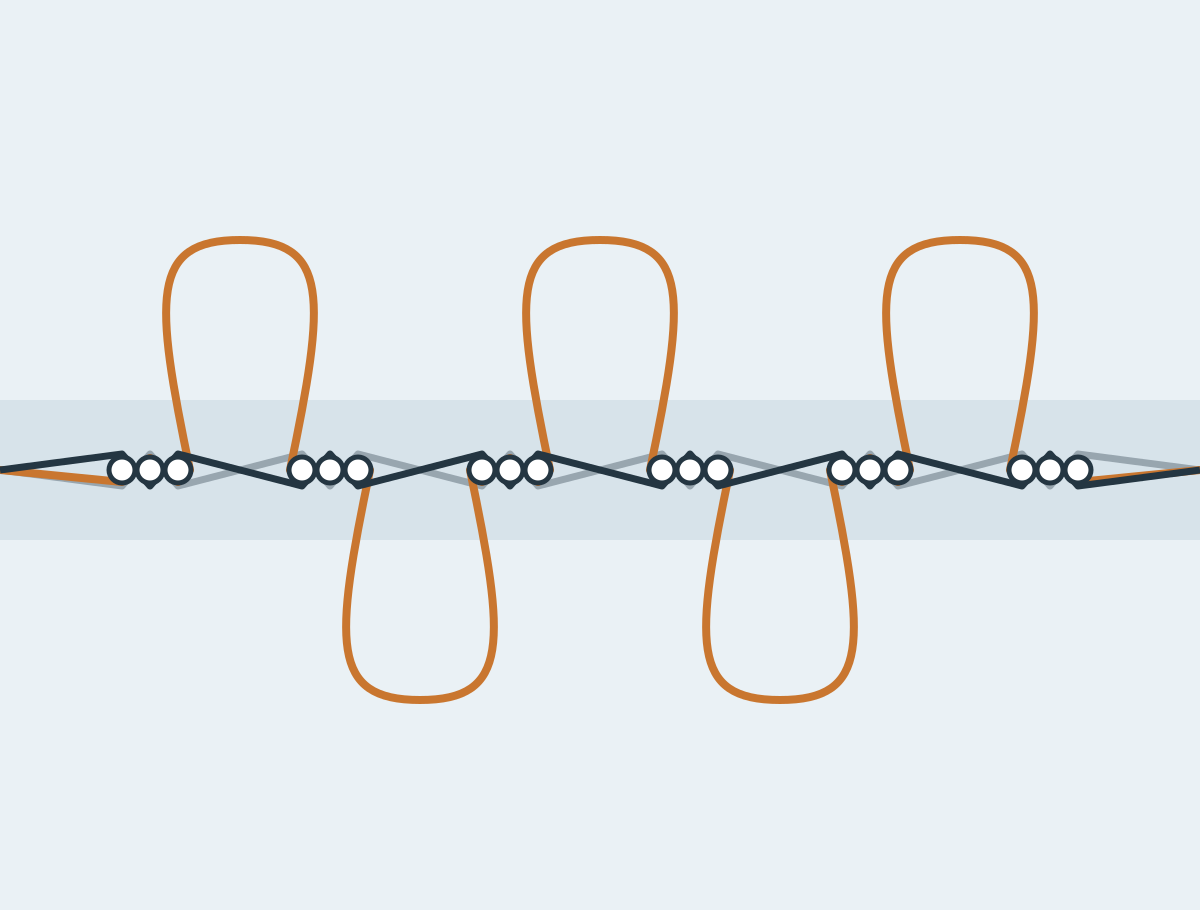
The weaving of terry fabric with two separately fed warps, in which groups of weft picks are first laid short of the cloth fell and then driven home together, so the slack pile warp is forced out into loops.
A terry loom weaves an ordinary ground cloth while running a second warp alongside it. The ground warp comes from its own beam under high tension; the pile warp comes from a separate beam under low tension, normally with a positive let-off that delivers a preset length for each pick group. The two cannot share a beam, because at every full beat-up the pile warp must supply roughly twice the loop height in extra length, plus its normal weave-in, while the ground warp stays taut[137].
Loops form by the loose-pick principle. In three-pick terry the first two picks of each group are left a set distance short of the fell, the loose-pick distance, and receive only a light beat-up. The third pick receives the full beat-up, the whole group slides along the taut ground ends to the fell, and the pile ends gripped between the picks are carried forward and buckle into loops[132]. Depending on the machine, the loose-pick distance is made by moving the reed or the cloth fell, as described under pile formation.
Shedding is by dobby or jacquard, because ground and pile ends interlace in different orders and flat bands and borders need weaves of their own. Weft is inserted by rapier or air-jet, and wide machines weave several towels side by side, to be separated by long-cutting. At the same pick rate, a four-pick construction forms a quarter fewer loops per pile end than a three-pick one.
The common weaving faults follow from the two-warp system: a broken or missing pile end leaves a lengthwise line without loops, uneven pile let-off or tension gives uneven pile height and streaks, a faulty loose-pick sequence gives short or missing loops across the width, and loom stops leave weft bars. Flat bands must also fall exactly where the towels will be cut. These are the faults looked for at greige inspection.
A single raised loop of pile yarn standing out of the ground cloth, anchored at its two legs between weft picks; the basic working unit of a terry surface.
Each loop has two legs bound into the ground and a crown. Its height above the ground, the pile height, is set on the loom, but its shape depends as much on the yarn. Plied pile yarns tend to stand as upright, open loops, while single yarns with lively twist curl into spiral loops, the look of so-called fashion terry[132]. Straight, well-oriented loops leave less tortuous capillaries, which research associates with faster water uptake; flattened, tangled or collapsed loops absorb more slowly and feel matted[133].
Loop length and pile height are related but not the same. The yarn in one loop is roughly twice the loop height plus the length bound into the ground, so a slightly taller loop consumes noticeably more pile yarn and adds weight. Because loops bend and compress, a loop height in a specification needs a stated measuring method.
The yarn that forms the loops of a terry fabric, fed as the pile warp; chosen mainly for softness, bulk and water uptake rather than for the strength required of ground yarns.
Pile yarn is what the user touches and what does most of the absorbing, so it is specified differently from the ground: fibre (usually cotton), preparation (carded or combed), spinning system (ring or rotor), count, ply and twist. In one documented Indian terry cluster, pile warps are mostly combed cotton singles of Ne 16 or Ne 20, with two-ply yarns used for higher qualities because they raise absorbency and resist pile lay[132].
A research review reports faster absorption from pile yarns that are ring-spun, combed, finer and low in twist, and slower absorption from rotor yarns, whose higher twist and shorter fibres give less orderly loops. Ply works in two directions: single yarns take up water faster at first, while two-ply yarns build bulkier loops that hold more water in total[133]. The limit is durability, since a softer, less twisted pile yarn sheds fibre more freely; see low- and high-twist pile yarns.
The second, lightly tensioned set of warp ends in terry weaving, wound on its own beam and fed forward in measured lengths so that it can be driven out of the ground cloth as loops.
The pile warp runs parallel to the ground warp and alternates with it across the width, singly or in pairs according to the draft. It is let off at low tension, usually positively: the loom delivers a preset length per pick group, about twice the loop height plus the yarn woven into the ground[137]. Pile warp is therefore used up several times faster than ground warp, and the ratio rises with pile height (see pile-to-ground ratio).
Tension that differs from end to end, uneven beam winding or a let-off that does not follow the loom produces loops of different heights, lengthwise streaks and, after dyeing, apparent shade differences between ends. Sizing practice varies; plied pile warps are often woven with little or no size, which keeps them soft but leaves them less protected against abrasion on the loom.
The tightly tensioned warp of a terry fabric which, interlaced with the weft, forms the base cloth that carries the load, holds the towel’s dimensions and anchors the loops.
The ground warp takes the highest tension on the loom and is rubbed continuously by healds and reed, so it is chosen for strength and abrasion resistance. Plied yarns are usual: in one documented terry cluster the ground ends are carded two-ply cotton of Ne 20/2 or 24/2, with cotton-polyester blends used for greater strength and rotor yarns also in use[132]. Ground warps are normally sized for weaving, and the size is removed in pretreatment.
Each loop is gripped between ground ends and weft, so the ground decides how well the loops stay in place, and its tension governs how freely the loose picks slide during pile formation. A fibre change in the ground is a fibre change in the towel: a cotton pile on a polyester-cotton ground is not a 100% cotton towel.
The crosswise yarn of a woven fabric, inserted one length at a time; each insertion is a pick. In terry, the weft binds both the ground warp and the legs of the pile loops.
In terry the picks are grouped by the terry motion, three to a group in three-pick terry. Weft is usually a cotton singles yarn; one terry cluster documents carded yarns of Ne 16 or Ne 20, alongside rotor yarns[132]. Pick density works with picks per loop to set how many loops form along the length, and it drives weight, firmness and loop anchorage. Too few picks leave loops easily pulled; too many give a stiff, heavy towel.
In flat bands and borders the weft is visible, so it may change there to a coloured, mercerized or chenille yarn.
The weave formed by the ground warp and weft beneath the pile; in standard three-pick terry a 2/1 rib, with the pile ends following the same rib order offset by one pick.
In the common three-pick construction, ground and pile ends both interlace in a 2:1 rib order, with the pile rib displaced by one pick against the ground rib[138]. That offset lets the loose picks slide along the ground ends while gripping the pile ends, and the position of a pile end within the order decides whether it loops on the face or on the back. Groups of four or more picks use correspondingly different repeats.
The ground weave governs strength, dimensional stability and how firmly the loops are held. Too open a ground lets loops pull out and the towel distort in washing; too dense a ground hinders the slide of the loose picks and gives a stiff, heavy fabric. Flat bands, borders and selvedges are woven in other weaves, such as plain, rib or satin-type effects, which is one reason they contract differently from the pile body.
The terry motion by which loops are made: picks are laid a set distance short of the cloth fell and then beaten up together, either by changing the reed’s beat-up position or by displacing the cloth fell.
The distance by which the loose picks are held back, the loose-pick distance, is the main setting for pile height; a study of 72 terry constructions found close agreement between measured pile length and the distance between the short and full beat-up points[139]. Two mechanical principles are used[140]. With reed control, the reed’s stroke is shifted so that the partial beat-ups stop short of the fell and the full stroke on the fast pick drives the group home. With cloth-fell displacement, the reed always beats to the same position while the fabric and back rest are moved away from it for the loose picks and returned for the fast pick.
Electronic terry motions drive this movement with motors under program control, so the loose-pick distance can change from one pick group to the next[141]. That is how one towel combines a looped body, a flat band where the distance is zero and no loops form, and bands or wave effects of different pile height. The pile let-off has to follow every change, since a taller loop needs more pile yarn.
The height of the terry loops above the ground cloth, usually stated in millimetres; set on the loom by the loose-pick distance together with the pile warp let-off.
Electronically controlled terry looms can program pile height group by group; one current machine offers settings from 0 to 12 mm[142]. Taller loops consume more pile yarn, so pile height feeds directly into weight and cost. Studies have generally linked longer loops with faster and greater water uptake, although the findings are not unanimous[133].
A taller pile feels fuller and holds more water but dries more slowly, flattens and tangles more easily and catches on rings and hooks. A shorter pile is more stable and is preferred where a smooth surface matters, including print faces, because tall loops break up a printed image. Loops compress under slight pressure, so the measured height depends on the method; it should be agreed on the finished fabric, not read from loom settings.
The number of loops per unit area of terry fabric: pile ends per centimetre across the width multiplied by the loops each pile end forms per centimetre along the length.
Each pile end forms one loop per pick group, so loops per centimetre of length equal pick density divided by picks per loop, and the count across the width follows the pile ends per centimetre. Loop density therefore rises with warp and weft density[133]. On double-sided terry the figure can be given per face or for both faces together, and a specification should say which. Dense loops support each other and stay upright, while sparse, tall loops lean and mat.
Reviewed research reports that the rate of water absorption increases with loop density and loop length, although one study found warp density, weft density and pile height to have only a small effect, and a very compact ground narrows the capillaries[133]. Two towels of equal weight can differ widely in density, one with many short loops and the other with fewer tall ones, and they differ in hand, drying and durability accordingly.
The relation between pile and ground yarn in a terry fabric, usually expressed as the length of pile warp consumed per unit length of ground warp, and sometimes as the pile yarn’s share of fabric mass.
As a length ratio, the figure states how many metres of pile warp are woven in for each metre of ground warp. It is written as 5:1, 1:5 or similar; house conventions differ on which number comes first. Patent literature uses this definition of the terry ratio and treats pile height as a function of it[143]. The ratio rises with pile height and with loops per unit length. Some mills state instead the pile yarn’s share of total fabric weight, which also depends on the yarn counts, so the two conventions cannot be converted without the full construction.
The ratio is a main driver of weight and yarn cost, and a higher share of pile generally means more absorbing surface. It also affects wet processing: one study of cotton terry found that dimensional contraction increased with pile ratio[144]. High ratios need a firm ground and adequate pick density to keep the additional pile anchored.
The resistance of terry loops to being pulled out of, or drawn along, the ground cloth in use and laundering; it depends on how firmly the weft and ground warp grip each loop’s legs.
Anchorage depends on the number of picks binding each loop, the pick density, ground warp tension during weaving, friction between the yarns, and the twist and ply of the pile yarn. A loop held by few or loosely packed picks can be pulled out by one leg, growing at the expense of its neighbours.
EN 15598 measures the force needed to pull loops out of the ground of a terry fabric[10]. The method yields a force; what counts as acceptable belongs in the buyer’s specification. Anchorage matters most for hospitality and institutional linen, which meets rings, hooks, hook-and-loop fasteners and industrial washing, where weakly bound loops become snags.
The standard terry construction, in which each loop-forming group consists of three weft picks: two loose picks held short of the fell and a third, fast pick that beats all three home together.
The cycle repeats every three picks. Picks one and two are inserted with a partial beat-up that leaves them a set distance from the cloth fell; pick three receives the full beat-up and drives the group forward[132]. Because the pile ends follow the 2:1 rib order of the ground shifted by one pick (see ground structure), the group slides along the taut ground ends while the pile ends held between the picks are carried forward into a loop on the face or on the back.
Three picks are the smallest group that gives a stable loop. Two-pick terry, once woven for bathrobe cloth, has lost its importance because its loops are unstable[132]. Groups of four to seven picks exist, but most terry is woven three-pick because each additional pick adds weft and weaving time[138]. Three-pick is therefore the default for bath, hand and hotel towels.
Along the length, three-pick terry forms one loop per pile end for every three picks, so loops per centimetre equal the pick density divided by three, while loop height is set independently by the loose-pick distance. Picks per loop can be checked on a sample by following one pile end and counting the picks between two of its successive loops. A specification should state three-pick together with pile and ground yarn counts, ends and picks per centimetre and pile height, since picks per loop alone fixes neither weight nor loop count.
A terry construction with four weft picks in each loop-forming group, binding each loop with more weft and forming fewer loops per centimetre of length than three-pick terry at the same pick density.
Each loop is enclosed by a longer group of picks and is held more firmly in the ground. At equal pick density, each pile end forms loops at three-quarters of the three-pick rate, so reaching a similar loop count along the length means raising pick density, which adds weft, weight and weaving time. The beat-up sequence is also more involved: a craft-cluster description of terry weaving gives the extra beating needed for each pile row as the reason four-pick and higher constructions are rarely produced[132].
Against a three-pick towel of similar weight, a four-pick towel has more weft under each loop and loops spaced further apart along the length, so the ground contributes more to the surface and the hand can be flatter and firmer. The same source calls four-pick towels heavier and of better quality[132], a judgement about one production setting rather than a general rule. The firmer anchorage is most useful where loops face hard wear, as in hospitality and institutional linen.
The label alone fixes neither loop count nor weight, so four-pick is specified with pick density and pile height. Comparing a three-pick and a four-pick offer on GSM alone is misleading; loops per square centimetre, pile height and, where anchorage matters, loop extraction results are better grounds for comparison.
Terry with loops on both faces (double-sided) or on one face only (single-sided); the face on which each pile end forms its loops is fixed by the weave.
Double-sided terry is the normal construction for bath, hand and hotel towels, which absorb on both faces. In single-sided terry every pile end loops on the same face and the reverse shows the ground. It absorbs less, is used for special purposes where one smoother face is wanted, and is described as difficult to weave free of defects[132]. The same control over loop side is the basis of patterned terry: two-colour jacquard designs swap the face on which each colour loops, and tone-on-tone effects move loops from one face to the other or omit them in areas.
A cotton pile yarn left with almost no twist, usually made by plying cotton with a water-soluble polyvinyl alcohol (PVA) yarn that carries it through weaving and is dissolved out in hot water during wet processing.
In the common method a PVA yarn is twisted together with the cotton yarn in the opposite direction, which largely cancels the cotton’s twist while the PVA gives the combined yarn enough strength to weave. In wet processing the PVA is dissolved in hot water, leaving the cotton with very little twist[145]; the temperature needed depends on the grade of PVA used. A related route blends PVA fibre with the cotton before spinning, and once it is washed out, voids remain in the yarn[133]. Zero-twist, no-twist and brand names are applied to yarns made in different ways.
Untwisted fibres open into a plush, airy loop, and research reviews report higher absorbency from zero- and low-twist pile yarns[133]. The costs lie in durability and processing. With little twist to bind them, fibres shed more readily as lint and loops lose definition sooner, and the dissolved PVA adds to the dyehouse effluent load[145].
Pile yarns with less (low-twist) or more (high-twist) twist than a normal weaving yarn of the same count, chosen to trade softness and absorbency against loop definition and durability.
Lower twist leaves a looser, bulkier pile yarn with more space between fibres, which research links to faster water uptake[133]; the hand is softer and the pile looks fuller, but there is more lint and loops lose their shape sooner over repeated washing. Higher twist gives compact, well-defined loops that resist abrasion and keep their shape through hard laundering, with a crisper, drier hand and lower absorbency.
Towels sold mainly on softness lean towards low-twist pile, while for linen that must survive repeated industrial laundering, plied yarns of moderate twist are the safer choice. Twist direction and balance matter too, because a lively single yarn can make loops spiral.
A weaving machine equipped for terry: two separately controlled warp let-offs, a terry motion that creates the loose-pick distance, and dobby or jacquard shedding for pile, ground and border weaves.
Compared with a flat-weaving machine, a terry loom carries a second warp beam for the pile with its own let-off and tension control, and a terry motion that moves either the reed or the cloth fell for the loose picks. The ground warp runs over a positively controlled back rest and the fabric is taken up positively, so the cloth advances evenly through the beat-up sequence[137]. Terry machines are built as rapier and air-jet looms: rapiers accept a wider choice of weft yarns, including fancy border yarns, while air-jets run faster.
The reed is the comb-like loom part whose dents space the warp ends and which beats each pick into the fell, the line where the cloth is formed; beat-up is that beating action.
Reed count states how closely the dents are spaced: dents per centimetre or per 10 cm in metric practice, and per inch or per two inches in traditional systems. With the number of ends drawn through each dent, it fixes the width and ends per centimetre on the loom; the fabric narrows afterwards as it contracts.
In terry, beat-up is deliberately unequal: partial for the loose picks and full for the fast pick, with either the reed changing its beat-up position or the cloth fell moving against a fixed reed stroke[140]. Damaged or unevenly spaced dents leave reed marks, fine lengthwise streaks that show more after dyeing and in flat borders.
A wire, flat-steel or cord element with a central eye through which one warp end is threaded so that it can be raised or lowered to form the shed; healds sit on heald frames or, on jacquard looms, hang from harness cords.
Every warp end passes through a drop wire, a heald eye and a reed dent in the order set by the drawing-in plan, or draft. On dobby looms the healds are mounted on heald frames and all ends on a frame move together, so the number of frames limits the patterns that can be woven. On jacquard looms each heald hangs from a harness cord tied to a hook that the jacquard head lifts individually. In terry, ground and pile ends are drawn into separate frames, with further frames for borders and selvedges. Worn heald eyes abrade yarn, and an error in the draft repeats along the whole warp as a lengthwise fault.
Weaving in which a dobby head raises and lowers a limited number of heald frames by program, producing geometric weaves, flat bands and borders; the usual shedding system for plain and bordered terry towels.
All ends drawn into one frame move together, so a dobby design is built from a small set of interlacing orders repeated across the width. Within that limit a dobby terry loom weaves the pile body, flat end bands, rib or satin-effect borders, simple checks and geometric figures, and stripes when coloured yarns are used. The patterned or plain band across a hotel towel is widely called a dobby border, whatever its exact weave. Electronic dobbies read the pattern from a file rather than from pegs or pattern chains, so a border can be changed quickly.
Lettering, logos and pictorial motifs need control of individual ends and therefore a jacquard. Dobby involves less pattern preparation and set-up, which keeps it the economical choice for standard hospitality and retail towels.
Also called: jacquard towel, tone-on-tone jacquard
Weaving in which a jacquard head lifts warp ends individually or in small groups through hooks and harness cords, so that each end can follow its own interlacing; used to weave logos, lettering and pictorial designs into towels.
A jacquard head replaces heald frames with hooks, each tied through harness cords to one or several healds, and an electronic jacquard selects every hook for every pick from a design file. This removes the frame limit of dobby weaving: the interlacing can change from end to end and pick to pick across the width. In terry, this control decides for each pile end and each pick group whether it loops on the face, on the back or not at all.
Three effects are common. Pile against flat ground draws a motif by leaving areas without loops. Tone-on-tone designs use a single colour and rely on the contrast between pile and flat areas or between loop heights. Two-colour jacquard uses pile ends in two colours: inside the motif one colour loops on the face and the other on the back, and outside it they swap, so the design appears on both faces in reversed colours. Woven colour effects need yarn-dyed pile, and the same technique weaves lettered borders and logo bands.
The design is drawn to the loom’s hook capacity and to the fabric’s ends and picks per centimetre, then translated into a weave file. A terry loop is coarse compared with a printed dot, so fine lines and small lettering must be drawn larger than for print and curves appear stepped; a woven sample is normally needed before bulk, because the effect cannot be judged reliably on screen.
Jacquard involves more set-up than dobby: design and weave-file preparation, sometimes a different harness tie, and sampling, which is why jacquard programmes carry minimum quantities and longer development time. In return the motif is part of the cloth, has no print layer, and lasts through industrial laundering as long as the towel does.
At Mira Towels: Jacquard and dobby weaving for patterns, borders and tone-on-tone logos are among Mira Towels’ published capabilities.
Also called: ends per inch, picks per inch, ends per cm, picks per cm, thread density
The number of warp ends and weft picks per unit length of a woven fabric, given per centimetre in metric practice or per inch (EPI, PPI); the basic thread-spacing figures of a construction.
For terry, ends should be given separately for ground and pile, because a single total hides the pile-to-ground arrangement, and picks per centimetre should be read with picks per loop to understand loop density. Loom-state and finished densities differ because the fabric contracts in wet processing, so a specification has to say which is meant.
Thread count, the number of warp and weft threads in one square inch counted together, is a bedding term. For towels it says little, since absorbency, hand and weight are dominated by the pile rather than by the ground’s thread spacing. Density can also mean mass per volume; see fabric density.
The tension under which warp ends are held and let off during weaving; in terry, high and steady for the ground warp and low, metered tension for the pile warp.
Ground warp tension must be high enough for a clean shed and for the loose picks to slide along the ground ends at full beat-up, and even across the width. Pile warp is delivered slack, normally by positive let-off of a preset length per pick group rather than by tension alone[137]. Electronic let-off systems monitor tension and adjust the beam drive as the beam diameter falls; one loom maker names constant yarn tension as a design aim of its pile-formation system[141].
Uneven ground tension causes slack areas, puckering and bowed or wavy borders. Uneven pile tension across or along the warp produces loops of different heights, streaks and patches that look like shade differences after dyeing.
The complete technical description of a fabric: weave, the yarns in each system with fibre, count, ply and twist, ends and picks per unit length and, for terry, picks per loop, pile height, width and mass per unit area.
For a terry towel a full construction names the ground warp, pile warp and weft yarns separately, ground and pile ends per centimetre, picks per centimetre, picks per loop, pile height or pile-to-ground ratio, one- or two-sided pile, band and border weaves, and finished width and mass per unit area. EN 14697 is the European standard setting out specifications and test methods for terry towels and terry towel fabrics.
Construction is what makes two offers comparable. Towels quoted at the same GSM can be built from different yarns, pile heights and pick densities and will behave differently in use. Greige and finished constructions must not be mixed up: densities, width and weight all change in wet processing, and the towel is accepted against the finished construction.
Also called: grams per piece, pounds per dozen, lbs per dozen
Towel weight stated per piece, in grams, or per dozen, in kilograms or, in North American practice, pounds; distinct from GSM, which is the mass per square metre of the fabric.
Piece weight and GSM are linked through the finished size. A 70 × 140 cm towel covers 0.98 m², so at 500 GSM it weighs about 490 g, which is 5.88 kg or about 12.96 lb per dozen. The link is approximate, because flat bands and borders differ in mass per area from the pile body and hems add folded fabric. When a specification states both GSM and piece weight, both must refer to the same finished size, or they will contradict each other.
Weight should be checked on conditioned towels, because cotton gains and loses mass with humidity, and it is accepted within an agreed tolerance rather than as an exact figure.
Fabric as it comes off the loom, before desizing, scouring, bleaching, dyeing or finishing.
Greige terry still carries size on the ground warp and the natural waxes of the cotton, so it is harsh and barely absorbent, and its dimensions and weight are not those of the finished towel. In one study of 72 terry constructions, contraction in weaving was only 1.5–2.0% in each direction, while contraction after washing reached 5.5–11.5% depending on the construction[139]; another study found that areal density rose through every stage of wet processing[144]. Greige constructions are designed with that change in mind.
Greige is inspected before wet processing, when faults are easier to trace and cheaper to deal with. Where greige is bought for dyeing and finishing elsewhere, the purchase specification should give loom-state width, weight and densities, with the expected finished values agreed separately.
Terry whose loops have been sheared off at the crown on one face, leaving a smooth, velvety surface of cut pile ends; the other face normally remains loop terry.
Velour starts as woven terry. On a shearing machine, a rotating cylinder carrying spiral blades works against a fixed ledger blade and cuts away the loop crowns standing above a set height, often in more than one pass, while the cut fibre is drawn off by suction. The cut ends open into a short, dense, upright pile.
Shearing removes yarn. In a study of 72 terry constructions, shearing waste amounted to 9.4–17.4% depending on the fabric[139], so the pile has to be woven heavier to allow for the loss. The freshly cut surface also carries loose fibre, so velour can lint more than unsheared terry in its first washes.
The sheared face is far more even than loops for jacquard figures and printing, because the design sits on level fibre tips instead of on separate loops; hence velour’s use for beach towels, printed towels and bathrobes. The cost is absorbency: research has found uncut pile to be more hydrophilic than cut pile[133], so a velour face takes up water more slowly than the same towel left in loops.
Velour is not velvet. Velvet is woven as a cut-pile fabric, for example face to face as a double cloth that is cut apart on the loom, or over wires[137], whereas towel velour is loop terry cut afterwards. On two-face printed towels the polyester print face may also be sheared, and the shearing height then becomes a print specification as well as a matter of hand.
At Mira Towels: Velour and jacquard faces are part of Mira Towels’ published capabilities, as are bathrobe fabrics in terry, waffle and velour.
A flat or patterned band woven across a towel, usually near each end and sometimes along the sides, in which the pile is suppressed or changed to frame the towel or carry a design.
On the loom, a border is made by changing the terry motion and the weave for a set number of picks. Loops are reduced or stopped, and ground and pile ends weave a flat structure such as plain, rib or satin effects, sometimes with a coloured, lustrous or chenille weft. A plain flat band carries the hem at each end; decorative borders add dobby or jacquard patterns, lettering or a band of pile at a different height.
Flat weave and pile body contract by different amounts in washing, so a border that is tight or loose relative to the body waves or puckers, and a weft of a different fibre can shrink differently again. The hem should be turned within the flat band so that it lies flat and does not enclose loops, and the bands must stay in register along the length, since the towels are cut through them.
The self-finished lengthwise edge of a woven fabric, formed on the loom so that it does not fray; on towels, the alternative to cutting and overlocking the side edges.
Shuttleless looms cut the weft at the edges, so the edge has to be secured, either by tuck-in devices that fold the weft tails back into the next shed or by leno ends that twist around the picks. A towel woven one piece wide can use these woven edges as its finished sides, often with a narrow flat band. Where several towels are woven side by side, the inner edges are cut during long-cutting and finished by overlocking or hemming. Selvedge tension has to match the body: tight selvedges pull the edges short and make towels wavy or dished, loose ones flare.
Damage in which a terry loop is caught and pulled out of the pile, leaving a long protruding loop and often a shortened row of neighbouring loops from which yarn has been drawn.
Snags begin with something that hooks: rings, watch straps, hook-and-loop fasteners, rough fingernails, sharp edges in laundry equipment. Whether a catch becomes a pulled loop depends on anchorage; tall loops, loops bound by few or loosely packed picks and smooth, slippery yarns pull more readily. A pulled loop should be trimmed level with the pile rather than pulled, because pulling draws more yarn out of the row. Prevention lies mainly in the construction (pick density, picks per loop and pile height), and resistance to loop extraction can be measured by EN 15598.
Loss of the regular loop geometry of terry, with loops flattened, crushed, leaning, tangled or matted, which changes appearance, hand and absorbency.
In the mill, distortion can come from processing in rope form with too little liquor, pressing, over-drying at high temperature, or long storage under compression in bales and cartons. In use, heavy loading in presses and drying flat without tumbling leave loops flattened and harsh. On two-face printed towels, excessive pressure or heat in the transfer press can crush and shine the polyester pile. Cotton loops usually recover with washing and tumble drying, which open the pile again; polyester pile crushed under heat may not. Distortion is judged against the approved sample after a defined number of wash and dry cycles.
A woven structure of square cells, formed by warp and weft floats of graduated length, that gives a three-dimensional honeycomb surface; an absorbent towel fabric without pile.
Areas of tight interlacing alternate with warp and weft floats of graduated length, so in wet processing the fabric contracts into a pattern of ridges and hollows that adds surface and volume without loops. For a given size, waffle is usually lighter than terry and dries faster, while holding less water in total. It is used for bathrobes, spa and kitchen towels and light hand towels. Long floats snag more easily, so float length is a balance between depth of relief and durability.
Also called: peshtemal, pestemal, peştamal, Turkish towel
A traditional Turkish flat-woven towel without pile, usually of cotton or cotton-linen, often striped and finished with twisted or knotted fringes; lighter, thinner and quicker to dry than terry.
The peshtemal (Turkish peştamal) began as the wrap of the Turkish bath and is now used as a bath, beach, spa and travel towel. It is woven as flat cloth, commonly in plain, twill or herringbone weaves, sometimes with honeycomb or other textured panels, and the warp ends are often left as fringes that are twisted or knotted. Without pile it holds less water in total than a terry towel of the same size, but it folds compactly and dries quickly. Linen in the blend adds strength and a crisper hand. Spellings vary between markets, and the names describe a style rather than a defined construction, so weave, fibre, size and weight still have to be specified.
At Mira Towels: Peshtemal and flat-woven cotton towels are among Mira Towels’ published capabilities.
How towel fabrics are weighed, measured and compared: mass per area, thickness, absorbency, wicking and drying, hand, dimensional stability, strength, surface wear and colour fastness. Several of these properties are routinely confused with each other, and the entries keep them apart.
Also called: g/m², grams per square metre, areal density, mass per unit area, fabric weight
The mass of a fabric per unit area, expressed in grams per square metre (g/m²). For towels it is normally quoted for the finished fabric or finished towel and indicates how much material the product contains, not how well it performs.
GSM is found by weighing specimens cut to a known area, or a whole piece of known dimensions, and dividing mass by area. ISO 3801 describes the procedure for woven fabrics, for complete pieces as well as small specimens, and ASTM D3776/D3776M offers options from a full roll to a small swatch[11]. Cotton exchanges moisture with the air, so specimens are weighed after conditioning in a standard atmosphere such as that of ISO 139[12]; a towel weighed straight from a humid store or a warm dryer can differ noticeably from its conditioned value.
The GSM quoted for a towel is usually the mass of the whole finished piece divided by its nominal area, borders, hems, labels and hanging loop included: a 70 × 140 cm towel weighing 490 g is a 500 GSM towel on that basis (490 g ÷ 0.98 m²). A cut specimen of the looped body gives a different figure, because borders and hems carry a different mass per area, so a specification should say which figure is meant and how it relates to towel weight per piece. Greige and finished GSM differ too: pretreatment removes size, waxes and some fibre mass, while relaxation shrinkage and relaxed drying draw the fabric together and raise its mass per area.
GSM measures quantity of material, not quality. A heavier terry towel holds more water in total and feels denser, but in the research reviewed on terry fabrics areal density had no effect on the rate of water uptake, and lighter fabrics held more water per gram[133]. The same mass can be built from fine or coarse yarns, ring or rotor yarn, tall sparse loops or short dense ones, so towels of identical GSM can differ widely in hand, absorbency and durability. Heavier towels also dry more slowly and take more energy to launder.
On sublimation-printed towels, extra mass usually means more or taller pile on the print face, which reduces print definition. GSM is a commercial figure as well as a technical one, so it is agreed with a tolerance in the specification and checked on finished goods; no test method sets that tolerance.
At Mira Towels: Our stock all-over printed towel is a 250 GSM construction with a polyester print face and a cotton reverse face, recommended when print clarity is the priority.
A term with two distinct meanings: the number of warp ends and weft picks per unit length of a woven fabric (thread density), or the mass of fabric per unit volume (bulk density), calculated from mass per unit area divided by thickness.
In weaving, fabric density normally means thread density: ends and picks per centimetre or per inch (EPI and PPI), stated separately for ground and pile ends in terry and described under warp and weft density. In fibre science and nonwovens the same words mean bulk density, usually GSM divided by thickness, in g/cm³ or kg/m³. Because thickness depends on the pressure applied when it is measured, a bulk density figure means little unless the thickness method and pressure are stated with it.
For towels, bulk density describes how tightly the fibre mass is packed. A low-density, lofty pile holds more air between fibres, feels softer and offers more volume for water, but can flatten in use. A compact structure has finer pores, which favour rapid initial uptake but leave less space to hold water. Since the term is ambiguous, a specification or test report should name the meaning and the units.
The distance between the two faces of a fabric, measured under a specified pressure applied by a presser foot of defined area. For compressible pile fabrics such as terry, the result depends strongly on that pressure.
ISO 5084 measures the thickness of textiles under a specified pressure and excludes floor coverings, nonwovens, geotextiles and coated fabrics[13]; the American method, ASTM D1777, explicitly covers pile fabrics[14]. A gauge lowers a presser foot of fixed area onto the specimen lying on a reference plate, and the reading is taken after a set time. Terry loops bend and collapse under load, so two laboratories’ results are comparable only when foot area, pressure and timing match.
Thickness and weight are separate properties. Towels of equal GSM can differ markedly in thickness with pile height, yarn bulk and how well the loops were opened in tumbling. Readings at a low and a higher pressure, together with recovery after the load is removed, describe compressibility and loft, which people associate with a full, soft hand. A thicker towel also gives moisture a longer path to escape, one reason heavy terry dries slowly.
Also called: water absorption, absorbency of towels
The ability of a fabric to take up and hold liquid water. For towels it covers three distinct behaviours: how fast water is taken up, how much water the fabric can hold, and how much water it removes from a wet surface in brief contact.
Absorbency is not one property. Terry research distinguishes dynamic absorption, the water taken up per unit mass of fabric per unit time, from static absorption, the maximum water held per unit mass of dry fabric[133]. A third behaviour matters to the user: how much water a towel picks up from wet skin in a short pat or wipe. A fabric can be fast and low in capacity, or slow and high in capacity, so rate and capacity are specified separately, as absorption rate and water retention.
Water first has to wet the fibre surface, which depends on fibre chemistry and finish: clean cotton and regenerated cellulose are hydrophilic, polyester is hydrophobic. It is then drawn by capillary action into the spaces between fibres within a yarn and between yarns and loops, where most of the water in a soaked towel is held, rather than inside the fibres.
Construction and yarn decide much of the result. The terry literature reports faster absorption with higher loop density and longer loops and with pile yarns that are finer, combed, low in twist and spun from long-staple fibre; ring-spun pile absorbs faster and holds more than rotor-spun pile, and plied pile yarns, which form fuller loops, hold more water than singles[133]. Wet processing matters as much. Residual size, natural waxes and spinning oils repel water, which is why greige terry absorbs poorly and a well-scoured towel wets almost at once.
Finishing can undo these gains. Conventional cationic softeners leave a fatty, hydrophobic film on the fibres and reduce water uptake, whereas washing and tumbling open the structure and increase it, so a new towel often absorbs better after its first launderings, once finishing residues have been removed[133]. Weight affects capacity rather than speed. Softness is no guide to absorbency either; the trade-off is described under hand feel.
Also called: wetting time, rate of absorption, sinking time
The speed at which a fabric takes up water, usually reported as the time a drop of water or an immersed specimen takes to become fully wetted; a shorter wetting time means faster absorption.
Rate is the property a user notices first: a towel that leaves water beading on its surface feels unabsorbent however much it could eventually hold. It corresponds to the dynamic absorption of terry research and depends on the construction and yarn factors listed under absorbency. Laboratories measure it with drop tests such as AATCC TM79 and with immersion or sinking tests that time how long a specimen takes to wet out; EN 14697 includes a method for the time of absorption of terry towels. The methods are compared under absorbency testing.
Wetting time is sensitive to surface chemistry. Hydrophobic finishes, cationic and amino-silicone softeners, residual spinning oils and incomplete scouring all lengthen it, even when the construction is unchanged. A new towel can therefore test slower than the same towel after a few washes, and a specification should state whether testing is done on new towels or after a defined number of launderings.
Also called: water-holding capacity, absorptive capacity, static water absorption
The amount of water a fabric holds when saturated and then drained, or after a defined spinning or pressing step, usually expressed as a percentage of the dry fabric mass.
Terry research calls this static water absorption: wet mass minus dry mass, divided by the oven-dry mass of the fabric, times 100[133]. The figure depends heavily on how surplus water is removed before weighing, whether by dripping for a set time, centrifuging or pressing, so values obtained by different procedures cannot be compared.
Capacity follows the pore volume the structure offers. Greater mass, longer pile and fuller plied pile yarns raise the total held, and washing and tumbling, which open the structure, increase it further; per gram of fabric, lighter terry holds more[133]. A dense, fine-pored fabric can wet quickly yet hold relatively little, while a thick towel can hold a great deal and take a long time to dry. High capacity suits bath and hotel towels; for gym or travel use, water left in the towel is water that must later evaporate.
The movement of a liquid into and along narrow spaces, driven by surface tension and by the liquid wetting the solid surfaces. In fabrics the capillaries are the gaps between fibres within a yarn and between yarns and loops.
The pressure that draws liquid into a capillary rises with the liquid’s surface tension and with the cosine of its contact angle on the solid, and falls as the capillary radius increases (the Laplace relation, Δp = 2γ cos θ / r); the Lucas–Washburn equation describes how fast the liquid advances[133]. Two consequences follow. When the contact angle exceeds 90°, as on a strongly water-repellent surface, the capillary resists water instead of drawing it in, so the fibre surface must be wettable first. And narrow capillaries pull strongly but hold little volume, while wide ones hold more but pull weakly; in terry, finer capillaries go with faster initial uptake but lower total capacity.
In a towel, capillaries exist at several scales: between fibres in a pile yarn, between the yarns of a loop and between neighbouring loops. Low-twist and zero-twist pile yarns, combed fibre and fine counts form long, continuous, less tortuous capillaries that favour fast uptake. Once their surfaces are wetted, hydrophobic fibres such as polyester carry liquid in the same way, which is how a polyester face can wick without absorbing much water into the fibre.
The spontaneous transport of liquid along or through a fabric by capillary action once the fibre surfaces have been wetted.
Wicking describes where water goes after it has entered the fabric; absorption describes how much is taken up and held. Wetting depends on the fibre surface and the liquid, wicking on the arrangement of fibres and yarns[133]. A fabric can wick well and absorb little: fine polyester filaments and microfibres spread liquid quickly over a large area and through the thickness while holding little inside the fibre, which helps it evaporate. Cotton terry both wicks and retains.
AATCC TM197 times how quickly liquid rises to specified distances in a vertical specimen[15], its companion TM213 records the height reached at specified times from a submerged edge[16], and AATCC TM198 times liquid spreading through a horizontal specimen[17]. Results depend on direction (warp or weft, face or back) and on finishes, and say nothing directly about capacity. On two-face sublimation towels, wicking on the polyester face and absorption by the cotton reverse are separate jobs and can be evaluated separately.
Also called: liquid moisture management, moisture management tester
The way a fabric transports liquid moisture through and across its structure, in particular from the face in contact with the skin to the opposite face, where it can spread and evaporate.
The concept comes from sportswear, where moving sweat away from the skin is the aim. AATCC TM195 measures, evaluates and classifies the liquid moisture management properties of knitted, woven and nonwoven fabrics[18]. In the Moisture Management Tester used for it, a test solution is dropped onto the upper, skin-side face of a specimen held between two sensors; changes in electrical resistance track how the liquid spreads on each face and passes through, and the readings are converted into grades by predefined indices.
For towels the concept is most relevant to microfibre sports and travel towels, knitted constructions and two-face fabrics in which one face moves water and the other holds it. Cotton terry is designed to absorb and retain water, so absorbency and drying tests say more about it. A moisture management claim means little unless the method and the result are stated.
The speed at which a wet fabric loses water to the surrounding air, expressed as water evaporated per unit time or as the time needed to reach a defined dry state.
Drying depends first on how much water the towel holds: a heavy, high-pile towel that absorbs a lot also has a lot to lose. It then depends on how readily vapour escapes, governed by thickness, air permeability, the wetted surface exposed and the air movement around it. Water inside cotton fibres and in fine capillaries leaves more slowly than water spread thinly over polyester filaments, so good absorbency and fast drying often pull against each other.
AATCC TM199 measures drying time with a gravimetric moisture analyser at a raised temperature[19], TM200 the drying rate of textiles at their absorbent capacity under airflow[20], and TM201 the drying rate of a fabric wetted with a prescribed volume of water on a plate held at 37 °C[21]. Each simulates different conditions, so results compare only within one method. For hotel linen the laundry also counts: heavier towels need longer tumble drying and more energy per piece.
The rate of air flow passing perpendicularly through a known area of fabric under a prescribed pressure difference between its two faces.
ISO 9237 applies to most fabrics, including technical fabrics, nonwovens and made-up articles permeable to air[22]; ASTM D737, the American equivalent, includes pile fabrics in its scope[23]. Results, given for example in mm/s or l/(m²·s), depend on the test area and the pressure drop, which must match before two results are compared.
Permeability falls as a fabric becomes thicker and its pores fewer or smaller, but it is not a simple function of weight: yarn twist, thread density, pile height and finishing all change the air paths. For towels it bears on drying, because moving air carries vapour out of the wet structure, and on how breathable a robe or wrap feels; a thin, open flat weave such as a peshtemal resists airflow far less than dense terry, one reason it dries quickly. The test is made on dry fabric, and in a wet towel swollen fibres and water films close many of those paths.
The tactile impression a fabric gives when touched, stroked and squeezed, combining softness, smoothness, fullness, flexibility and thermal feel. It is a human perception, only partly captured by instruments.
A person feeling a towel responds to how easily it compresses and recovers, how it bends, how smooth its surface is, how it slides against the skin and how warm or cool it feels. Panel assessment against agreed references remains the reference method. Objective systems split hand into measurable components, the Kawabata Evaluation System (KES-F) and FAST being the best known for fabrics generally. For terry, one published method derives a handle value from thickness, compression, bending stiffness, tensile and shear elasticity and the dynamic coefficient of friction, and reports that it matches subjective assessment[146]; instruments that analyse the sound of blades moving over the surface have also been used on terry towels[147].
Softness starts with fibre and yarn. Finer fibres and longer staple give more pliable yarns, low-twist and zero-twist pile yarns give fuller loops at some cost in durability and lint, and hairier ring-spun yarn feels softer than rotor yarn of the same count. A tall, sparse pile feels soft when new but flattens, while a short, dense pile feels firmer and keeps its shape. Finishing then adjusts the surface, with softeners lubricating the fibres and tumbling opening the loops.
Softness says nothing reliable about absorbency, and the two often pull in opposite directions. Conventional cationic softeners make the surface smoother and more hydrophobic and reduce water uptake[133], so a towel that feels exceptionally silky in the shop can absorb less in its first uses than one with a drier hand. Hydrophilic softeners narrow this trade-off but do not remove it.
Hand also changes in use. In a study of terry towels laundered up to ten times, line drying reduced softness and smoothness more than tumble drying, washing temperature had no significant effect, and fabric softener offset part of the loss caused by line drying[147]. Samples are best judged after laundering as well as new, against a retained reference and under the same conditions.
At Mira Towels: Our published quality checks compare absorbency and hand feel with what was signed off at sample approval.
The volume a fabric or yarn occupies for its mass, together with its ability to spring back after compression; a bulky, lofty towel feels full and thick for its weight.
Bulk is the inverse of bulk density: more volume per gram means more air held between fibres. In towels it comes mainly from the pile yarn. Low-twist and zero-twist yarns let fibres spread apart, plied yarns form rounder loops, and textured filament yarns gain bulk from crimp or loops introduced into the filaments. Loft is the recovery side of bulk, the ability of the pile to regain its height after compression in packing, use or laundering, assessed as thickness before and after a load.
Tumbling opens the loops and raises loft, while compression in bales, pressing and line drying leave terry flatter and stiffer. Greater bulk adds space for water and still air, which makes a towel feel warm and lets a lighter towel feel heavier than its GSM suggests, but very lofty, low-twist piles shed more lint and flatten more readily.
The way a fabric hangs and folds under its own weight, governed mainly by its bending stiffness, its shear behaviour and its mass per unit area.
Drape is usually quantified as the drape coefficient. A circular specimen is supported on a smaller concentric disc and allowed to fall into folds, and the projected shadow area outside the disc is expressed as a percentage of the area of the unsupported ring: near 0 % for a fabric that hangs almost straight down, near 100 % for one that stays nearly flat. ISO 9073-9, although part of the nonwovens test series, specifies a drape coefficient method stated to apply to nonwovens, woven and knitted fabrics[24].
Drape is seldom specified for heavy terry, where stiffness and bulk dominate. It matters more for bathrobes, flat-woven peshtemals, lightweight printed beach towels used as wraps, and for how a towel hangs on a rail or in a display. Softeners, lower twist and lighter constructions increase drape; dense ground weaves, stiff residues and coatings reduce it. A fabric can drape well and still feel harsh, so drape and hand are judged separately.
The ability of a fabric or finished towel to keep its length, width and shape when exposed to washing, drying, heat or moisture. Poor dimensional stability shows as shrinkage, growth, distortion or puckering.
Several mechanisms change fabric dimensions, and they affect fibres differently. Relaxation shrinkage is the release of strain locked into yarns and fabric during spinning, weaving and wet processing: once wetted and agitated, the structure returns towards a relaxed geometry, usually contracting most in the direction that was stretched. Swelling shrinkage occurs because cotton fibres swell in water, which increases yarn diameter and crimp and draws the fabric in; it is partly reversible on drying. Felting shrinkage belongs to wool and does not occur in cotton or polyester. Thermal shrinkage affects thermoplastic fibres: polyester that has not been heat-set contracts when heated beyond the temperatures it has already been exposed to.
Terry adds its own movement. Loops swell, contract and redistribute when wet, the looped body and the flat woven border can shrink by different amounts, and hems fold several layers together; differences between these zones produce wavy borders, rippled hems and towels that are no longer rectangular. On two-face sublimation towels the polyester face and the cotton reverse respond differently to heat and laundering, and an unbalanced composite can bow, curl or pucker after the first wash, distorting the printed image with it.
Dimensional stability is built in during processing rather than achieved by testing. Cotton terry is dried in a relaxed state, in tumble or relax dryers or on a stenter with overfeed, instead of being pulled out to width; fabric stretched to size stores shrinkage that appears in the customer’s first wash. Flat woven cotton can be mechanically pre-shrunk by compacting. Polyester and polyester-faced fabrics are heat-set under controlled dimensions and then stay stable in later treatments, such as transfer printing, tumble drying or ironing, as long as these remain below the heat-setting temperature.
Testing is described under dimensional stability testing; the methods give a percentage change, while the limit, the wash and dry procedure and the number of cycles come from the buyer’s specification. For towels it helps to state whether results apply to the body, the whole towel or both, and to inspect borders and hems after washing as well as measuring them.
Also called: residual shrinkage, relaxation shrinkage
A reduction in the length or width of a fabric or article, usually after wetting, laundering or heating. Residual shrinkage is the part still present in finished goods that will appear in the user’s first washes.
Shrinkage is expressed as a percentage of the original distance between benchmarks marked before washing, separately for length and width; the methods (ISO 5077 with ISO 6330 and ISO 3759, or AATCC TM135) are covered under dimensional stability testing.
Most shrinkage of cotton towels is relaxation shrinkage released in the first wash or two, but some fabrics keep shrinking over further cycles (progressive shrinkage), so a specification may call for measurement after more than one cycle. Length and width usually differ, since warp and weft carried different tensions in weaving and finishing. Residual shrinkage reflects the finishing route: relaxed drying and tumbling reduce it, stretching to width increases it. The test methods fix no acceptable values; these are agreed per programme and are best checked on finished towels as well as on fabric, because hems and borders change the result.
Distortion of the weft (filling) yarns of a woven fabric, or the courses of a knitted fabric, away from a straight line at right angles to the selvedge: bow is a curve across the width, skew a straight but diagonal line.
Both arise mainly in wet processing and finishing, when one part of the width is pulled forward more than another by uneven roller tension, unequal running of the two stenter chains or uneven batching. Bow forms when the centre leads or lags behind the edges, skew when one edge leads the other. Weft straighteners on finishing ranges detect and correct the distortion before the fabric is set. In knits, yarn twist can cause a related diagonal distortion known as spirality.
On towels the defect shows wherever a line should run square to the edge: woven borders and dobby bands that curve or slope, stripes running off square, and printed designs that no longer align with the cut edges. ASTM D3882 measures bow and skew in woven and knitted fabrics and can also be applied to printed geometric designs[25]; AATCC TM179 measures the change in skew after home laundering, comparing marks applied before and measured after two standard laundering cycles[26]. Distortion straightened only temporarily in finishing can return when the towel relaxes in its first wash.
The ability of a fabric surface to withstand wear from rubbing against other surfaces, usually measured as the number of rubbing cycles a specimen survives before reaching a defined end point.
The Martindale method is the most widely used laboratory test: a circular specimen is rubbed against a standard abradant under a defined load in a path that continuously changes direction. ISO 12947-1 specifies the apparatus, and the end point depends on the part used: specimen breakdown, such as broken threads or a hole (Part 2), mass loss (Part 3) or change of appearance (Part 4)[27]. ASTM D4966 is the American Martindale method[28].
Martindale testing fits terry poorly. ISO 12947-1 limits the apparatus to pile textiles with a pile height of up to 2 mm[27], which excludes many terry constructions, and ASTM D4966 notes that material thickness may limit suitability and that its between-laboratory precision is poor[28]. Terry wears by fibre loss, lint, thinning loops and finally exposed ground weave, so towel durability is usually judged by appearance and mass after repeated laundering and by loop anchorage rather than by rub counts. Martindale testing applies more directly to flat polyester print faces, knits and peshtemals.
The maximum force a fabric specimen withstands when pulled to rupture, reported separately for the warp and weft directions and often together with the elongation at maximum force.
ISO 13934-1 measures maximum force and elongation at maximum force on a strip of defined width; ISO 13934-2 is the grab method, in which jaws narrower than the specimen grip its centre so that neighbouring yarns also share the load[29]. Both are intended mainly for woven fabrics, use constant-rate-of-extension machines and can test conditioned or wet specimens; strip and grab results are not interchangeable.
In terry the load is carried by the ground warp and the weft; the pile warp, stored as loops, contributes little until the loops are drawn straight, so a towel’s tensile strength mainly describes the ground cloth. Wet processing can lower it: harsh bleaching degrades cellulose, and uncontrolled cellulase treatments such as bio-polishing remove fibre mass and weaken the fabric. Tensile tests confirm that processing has not damaged a fabric and compare constructions intended for heavy laundering. Minimum values come from the buyer’s specification, not from the methods.
The force needed to propagate a tear from an existing cut in a fabric, which reflects how the yarns at the point of tearing group together and share the load.
ISO 13937 has four parts: the ballistic pendulum (Elmendorf) method, single-tear methods on trouser-shaped and wing-shaped specimens, and a double-tear test on tongue-shaped specimens[30]. They load the fabric differently and give different values, so the method is reported with the result. The methods are intended mainly for woven fabrics, and the ballistic pendulum method is generally not applicable to knitted or woven elastic fabrics.
Tear strength can fall while tensile strength holds up, because anything that locks yarns in place stops them bunching together to resist the tear: resin and coating finishes tend to lower tear resistance, while softeners that let yarns slide can raise it. On towels, tearing matters most at weak points such as hems, cut edges and hanging-loop attachments, and in lightweight flat-woven or knitted printed towels, where a snag can start a tear that runs.
The formation of small balls of entangled fibre, called pills, on a fabric surface, held to it by anchoring fibres, as a result of rubbing during wear or laundering.
Pilling develops in stages: fibre ends are drawn out of the yarns to form fuzz, the fuzz entangles into pills, and the pills either remain attached or wear off. Strong polyester fibres hold pills firmly, so pills accumulate; weaker cotton fibres tend to break and let pills fall away, although cotton and blends can still pill. Short fibres, low twist, hairy yarns and loose constructions all increase pilling.
ISO 12945 provokes pilling with the pilling box (Part 1), the modified Martindale (Part 2) or the random tumble tester (Part 3), and Part 4 assesses the result visually, with separate grades for pilling, fuzzing and matting from 5 (no change) to 1 (severe change)[31]. Loop terry is generally less affected by visible pilling than smooth-faced fabrics; flat polyester print faces, knitted sports towels, microfibre and brushed robe fabrics are more exposed. The grade required is set by the buyer.
The shedding of loose fibres and fibre fragments from a fabric during use, laundering and tumble drying; lint loss is the mass of fibre removed in this way.
Every new cotton towel sheds some fibre, mostly short fibres held loosely in the pile yarn and fibres cut during shearing or cross-cutting, and shedding is usually heaviest in the first launderings. It increases with short fibre content, low-twist and zero-twist pile yarns, very hairy yarns and velour faces, where shearing cuts the loop tips and leaves free fibre ends.
Mills reduce linting with combed or long-staple pile yarns, adequate twist, thorough removal of shearing waste and enzymatic bio-polishing, which removes protruding fibres. There is no single standard lint test for towels. ISO 9073-10 measures lint and particle generation in the dry state; it was written for nonwovens, although it can be applied to other textiles[32]. Where lint is part of a specification, the procedure has to be defined in it, for example weighing the lint collected from a dryer filter after a stated wash and dry cycle.
The resistance a fabric surface offers to sliding against another surface, usually expressed as a coefficient of friction: the friction force divided by the normal force pressing the surfaces together.
A low-friction surface feels silky and glides over the skin; a higher-friction surface feels drier and more textured. Loop terry, sheared velour and a flat polyester print face each give a different friction and roughness profile, and softeners, silicones in particular, lower friction markedly by lubricating the fibre surfaces.
Static friction, the force to start sliding, differs from dynamic friction, the force to keep sliding. Fabric friction is measured with sled-type instruments that draw a weighted probe across the specimen, and with the surface tester of the Kawabata system; an objective handle method developed for terry uses the dynamic coefficient of friction as one of its inputs[146]. Results depend on the contact material, load and direction, so friction values serve to rank finishes or constructions under one method rather than as absolute figures.
Also called: color fastness, colorfastness, colourfastness
The resistance of a textile’s colour to change, and to transfer onto other materials, when exposed to agencies such as washing, rubbing, light, perspiration, chlorinated water or heat.
Colour fastness is a family of tests rather than one property, each covering one agency: domestic and commercial laundering, rubbing (crocking), light, perspiration, water, chlorinated pool water, hypochlorite bleach, hot pressing and others. ISO 105 groups its methods into lettered sections, with Part A01 setting out the general principles of testing[33]; AATCC publishes a parallel set of methods. A towel’s fastness profile is the set of results for the agencies that matter in its use.
Most tests assess two effects: the change in colour of the specimen, and staining of adjacent undyed fabrics, often a multifibre strip carrying several fibre types. Each is rated on a grey scale from 5 (no change) to 1. Light fastness is the exception, rated against blue wool references on a scale of 1 to 8.
Fastness depends on the dye class and on how completely the dye was fixed and washed off. The usual weak points are hydrolysed reactive dye left on cotton by an incomplete wash-off, the binder film of a pigment print, and sublimation dye that stayed on the polyester surface instead of diffusing into the fibre, which rubs off and can migrate again under later heat. Deep shades carry more dye and are the hardest to make fast, particularly to wet rubbing.
A test method defines how to treat and assess a specimen; it does not define a pass. The agencies, the exact procedure (for washing, the test code) and the grades required come from the buyer’s or retailer’s specification, and a result is valid only for the sample tested, so bulk dye lots are checked by the same method. The procedures are described under colour fastness to washing and the neighbouring test entries.
The wet and thermal stages that turn loom-state fabric into an absorbent, coloured and stable towel: preparation, dyeing, wash-off and finishing. They decide absorbency, shade, fastness, hand and residual shrinkage, and they differ sharply between cotton and polyester components.
The aqueous treatments applied to textiles after spinning or weaving: pretreatment, dyeing, washing-off after dyeing or printing, and wet finishing, run batchwise in machines or on continuous ranges.
Wet processing turns loom-state terry into an absorbent, coloured towel and uses most of a mill’s water, steam and chemicals. It runs either on continuous ranges, with open-width fabric passing through successive baths, steamers and washers, or in batch machines that take a fixed load through programmed fills and drains. Terry is mostly batch-processed as rope in winch, jet or soft-flow machines, because range tension distorts the pile. EU indicative levels for water use are 10–32 m³ per tonne for batch bleaching and 10–150 m³ per tonne for batch dyeing of fabric[89].
Cotton needs desizing, scouring and usually bleaching before it wets out evenly and takes dye. A polyester component, such as the print face of a sublimation towel, carries spin finishes and lubricants rather than natural waxes and has no natural colour, so it is only washed or mildly scoured and then stabilised by heat setting, a dry-heat step. In a two-fibre towel every stage has to suit both components.
The preparatory wet treatments that remove size, natural impurities and natural colour from greige textiles so that they absorb water evenly and accept dyes and finishes; for cotton, mainly desizing, scouring and bleaching.
Pretreatment aims at uniform absorbency and a clean, even base for colour. Greige cotton terry carries size on the ground warp, a layer of wax, pectin, protein and hemicellulose on every fibre, and the cream colour of raw cotton[148]; desizing, scouring and bleaching remove them in turn. The steps are increasingly combined, and the EU best-available-techniques (BAT) conclusions list combined pretreatment of cotton and cold pad-batch desizing or bleaching among their water- and energy-saving techniques[89]. Combining saves rinses but needs tighter control, since an impurity one step leaves behind can no longer be removed by the next.
In digital printing the word means something else: a coating of thickener and auxiliaries (for reactive inks on cotton, also alkali and urea) applied before inkjet printing to control ink spread and fixation. A specification should say which sense is meant.
Removal of the protective size applied to warp yarns before weaving, by enzymatic breakdown of starch, by oxidative treatment, or by hot washing of water-soluble synthetic sizes.
Terry ground warps are usually sized to survive abrasion on the loom. Residual size blocks water uptake and dye penetration and later shows as harsh, patchy or unevenly dyed areas. The method follows the size chemistry. Amylase enzymes break starch into soluble fragments. Polyvinyl alcohol and polyacrylate sizes are water-soluble and come out mainly in hot washing. Oxidative desizing with peroxide or persulphate degrades starch and polyvinyl alcohol and can be combined with scouring and bleaching; for some cellulosic materials one oxidative liquor can replace separate desizing baths[89]. Zero-twist pile yarns add a related step: the water-soluble fibre twisted with the cotton is dissolved out in hot water.
Starch removal is commonly checked with the iodine test, in which residual starch turns blue to violet and is rated against the TEGEWA violet scale. The test detects starch only[149], so on a warp sized with a blend a clean result does not prove the fabric is size-free.
Hot alkaline washing that removes waxes, pectins, proteins and other non-cellulosic substances from cotton, turning a water-repellent greige fibre into a hydrophilic one; on polyester, a milder wash that removes spinning oils.
Raw cotton is enclosed in a thin layer of wax, pectin, protein and hemicellulose that repels water. Conventional scouring removes it with sodium hydroxide plus wetting, emulsifying and sequestering agents; published conditions reach 130 °C at pH 10–12[148]. Waxes are emulsified, pectins and proteins degraded and dissolved, and the fabric loses a little weight. Well-scoured cotton wets out almost instantly. Slow wetting in a drop or sinking test often points to under-scouring, although excess softener gives the same symptom.
Bioscouring uses pectinase enzymes at moderate temperature in a near-neutral or mildly alkaline bath. It is gentler on the cellulose and gives a lighter effluent, but under such mild conditions waxes are not removed completely[148], so absorbency and dyeing behaviour must be confirmed. Polyester has no wax; its scour strips the spinning and knitting oils that would otherwise cause uneven dye uptake in printing.
Oxidative removal of the natural colour of cotton, most often with hydrogen peroxide under alkaline conditions, to give a white fabric or a clean base for pale and bright shades.
Natural pigments that survive scouring give cotton its cream to yellowish tone. Hydrogen peroxide is the usual bleach for cotton terry: it gives a high, even white and decomposes to water and oxygen. Alkali shifts it towards the perhydroxyl anion, generally regarded as the active bleaching species, so conventional recipes run at pH 10–12 and up to 120 °C in pressurised equipment[148]. It also removes impurities left by scouring and usually improves absorbency further[148].
The same chemistry can attack the fibre. Uncontrolled decomposition of peroxide forms radicals that oxidise cellulose, and peroxide bleaching measurably lowers the degree of polymerisation of cotton[148], the chain length on which strength depends. Iron and copper ions catalyse that decomposition locally, so a rust particle or metal fragment can burn a pinhole or weak spot, a fault called catalytic damage. Stabilisers and sequestering agents keep decomposition in check; the EU BAT conclusions describe optimised peroxide bleaching as using softened water, removing metal impurities beforehand and controlling pH and peroxide concentration[89]. Over-bleaching adds little whiteness and costs strength that towels for industrial laundering need.
Residual peroxide can attack some reactive dyes and shift the shade, so it is rinsed out before dyeing or, with far less water, decomposed by the enzyme catalase, as in integrated enzymatic processes developed for cotton towels[150]. White hotel towels get a full bleach, usually followed by optical brightening; pale and medium shades need less; some dark shades are dyed on scoured, unbleached cotton. Whiteness can be measured instrumentally, for example by ISO 105-J02[34].
Sodium hypochlorite, long the standard cotton bleach, is still used in some processes, but it releases chlorine-containing compounds to the effluent; the EU BAT conclusions name chlorine-free bleaching with chemicals such as hydrogen peroxide, peracetic acid or ozone as best available technique[89]. Bleaching removes colour, whereas optical brightening adds a fluorescent compound that makes fabric look whiter. Laundry chlorine bleach on finished towels is a separate subject, covered by colour fastness to chlorine.
Also called: optical brighteners, fluorescent whitening agents
Colourless fluorescent compounds that absorb near-ultraviolet radiation and re-emit it as visible blue light, so that white textiles look whiter and brighter than bleaching alone can make them.
Bleached cotton reflects slightly less blue light than other wavelengths, which the eye reads as a faint yellow cast. Brighteners add emitted blue light, so a brightened white can return more blue light than falls on it. They are applied in or after the bleach bath, by exhaustion or padding, and are standard on high-white hotel and spa towels; ISO 105-J02 covers instrumental whiteness and tint measurement of such fluorescent materials[34].
The effect depends on the light: brilliant under daylight or lamps with an ultraviolet component, plainer under UV-poor LED, which matters when whites are approved in one setting and judged in another. Brighteners cannot hide poor bleaching and they shift pale shades, so they are normally kept off coloured goods. Detergents containing brighteners build them up in laundering, while hypochlorite and long light exposure degrade many of them. Specifications that exclude or limit brighteners must say so explicitly.
Treatment of cotton yarn or fabric with concentrated sodium hydroxide, usually under tension, that swells the fibres permanently and increases their lustre, dye uptake and strength.
In concentrated caustic soda the flat, twisted cotton fibre swells and its cross-section becomes rounder. Washed free of alkali under tension, it keeps a smoother, more regular surface that reflects light evenly, hence the sheen. The cellulose lattice changes from cellulose I to cellulose II and the fibre becomes more accessible, so mercerised cotton is stronger and dyes deeper with the same amount of dye. Without tension the material shrinks heavily (slack mercerisation). The EU BAT conclusions associate recovery of 75–95 percent of the caustic soda from mercerisation rinsing water with best available technique[89].
Mercerisation is common for sewing threads, flat-woven cotton and sheen yarns, and unusual on terry pile, which is processed relaxed to keep the loops open. In a towel description, “mercerised” normally describes yarns in jacquard or dobby borders that shine against the matt pile, not the whole towel.
The use of enzymes, biological catalysts that act on one type of chemical bond, to carry out specific wet-processing steps such as starch desizing, bioscouring, peroxide removal and bio-polishing under mild conditions.
Each enzyme class has one job. Amylases break down starch size; pectinases degrade the pectin that binds waxes to cotton, the basis of bioscouring; catalase decomposes residual hydrogen peroxide; cellulases hydrolyse cellulose itself for bio-polishing and softening. Being specific, enzymes leave the rest of the fibre largely untouched and work at moderate temperatures, which saves energy and lets steps share one bath. The EU BAT conclusions list enzyme treatment among the techniques that lower process-chemical consumption[89].
The price is a narrow process window. Each enzyme works within a limited pH and temperature range, can be inhibited by other bath chemicals and loses activity if overheated or badly stored. Afterwards it often has to be deactivated by heat or a pH change; one published bioscouring procedure heats the bath to 80 °C for 10 minutes[148]. Deactivation matters most for cellulases, which otherwise go on degrading the cotton.
Controlled treatment of cotton or other cellulosic fabric with cellulase enzymes that removes protruding fibre ends and microfibrils from the surface, reducing fuzz, pilling and lint.
Cellulase hydrolyses the cellulose chains it can reach, and surface fibre ends and fibrils are the most exposed. Weakened, they break off under the machine’s mechanical action and are rinsed away, leaving a cleaner surface, a softer hand and clearer colour. The treatment runs alone or combined with dyeing.
The cost is fibre. Every bio-polish removes some weight and strength, more with higher dose, longer time and stronger agitation, so the process is set for the smallest effect that meets the target and ended by deactivating the enzyme. Terry needs particular care: open, often low-twist pile loops expose a large surface, and aggressive treatment thins the pile and weakens the loops. Removing loose fibre reduces lint in use but does not make up for short-fibre or very low-twist yarns.
Management of the acidity or alkalinity of process baths and of the finished fabric, including neutralisation of residual alkali after scouring, bleaching and dyeing; on the pH scale, 7 is neutral.
Almost every wet process runs at a chosen pH: strongly alkaline for scouring, peroxide bleaching and reactive dye fixation; mildly acidic for polyester dyeing and acid cellulases; near neutral for many softeners. Alkali carried over disturbs the next step, so the fabric is neutralised, usually with acetic acid, before finishing. Final pH matters beyond skin contact: softener emulsions are formulated for a pH range, some dyes change shade with pH, and residual alkali can promote yellowing in storage.
For finished textiles the value is the pH of a water extract, determined by ISO 3071[35]; the method gives the number, and limits come from buyer specifications or certification schemes. OEKO-TEX® STANDARD 100, for example, sets pH 4.0–7.5 for product classes I and II (baby articles and articles in direct skin contact) and 4.0–9.0 for classes III and IV, with exceptions for products that must be wet-processed further[105].
The rinses and hot soaping baths that remove unfixed and hydrolysed reactive dye, salt and alkali from cotton after dyeing or printing; for polyester dyed with disperse dyes, the counterpart is reduction clearing.
A reactive dyeing ends with fixed and hydrolysed dye side by side in the fibre. Wash-off first rinses out the salt, because electrolyte keeps hydrolysed dye on the fibre, then soaps hot with detergent and finishes with hot and cold rinses. More than seven rinsing stages are not uncommon, and wash-off with its effluent treatment can account for up to half the cost of reactive dyeing[121]; dye-transfer-inhibiting polymers in the bath can shorten the sequence[121]. Shortcuts show up in the customer’s first washes as colour bleeding and staining.
Disperse dyes on polyester leave dye on the fibre surface instead. Reduction clearing, an alkaline treatment with a reducing agent, conventionally sodium dithionite, destroys or solubilises it and improves washing and rubbing fastness[151]. Transfer-printed polyester is usually not washed after printing, so its surface dye is controlled through transfer temperature and dwell time.
The concentration of dissolved calcium and magnesium in process water, usually expressed in milligrams per litre as calcium carbonate or in degrees of hardness.
Hardness is reported in mg/L as CaCO₃ or in national units such as German degrees (1 °dH ≈ 17.8 mg/L as CaCO₃); the US Geological Survey classes water above 180 mg/L as very hard[152]. Calcium and magnesium interfere at almost every wet stage, so mills soften or demineralise their supply. With soaps and some detergents they form insoluble salts that settle on the loops as a greyish film, dulling whites and lowering absorbency; they reduce dye solubility and promote aggregation, causing uneven dyeing; and in peroxide bleaching they form deposits with silicate stabilisers that harshen the hand.
Sequestering agents bind remaining ions but add to the effluent load; the EU BAT conclusions list softened water among the measures that let peroxide bleaching run with few or no complexing agents[89]. Iron and manganese, though not hardness ions, are controlled too because they catalyse peroxide decomposition. After sale, towels washed repeatedly in hard water can build up mineral deposits and stiffen.
The ratio between the dry mass of textile in a batch process and the amount of process liquor, written for example as 1:8, meaning 8 litres of liquor per kilogram of fabric.
The dye bath, or dye liquor, is the solution of dye, salt, alkali and auxiliaries in which goods are processed; the EU BAT conclusions define liquor ratio as the weight ratio between dry textile and process liquor[89]. Shorter ratios mean less water to heat, fewer chemicals and less effluent, and machine makers have pushed them down: one specified its soft-flow series for heavy terry at down to about 1:4 for cotton[153].
Terry limits how far this can go. A heavy pile holds much liquor and needs free liquor to move without crushing, creasing or abrasion marks, so the workable ratio depends on fabric weight, machine and load. It must also stay constant from lab dip to bulk and from lot to lot: dye is dosed on the weight of fabric but salt and alkali in grams per litre, so a different ratio changes bath concentration, chemicals per kilogram, exhaustion and shade.
Batch dyeing in which dye moves from a bath onto and into the textile over a controlled time and temperature profile until the bath is largely exhausted; the usual method for terry towels.
Goods and liquor circulate against each other while temperature rises and salt, alkali or acid are dosed on a programme. Dye is first adsorbed on the fibre surface, then diffuses inside and, with reactive dyes, fixes. In a winch, a reel lifts the fabric rope and drops it back into the bath; in jet and soft-flow (overflow) machines a liquor stream carries the rope through a nozzle or over a weir, giving faster exchange at shorter liquor ratios; in package dyeing the yarn stays still on perforated cones while liquor is pumped through. Piece-dyed terry runs as rope in low-tension soft-flow, jet or winch machines.
Continuous and semi-continuous dyeing pad dye onto open-width fabric and fix it by steam, dry heat or storage. In cold pad-batch the padded fabric is slowly rotated at room temperature for a prolonged period[89], which suits some flat cotton fabrics but not deep pile. Reproducible exhaust shades depend on stable water quality, accurate weighing of dye and goods, a constant liquor ratio, identical temperature and dosing profiles, and consistent pretreatment.
Water-soluble dyes, used mainly on cellulosic fibres such as cotton, that form a covalent bond with the fibre under alkaline conditions; the main dye class for coloured cotton towels.
A reactive dye combines a chromophore, the coloured part, with sulphonate groups that make it soluble and one or more reactive groups that attach to cellulose by nucleophilic substitution or by addition, depending on the group. The resulting covalent bond gives very good washing fastness, and reactive dyes account for over half of world dye consumption on cellulosic fibres[121].
Exhaust dyeing runs in two stages[121]. Salt (sodium chloride or sodium sulphate), often up to 150 g per litre, overcomes the repulsion between the anionic dye and the negatively charged cotton and drives the dye onto the fibre. Alkali then raises the pH to around 11, ionising some cellulose hydroxyl groups into cellulosate anions that bond with the dye. The same alkali supplies hydroxide ions that react with dye in the bath, so up to 40 percent of the dye may be hydrolysed instead of fixed and must be washed off[121]. Highly reactive dyes are applied cooler and less reactive types hotter, with salt, alkali, time and temperature balanced for each dye range.
Bifunctional (bi-reactive) dyes have two reactive groups and generally fix more efficiently, which lightens the wash-off load. A properly fixed and washed reactive dyeing withstands domestic and commercial washing well, which is why reactive dyes dominate coloured cotton terry. Light fastness and resistance to chlorine or peroxide bleach differ between dyes and shades and must be tested, not assumed. That testing matters most for coloured hotel towels facing industrial laundering.
Direct dyes, the older cotton alternative, are held only by physical forces: cheaper and simpler to apply, they bleed far more in washing unless aftertreated. Reactive dyes are also printed on cotton, with alkali in the paste and fixation by steaming. They do not colour polyester, which needs disperse dyes or sublimation.
Non-ionic dyes of low water solubility and small molecular size, applied as fine dispersions, that colour polyester and other hydrophobic synthetic fibres by diffusing into them at high temperature.
Standard polyester has no ionic sites for dyes, so it is coloured by dyes that dissolve in the polymer. From an aqueous dispersion a small fraction of dye dissolves, is taken up by the fibre and is replenished from the particles. The fibre accepts dye only when heat opens its structure: polyester is dyed in pressurised machines at around 130 °C[154], with carriers at lower temperatures, by padding and dry heat (thermosol), or by sublimation from transfer paper. Cotton has little affinity for disperse dyes, which is why sublimation needs a polyester face[155].
Low-energy disperse dyes are small, less polar molecules that dye quickly and level well but withstand heat poorly; high-energy dyes are larger and more polar, dye slowly, resist heat better and are typically used for thermofixation[154]. Sublimation needs a balance: dye that vaporises readily enough to transfer, yet resists migrating out again in hot drying or ironing. Surface dye after exhaust dyeing is removed by reduction clearing (see washing-off).
Water-insoluble dyes for cellulosic fibres that are reduced in alkaline solution to a soluble leuco form, absorbed by the fibre and then oxidised back to the insoluble dye inside it.
Vat dyeing switches the dye’s solubility. A reducing agent, conventionally sodium dithionite (hydrosulphite) with caustic soda, converts the insoluble dye into its soluble leuco form, which has affinity for cotton. After uptake, air or an oxidising agent regenerates the insoluble dye inside the fibre, and hot soaping develops shade and fastness. Indigo is the best-known vat dye, although denim dyeing applies it quite differently.
Many vat dyes have very high washing and light fastness on cotton and tolerate oxidative bleaching better than most reactive dyes, so they have traditionally been chosen for heavily laundered goods such as some workwear and table and kitchen linen. The drawbacks are cost and complexity: expensive dyes and reducing chemicals, harder level dyeing, limited bright shades and sulphur compounds in the effluent. For most towels reactive dyes give adequate fastness; vat dyes become a specification choice where bleach resistance is a documented requirement, confirmed by testing.
The permanent attachment of dye to the fibre in dyeing or printing; as fixation rate, the share of the applied dye still on the fibre after unfixed dye has been washed out.
The mechanism depends on the dye class. Reactive dyes bond covalently with cellulose under alkali, and dye that reacts with water instead is lost (see dye hydrolysis). Disperse dyes fix physically: heat opens the polyester structure, dye diffuses in, and on cooling the structure closes around it, in high-temperature dyeing, thermofixation of direct prints or sublimation transfer[156]. Pigments are not fixed in the fibre at all; a cured binder film holds them on the surface.
Unfixed dye is paid for and then discharged as coloured effluent, and any left on the fabric causes bleeding, back-staining and poor wet rubbing fastness. Higher-fixation dyes, controlled alkali dosing and correct temperature raise the fixed share; washing-off removes the rest.
The side reaction in which a reactive dye reacts with hydroxide ions in water instead of the fibre, leaving dye that can no longer bond to cotton and must be washed out.
The alkali that activates cellulose also activates water. The reactive group cannot tell a cellulosate anion from a hydroxide ion, so fixation and hydrolysis compete, and up to 40 percent of the dye may hydrolyse[121]. Hydrolysed dye is still held to cotton by hydrogen bonding and van der Waals forces and looks like fixed dye, but without a covalent bond it comes out in washing[121].
Hydrolysis increases with pH, temperature and time in alkaline solution. Dyehouses limit it by adding alkali only after the dye has exhausted, dosing it progressively, mixing dye and alkali solutions only shortly before use and matching dyes to the temperature profile. In printing it limits the pot life of alkaline print pastes. Since it cannot be eliminated, every reactive dyeing ends with washing-off.
Producing and verifying a colour that matches an agreed standard, by visual assessment in controlled light and by instrumental measurement with a spectrophotometer, within a tolerance agreed between buyer and supplier.
Every match starts from a standard: a physical sample, an approved lab dip or strike-off, or a colour-system reference. A physical standard on the same substrate is the most reliable; a match of cotton terry to paper or plastic can only be approximate, because surface, texture and colourants differ.
Visual assessment uses a viewing booth with standardised light (commonly a D65 daylight simulator, illuminant A incandescent and a TL84 store fluorescent), neutral grey surroundings and a fixed viewing geometry; ASTM D1729 is one standard practice for such appraisal[36]. Terry samples are compared with the pile lying the same way, since pile direction alone changes how deep a shade looks.
A spectrophotometer measures the reflectance curve, from which CIELAB values are calculated: L* for lightness, a* for the red-green axis and b* for the yellow-blue axis. The difference ΔE between standard and batch is calculated with a perceptually weighted formula, usually CMC(l:c) as specified in ISO 105-J03[37] or CIEDE2000 as specified in ISO/CIE 11664-6[38]; CMC 2:1 is the usual setting for acceptability judgements on textiles. Different formulas give values that are not interchangeable, so a tolerance must name formula, illuminant and observer. The limit itself is a commercial agreement for each programme, not part of the method.
The same instruments predict recipes: from the target’s reflectance and a database of dyes on the actual substrate, software proposes dye combinations, ideally ranked by their risk of metamerism. Scale-up is the weak point. A lab dip dyed in a beaker rarely lands exactly on the shade from a production machine with a different liquor ratio, water supply and heating rate, so mills correct from experience and approve a bulk trial for critical colours. On sublimation-printed faces the match is reached through the colour profile and artwork file instead of a dye recipe.
At Mira Towels: Most projects run a strike-off or pre-production sample before bulk, and final checks compare colour and print against the approved sample.
A colour match that holds under one light source but fails under another, because the two samples have different spectral reflectance curves that look alike only in the first light.
Two colours can look identical for different physical reasons. A reactive-dyed cotton border and a disperse-coloured polyester print face reflect light differently across the spectrum, so they can match in a daylight booth and part under a shop fluorescent or warm LED. Matching to a paper or plastic reference, or dyeing a repeat order with a different recipe, carries the same risk. Such a match is metameric, and the two samples form a metameric pair.
A single light cannot reveal metamerism. A specification should name the primary approval illuminant and at least one check light chosen for the end use: a hotel bathroom under warm LEDs is not a daylight booth. Colour software can calculate a metamerism index for the pair. Programmes that combine sublimation-printed polyester with reactive-dyed cotton parts should approve the parts together under the agreed lights.
Differences in colour within a single dye lot or production batch, such as between the sides and centre of a piece, along its length, or from piece to piece.
Listing, or side-centre-side variation, is a difference between the edges and middle of the width, typical of uneven squeeze in padding. Ending, or tailing, is a gradual change from one end of a piece to the other. Piece-to-piece variation appears between ropes or rolls of one lot. On terry, pile lying in different directions reflects light differently, so a towel can look shaded with no difference in dye. In batch dyeing the usual causes are uneven pretreatment, poor liquor circulation, too rapid addition of dye or alkali, and uneven drying or finishing.
Acceptability is set in the specification, usually as an instrumental tolerance or a grey-scale grade. Where some variation is unavoidable, goods are sorted into shade bands that are packed separately, so that towels from different bands do not meet in one hotel room or on one shelf. A continuity card, with cuttings from successive pieces mounted together, documents the variation through a lot.
Differences in shade, and also in weight, hand or dimensions, between separate dye lots or production batches made to the same specification.
Every dye lot is a new dyeing. Yarn lot, water quality, dye moisture content, machine and load all vary slightly, and together they produce a measurable shade difference between lots even with an unchanged recipe. A repeat order dyed months later can only fall within an agreed tolerance of the approved standard, never be identical. Weight, loop height and hand also move with yarn lots and finishing, and sublimation colour with paper, ink and profile changes.
Batch differences are managed rather than avoided. Buyer and mill agree a sealed reference sample and shade tolerances, number each dye lot and keep lots segregated in packing and on cartons, so that one delivery does not mix shades. Large programmes reserve yarn from one lot where practical. A lot outside tolerance is treated as a separate shade, not mixed in.
The release of loose dye from a coloured textile into water during washing or wetting, seen as coloured wash water, fading, and staining of other items or of white areas of the same towel.
Bleeding in towels almost always comes from unfixed dye: on cotton, hydrolysed or unfixed reactive dye left by an incomplete wash-off[121], worst in deep shades; on polyester, disperse dye left on the fibre surface. A trace of colour in the first wash of a deep shade is common. Continued bleeding, or staining of white borders and other laundry, is a fault and shows as poor staining grades in washing-fastness tests such as ISO 105-C06 or AATCC TM61.
Printing and artwork use the word differently. Print bleeding is ink or dye spreading beyond the edge of a motif, a sharpness problem; bleed in artwork is image area deliberately extended beyond the cut line so the print reaches the edge after cutting. Specifications should keep the three meanings apart.
Transfer of loose dye onto lighter or undyed areas during wet processing or washing, for example onto the white ground of a yarn-dyed towel, a white border or another fabric in the same load.
Dye released into the bath during dyeing and washing-off can settle where it does not belong: on white or pale stripes and jacquard grounds next to deep yarn-dyed ends, on border yarns meant to stay white, on the white reverse of a two-face construction. A bleeding towel stains white laundry the same way; fastness tests assess this on adjacent fabrics with the grey scale for staining, ISO 105-A03.
Prevention starts with well-fixed, well-washed dyeings. Yarn for yarn-dyed towels must be fully washed off before weaving, or its loose dye migrates into the white ends in the first wet processing. Dye-transfer-inhibiting polymers in the wash-off bind released dye and limit redeposition[121]. Cross-staining is used largely as a synonym.
Processing substances left in the finished textile, such as alkali, peroxide, surfactants, excess softener, formaldehyde from some finishes or traces of restricted substances, controlled by washing, chemical selection and testing.
Most residues are process leftovers: alkali that shifts the pH, peroxide, surfactants, softener beyond what the fibre holds. Others are substances of concern, such as formaldehyde from some resin finishes (uncommon on terry), alkylphenol ethoxylates once common in detergents and wetting agents, aromatic amines that certain azo dyes can release, and heavy-metal traces from dyes or catalysts. Certification schemes limit many of them; the OEKO-TEX® STANDARD 100 limit tables, for example, cover formaldehyde, extractable heavy metals and alkylphenol ethoxylates[105]. Residues affect skin contact, absorbency, odour and legal compliance in the market of sale.
A restricted substances list (RSL) sets limits for the finished product and is checked by testing articles; a manufacturing restricted substances list (MRSL) controls which chemicals may be used in production at all. Thorough rinsing, neutralisation, catalase treatment and compliant dyes and auxiliaries keep products within limits, which differ between schemes, buyers and product classes and should be taken from the governing document.
At Mira Towels: Mira can support towel programs where OEKO-TEX®, GOTS, ISO 9001 or ISO 14001 documentation is required; scope is confirmed during quotation.
The treatments after dyeing or bleaching that set a fabric’s final hand, appearance and performance: chemical finishes applied from a bath or by padding, and mechanical ones such as tumbling, shearing, brushing, calendering and compacting.
Chemical finishing of towels is dominated by softeners and hydrophilic agents, exhausted in the dyeing machine at the end of the process or padded on open-width fabric. Functional finishes such as antimicrobials are offered too, but any claim depends on the chemistry, its laundering durability and the rules of the market of sale, and needs test evidence. Mechanical finishes change the structure: tumbling opens and fluffs loops, shearing cuts them to make velour, brushing raises fibres, calendering smooths flat fabrics and compacting reduces residual shrinkage.
On towels every finish is judged against absorbency. Softeners improve hand but reduce water uptake, while plain washing and tumbling increase it[133], so the recipe is a compromise the buyer should approve on samples tested as delivered and after washing. Calendering and compressive shrinking do little for pile; for terry the decisive mechanical steps are drying and tumbling.
Finishing agents that lubricate fibres to give a smoother, softer hand: cationic softeners based on fatty quaternary ammonium compounds, and silicone softeners based on polysiloxanes, often amino-functional.
Softeners lubricate the fibres, so loops bend and slide more easily and the towel feels fuller and smoother. Cationic softeners are drawn by their positive charge to the negatively charged surface of wet cotton, where their fatty chains point outwards. That layer feels soft and also makes the surface more hydrophobic: research on terry consistently finds that softeners reduce water uptake[133].
Silicone softeners are polydimethylsiloxanes modified with functional groups. Amino-functional types soften far more effectively than unmodified ones because their partly protonated amino groups interact with the negatively charged cotton. One producer’s technical literature also notes that conventional silicone softeners make textiles very poor absorbers and that yellowing of whites is a frequent problem with conventional softeners[157]. Hydrophilic silicones carry polyether (polyglycol) chains that restore much of the absorbency while keeping a silicone hand[157]; block copolymers pursue the same balance by other chemistry.
A towel heavily finished with amino silicone can feel silky on the shelf and still wet out slowly at first; part of the softener leaves in the first launderings, and since plain washing increases water uptake[133], absorbency often improves. Whites are finished with low-yellowing grades. Softener choice should rest on absorbency tests before and after a defined number of washes plus a hand assessment, never on hand feel alone.
On the polyester face of a printed towel, softener and other surface finishes can draw disperse dye outwards when the towel is reheated, a form of dye migration, so the print side is kept lightly finished.
At Mira Towels: Published quality checks include absorbency and hand feel as signed off at approval.
Finishes that increase the wettability of a textile surface or limit the water repellency caused by softeners, such as hydrophilic silicones and polyether- or polyethylene-glycol-based agents.
On cotton towels a hydrophilic finish usually means a hydrophilic softener, whose polyether chains attract water and avoid the water-repellent layer of a conventional softener[157]. Polyester absorbs almost no water into the fibre, and there the finish makes the surface wettable so that water spreads and wicks along it, as needed on microfibre towels and on the polyester face of two-face towels.
Durability is the open question: some hydrophilic finishes wash out within a few launderings, others are built to last, so claims of lasting absorbency or wicking need testing after repeated washes. No finish gives a polyester face the water-holding capacity of cotton; it improves wetting, not what the fibre absorbs.
Drying towels or towel fabric in rotating drums or tension-free dryers with hot air; in the mill, relax drying opens the pile and releases shrinkage before the towels are cut and sewn.
In the mill, terry is dewatered by centrifuge or squeeze rollers and dried in batch tumble dryers or continuous relax dryers, where it travels loosely on a conveyor or in an air stream. Free of tension, warp and weft contract, so shrinkage that would otherwise appear in the customer’s first wash is taken out, and tumbling separates and lifts loops flattened in the rope. A towel dried flat under tension leaves the mill larger than it will stay.
Homes and laundries then tumble dry the towel, often hotter. Cotton terry tolerates this, although over-drying at high heat harshens the hand and increases lint. On polyester-face printed towels disperse dye can migrate in a very hot dryer, blurring the image or marking other textiles, so their care instructions should limit drying temperature.
Stabilising a thermoplastic fabric such as polyester by heating it, at controlled width and length, well above its glass transition temperature, so that it keeps those dimensions and does not shrink when heated again.
Polyester carries internal stresses from spinning, drawing, texturing and fabric formation. Well above the glass transition temperature the chains become mobile, the stresses relax and the structure recrystallises in the dimensions at which the fabric is held, usually on a stenter with set width and overfeed; once cooled, it keeps them. Fabric set at a given temperature stays stable when later heated below it but can shrink and distort above it, so setting conditions are chosen with the later processes in mind.
Heat transfer printing has long been run at about 175–220 °C[158], and a face set too low or not at all contracts in the press, distorting image and panel. In a two-face towel the cotton reverse, which yellows and weakens under prolonged high heat, limits how far setting can be pushed. Cotton has no thermoplastic memory and is stabilised by relaxation and compressive shrinking instead; because only the polyester is set, the two faces can shrink differently in laundering.
A finishing machine that carries open-width fabric through a heated chamber on two endless chains of pins or clips, controlling width and length while the fabric is dried, heat-set or cured.
The stenter grips the fabric edges and holds a set width while hot air dries it or, for polyester, heat-sets it. Overfeed, feeding fabric onto the chains faster than they run, lets the length relax; weft straighteners at the entry correct bow and skew; a padding mangle in front applies finishes that are dried and cured in the same pass.
Terry calls for restraint. Fabric pulled out to width stores tension that returns as first-wash shrinkage, and pins or clips can mark or flatten the pile near the edges, so cotton terry is often dried relaxed and only lightly tentered, with generous overfeed. For flat polyester and two-face fabrics the stenter is the usual heat-setting machine, and its width, overfeed, temperature and dwell settings fix the dimensions the fabric carries into printing.
Mechanical compressive shrinking of fabric in the length direction, by pressing it against a stretched rubber belt or felt that then contracts, to reduce residual shrinkage before the fabric is made up.
Fabrics stretched lengthwise in processing release that stored extension as shrinkage in washing, and compressive shrinking removes it in advance. The fabric is dampened, usually with steam, and fed onto a thick rubber belt or felt held stretched around a roller; as the belt recovers it carries the fabric with it and pushes the yarns closer together, and a heated cylinder sets the compressed state.
Sanforized is a trademark for a compressive shrinkage process originally licensed to the industry by Cluett, Peabody & Co.[106]; “sanforizing” is often used loosely for any compressive shrinking, but the mark itself is controlled by its owner. The process is most common on flat woven fabrics such as shirtings and denim, and compactors with felts or rollers do the same for knits. Terry towels, whose pile would be crushed, are stabilised mainly by relaxed drying and tumbling; compressive shrinking may still apply to flat-woven towels and flat fabric components.
How designs reach a towel: the physical chemistry of dye sublimation on polyester, the two-face constructions it depends on, the methods used on cotton and in heat-applied decoration, and the artwork, colour and transfer settings that decide print quality.
Colouring of polyester with disperse dyes that are heated until they pass into the vapour phase, diffuse into the softened polymer and remain trapped inside the fibre once it cools.
The colorants are disperse dyes: small, non-ionic molecules with very low water solubility, first developed for cellulose acetate and later adopted for polyester. In transfer printing, dye on coated paper pressed against the fabric develops enough vapour pressure at transfer temperature to leave the paper, cross the very small gap, condense on the fibre and diffuse inwards. Polyester at that temperature is far above its glass transition temperature, so chain segments in the amorphous regions move freely and leave room for dye molecules to enter. As the fabric cools, that mobility is lost and the dye is held in the amorphous regions[156]. The crystalline regions take up essentially no dye.
Strictly, sublimation is the change from solid to vapour, only the first step of a sequence that continues with transport through the gas phase, adsorption on the fibre and diffusion into it. The trade uses the word for the whole sequence, and also for direct printing, where the dye enters from the fabric surface rather than from paper.
Disperse dyes colour polyester because they dissolve in the hydrophobic polymer once heat opens its structure; in thermosol dyeing of blends, dye padded onto the cotton even sublimes across to the polyester[158]. Cellulose offers no comparable affinity. On untreated cotton the dye stays on the surface and washes out, and transfer printing of natural fibres needs an intermediary polymer or different dye chemistry[155].
With the colour inside the fibre, a well-transferred print has no hand of its own and does not crack or peel like a printed film. The dyes are transparent, so the base must be white or light and there is no white ink. Durability is limited mainly by surface dye left after an incomplete transfer and by dye migration on reheating. A ‘sublimation towel’ is a towel with a polyester print face, not a printed cotton towel.
Printing method in which disperse-dye ink is jetted onto transfer paper or directly onto polyester fabric and then fixed into the fibre with heat, producing colour inside the fibre rather than on its surface.
An industrial workflow runs from artwork prepared at final size with bleed, through RIP software that converts it into ink quantities via an ICC profile, to a wide-format inkjet printer that prints in mirror image on transfer paper or the right way round on pretreated fabric. Heat then develops the colour, in a rotary calender or flat heat press for paper, or a calender or hot-air unit for directly printed fabric. The printed fabric is finally cut along the layout, sewn and inspected.
Without screens, the number of colours does not change the process, photographs print as easily as flat colour, and short runs carry no set-up. The limits are fixed: a polyester or polyester-rich substrate on a white or light base, some saturated and fluorescent colours outside the gamut of standard ink sets, and sensitivity of the finished print to high heat in later use.
Towels add their own constraints: a pile face limits detail and can be crushed, the cotton reverse releases steam in the heat zone, edge-to-edge designs require panel printing and accurate cutting, and the two fibres shrink differently in laundering.
Pigment printing, plastisol and DTF (direct-to-film), by contrast, leave a layer of binder, ink or adhesive on the fibre surface; reactive printing bonds dye chemically to cotton; sublimation diffuses disperse dye into polyester. Screen printing names an application method rather than a colorant, so it can carry several of these paste types.
Temperature range in which the amorphous regions of a polymer change from a rigid, glassy state to a softer, rubbery state in which chain segments can move.
For PET the glass transition lies at about 70–80 °C[159]; in drawn, partly crystalline fibres the measured value depends on crystallinity, orientation, thermal history and the test method. It is not a melting point: the crystalline regions stay solid until a far higher temperature. Above Tg, free volume opens between the chains and disperse dye can diffuse in, though slowly at first, which is why polyester is dyed in water at about 130 °C under pressure[159] and sublimation-printed at around 190–210 °C. Chain mobility above Tg also underlies heat setting, crease retention when polyester is pressed hot, and dye migration on reheating. Heating cotton opens no comparable route, because hydrophilic cellulose has no affinity for disperse dye.
Inkjet ink in which finely milled disperse dye is suspended in a water-based carrier, formulated for printing transfer paper or polyester fabric before heat fixation.
The dye is dispersed, not dissolved, so particle size and dispersion stability decide whether the ink jets reliably; settling or agglomeration blocks nozzles and shows as banding. Ink sets start from CMYK and often add light cyan and light magenta for smoother gradients, or orange, red, blue and fluorescent colours to extend the gamut. The dye selection follows the energy classes described under disperse dyes: transfer inks need dyes that vaporise readily at transfer temperature, while higher-energy dyes need more heat but migrate less once fixed.
Ink is formulated for a particular print-head type and is part of the printing condition an ICC profile describes, so a change of ink means a new profile. On paper it looks dull; the final colour develops only during transfer, which is why prints are judged on fabric.
Coated paper that holds sublimation ink close to its surface during printing and releases the dye towards the fabric in the heat of transfer.
The coating has two jobs that pull against each other: it must absorb the ink’s water quickly so the paper dries without cockling, yet keep the dye near the surface so that as much as possible leaves in the heat. Grades differ in weight, drying speed and release, and heavy coverage or high-speed printing calls for a suitable grade. The design is printed in mirror image.
Tacky paper carries a heat-activated adhesive that holds it to the fabric during transfer. It is used on knitted, stretchy and pile fabrics, where any movement produces ghosting, and must release cleanly without pulling fibres. On calenders a separate protection paper is often run to keep dye off the felt blanket. Spent paper is waste, one argument for direct printing.
Trade term for decorating textiles with heat and pressure, used both for sublimation dye transfer and for applying printed or cut films that bond to the fabric surface with an adhesive.
The two meanings describe different products. In sublimation heat transfer the dye moves from paper into polyester fibres and nothing is added on top. Heat-applied decorations instead bond a layer to the surface: plastisol transfers (screen-printed ink on release paper), heat-transfer vinyl (cut coloured film with a heat-activated adhesive) and DTF prints. Because an adhesive does the bonding, these work on cotton and dark fabrics, but the layer has its own hand and can crack, peel or lift with stretching, laundering and hot tumble drying.
Engineering documents also use the term for the flow of heat, in a calender drum or a dryer. A towel specification should therefore name the process, such as ‘sublimation print on polyester face’ or ‘DTF transfer logo’, rather than the generic term.
Printing a design first on an intermediate carrier, usually paper, and moving it onto the textile in a second step with heat and pressure.
Sublimation transfer is the dominant form for polyester. Its principle was recognised in thermosol research: sublimable dyes applied to a substrate with no affinity for them could be transferred at 175–220 °C to hydrophobic fibres that had one[158]. Other transfer principles exist, including melt and film-release transfers, and natural fibres still need an intermediary polymer or other dye chemistry[155].
For pile fabrics the route has advantages: the image forms on smooth paper, so ink cannot wick along the loops, and the fabric needs no ink-receptive pretreatment or washing. The costs are paper consumption, mirror printing, the risk of ghosting from any movement, and some dye that always remains on the spent paper.
Also called: direct sublimation, direct disperse printing
Inkjet printing of disperse-dye ink straight onto polyester fabric, followed by heat fixation that drives the dye into the fibre, without transfer paper.
The fabric is usually pretreated so that ink droplets stay where they land and more of the dye is fixed. In one study of polyester printed with disperse inks, a one-bath pretreatment raised colour yield, and fixation was optimal at 190 °C for 45 seconds, followed by washing[160]. Industrial lines fix in a calender or hot-air unit; whether a wash follows depends on the ink and pretreatment system. Direct printing saves paper and can drive colour through thin fabrics, which suits flags.
Pile faces are harder to print directly: they absorb ink unevenly, droplets wick along filaments, and the fabric must travel flat and stable under the heads, so transfer remains the more common route for towels. Neither DTF (direct-to-film transfer) nor direct-to-garment printing, usually pigment inkjet on pretreated cotton, is direct sublimation.
Inkjet printing of textiles from digital files, with the ink class chosen to suit the fibre: disperse for polyester, reactive for cellulose, acid for polyamide, wool and silk, or pigment for most fibres.
‘Digital’ describes how colour is placed, not how it is fixed. Reactive and acid inks need pretreated fabric, steaming and washing; disperse inks are fixed by dry heat or transferred from paper; pigment inks rely on a heat-cured binder and need no washing. Fastness and hand therefore follow the ink class rather than the printer.
All of them need colour management and none needs screens, so short runs and design changes carry no set-up. On towels, reactive inkjet printing on cotton terry keeps an all-cotton hand and absorbent printed areas, but loops limit fine detail and the steaming and wash-off chain is longer. Sublimation needs a polyester face and in return reproduces photographic images with no added hand.
Printing with insoluble coloured particles that have no affinity for the fibre and are held on its surface by a binder film cured with heat.
A pigment paste or ink combines the pigment dispersion with a film-forming binder, commonly acrylic, a thickener and often a cross-linker. After screen or inkjet printing the fabric is dried and cured, normally without wash-off, which keeps the process short and economical with water. Because adhesion comes from the binder rather than from the fibre, pigment works on cotton, polyester and blends alike.
The binder is also the limitation. Heavy coverage feels firmer than the surrounding fabric, and rubbing fastness, especially in deep shades, depends on binder quality and curing. On loop terry the film coats the loop tips, so printed areas can feel harder and absorb less than unprinted pile. Pigment inks are also the basis of DTF and most direct-to-garment printing.
Printing cotton and other cellulosic fabrics with reactive dyes that form a covalent bond with the fibre during steaming, after which thickener and unfixed dye are washed out.
In screen printing the paste carries the reactive dye, alkali, urea and a thickener such as alginate; in inkjet printing the alkali and auxiliaries are padded onto the fabric beforehand. The printed fabric is dried and steamed, and the dye reacts with the hydroxyl groups of cellulose. Part of it reacts with water instead and cannot bond, so the fabric is rinsed, soaped hot and rinsed again[121]. Incomplete wash-off leaves loose dye that bleeds into white grounds and adjacent fabric.
The result has no film, a soft hand, good washing fastness and absorbent printed areas, at the cost of a longer process with wash-off effluent. On loop terry the loops break up fine lines and deep shades must penetrate the pile; a sheared velour face prints sharper.
Also called: rotary screen printing, flat-bed screen printing
Printing in which paste is forced through the open areas of a fine mesh screen onto the fabric, with a separate screen for each colour of the design.
Flat-bed machines lower flat screens onto fabric on a blanket and draw a squeegee across them; rotary machines use cylindrical screens with an internal squeegee and print continuously, with the repeat tied to the screen circumference. Each screen must register with the others. The screen is only the applicator: on cotton towels the paste is typically reactive, pigment or discharge (which removes a dyed ground colour and can replace it with another), while plastisol inks are mainly a garment technique.
Because every colour needs its own screen, set-up cost rises with colours and designs, and the method pays off on long runs with limited colours; photographic gradients need halftones and many screens. On pile, paste must penetrate between the loops, so mesh, squeegee pressure and paste viscosity are matched to the construction.
Heat-applied transfer method in which pigment ink and a white backing layer are printed onto PET film, coated with hot-melt adhesive powder, cured, and then pressed onto the textile.
The colour layers are printed in mirror image, followed by a layer of white ink that makes the image opaque. Adhesive powder is applied to the wet print, the excess removed and the powder fused by heat; the transfer is later pressed onto the product and the film peeled away, leaving a thin layer of ink and adhesive on the fabric surface. The adhesive lets DTF bond to cotton, polyester and blends, and the printed white lets it cover dark fabrics, two things sublimation cannot do.
The layer is also its limitation: over large areas it adds hand and can crack or lift with stretching, laundering and high heat, and on loop terry it bonds only to the loop tips, so DTF suits placed logos rather than all-over towel designs. The acronym is sometimes read as ‘direct-to-fabric’, a different process, so a specification should spell the method out.
Dye-receptive polymer, often polyester-type, applied to cotton so that disperse dyes have a layer to diffuse into, since untreated cellulose cannot hold them.
Coatings, sprays and pretreatments of this kind supply the receptive polymer that cellulose lacks[155]; the colour then lives in the coating, not in the cotton. Colour strength and fastness are therefore lower than on a polyester face, the hand is stiffer, and the coating can wear or wash away. On loop terry it covers loop tips unevenly and reduces absorbency.
In a polyester/cotton blend only the polyester holds disperse dye, so the image looks muted or heathered in proportion to the cotton share. Neither route is equivalent to printing a polyester face, and an all-cotton printed towel is made by reactive or pigment printing instead.
Also called: print face, polyester printing surface
Polyester surface of a fabric, normally white, constructed and prepared specifically to receive a sublimation print.
Any cotton in the face prints pale, so the face itself should be polyester. Filament and textured filament yarns give a smoother, more even surface than spun polyester and shed fewer fibres. Height and density matter because dye vapour reaches loop tips first, so short dense loops, sheared velour and flat knitted or woven faces print sharper than tall open pile. Whiteness counts as well: every colour is printed onto the base shade, and a slightly yellow or uneven face shifts the whole image.
Preparation is part of the face. Spinning oils are scoured out because they cause uneven uptake, the polyester is heat-set so it does not contract in the press, and softeners on the print side are kept to a minimum because surface finishes encourage dye migration. A buyer can ask for the face’s fibre content and yarn type, its construction (loop or sheared), heat setting and a whiteness reference. ‘White base fabric’ also means any unprinted fabric supplied for printing.
Also called: two-face towel, sublimation towel, poly-cotton towel
Towel whose printable face is polyester and whose reverse is cotton, combined in one woven, knitted or bonded fabric so that the face carries a sublimation print while the reverse absorbs water.
The construction splits two jobs that no single fibre does well. Sublimation dyes colour polyester but not cotton, and polyester takes up very little water into the fibre, although a fine polyester surface can wick water along itself. Cotton absorbs readily but cannot hold a sublimation print. Together they give a towel that carries photographic artwork and still dries the skin.
There are several ways to combine the faces. In woven two-face terry, the pile warp is arranged so that the loops on one face are formed almost entirely of polyester and those on the other of cotton; fabrics of this type are sold specifically for transfer printing, with the polyester side printed and the cotton side left to absorb[161]. Knitted constructions use plating to place polyester on the face and cotton on the back, and bonded composites join a polyester fabric to a cotton one with adhesive. They differ in stability, hand and laundering behaviour, so the specification should name the construction.
Weight works against print definition, because a heavier two-face towel usually has more or taller pile on the face; lighter builds are often chosen when the image matters most. The towel dries mainly through its cotton side. Care differs from cotton terry: very hot tumble drying and ironing can re-mobilise the dye, the cotton reverse is affected by chlorine bleach, and the two fibres shrink differently, which can bow or curl the towel if the fabric was not stabilised. Care instructions follow the more sensitive component.
Three misconceptions recur. The towel is not 100% cotton, and in the EU its label must give the fibre composition, here both polyester and cotton[87]. The cotton side is not printed; it stays white or carries its own dyed shade. And the product is not a polycotton blend, in which both fibres are mixed in the yarn, appear on both faces and print pale in proportion to the cotton share.
At Mira Towels: Our stock all-over printed towel is a 250 GSM construction with a polyester print face and a cotton reverse face; only the polyester face is printed. It is recommended when print clarity is the priority, with an MOQ of 100 pieces and approx. 2–3 weeks after order approval.
The face is the side of a fabric intended as its working or display surface; the reverse, or back, is the opposite side. In two-face towels the face is polyester for printing and the reverse is cotton.
In weft knitting the technical face is the side showing the face loops; in woven fabrics it is set by the weave and the finish; in towels it is the side that is sheared, printed or meant to read correctly in a jacquard design. On a two-face terry the polyester side is usually smoother and slightly lustrous; where the faces are hard to tell apart, the supplier’s fabric specification is the reference.
A specification should state which face is printed or sheared and what the reverse is, for example ‘print on polyester face; reverse cotton loop, white’. In laminated and coated textiles, ‘backing’ means the substrate layer, a related but different use.
Fabrics made by joining two or more textile layers with an adhesive, a hot-melt web or film, or a melted foam layer, as opposed to integrating both fibres in a single woven or knitted structure.
Wet adhesives are applied by roller or spray; hot-melt adhesives come as powders, webs or films that soften under heat and pressure; flame lamination melts the surface of a polyurethane foam so that it acts as the glue. In a structurally integrated two-face fabric, by contrast, interlaced or interlooped yarns hold the faces together, with no adhesive between them.
In towels an adhesive layer adds stiffness, can hinder water passing from face to reverse, and may delaminate in laundering and tumble drying. A thermoplastic adhesive must also survive sublimation transfer temperatures without softening or migrating. Buyers should ask which method is used and evaluate samples after repeated washing; ‘fabric integration’ is used loosely for both bonded and integrated structures.
Woven fabrics are made by interlacing warp and weft yarns at right angles; knitted fabrics are made by interlooping one or more yarns into rows and columns of loops.
Weaving gives little extension along warp and weft, so woven terry, borders and hems hold their shape. Knitting gives extensibility and recovery; weft-knitted fabrics form loops across the width, warp-knitted fabrics along the length, and knitted terry, with a loop pile from an additional yarn, is a separate construction from woven terry.
Plating feeds two yarns into the same stitches so that one lies mainly on the face and the other on the back, which allows a knitted fabric with a polyester print side and a cotton back. Knits are lighter and stretch under the tension of feeding, transfer and cutting, so printed knitted towels need tension-free handling, good heat setting and often tacky paper to avoid distortion, curling edges and size drift.
Printing in which the design covers the whole visible surface of a product rather than a defined area, usually running to its edges.
Print coverage, the share of the surface carrying ink, costs ink and paper in sublimation but adds no hand; in pigment or plastisol printing high coverage makes the fabric firmer. All-over towel designs are produced by sublimation on printed panels, by rotary screen printing for repeating designs, or by digital reactive or pigment printing on cotton. A placement print, by contrast, occupies a defined area such as a logo. On a two-face towel all-over printing covers only the polyester face; the cotton reverse stays plain.
At Mira Towels: Standard all-over printed towel sizes are 30×50, 50×100, 75×150, 75×180, 100×150 and 100×180 cm; custom sizes are available.
Printing in which the design reaches every cut edge and hem of the finished product, with no unprinted margin.
On towels it is normally achieved by panel printing: the design is printed onto roll fabric at towel size plus bleed, and the towels are cut through the printed area and sewn afterwards. Pressing an already-hemmed towel rarely gives true edge-to-edge coverage, because hems are thicker than the body, contact pressure falls away at the edges and dye vapour does not reach inside folds, which leaves a pale margin. A folded hem also turns a strip of printed face onto the cotton side. Panel printing makes cutting accuracy decisive: frames and lines running parallel to the edge reveal any deviation.
Extension of the artwork beyond the intended cut line, so that cutting and sewing variation, and fabric turned into a hem, still show the design rather than unprinted fabric.
The amount depends on the edge finish (an overlocked edge consumes less fabric than a folded hem), the cutting method and the manufacturer’s template; there is no universal figure. The background is extended, not the whole image stretched, and text and logos are kept inside a safe zone away from hems. The term has nothing to do with colour bleeding, the loss of loose dye in washing, or with print bleeding, the spread of ink beyond its intended edges.
At Mira Towels: Our production team supplies the sublimation artwork template for the chosen towel size and checks files for scale, bleed and colour.
Placement of a design relative to the edges, centre and hems of the finished product, and the accuracy with which printing and cutting reproduce that placement.
A positioning instruction states where the design sits (centred, offset by a given distance, aligned to a border), its orientation and how it should appear when folded. Errors come from bow and skew, shrinkage in transfer, cuts that miss the printed layout and take-up in hemming.
‘Registration’ has two meanings. In screen printing it is colour-to-colour registration: each screen must line up with the others. In inkjet printing all colours are jetted from the same head carriage or print bar in one run, so colour fit is built in and the remaining issue is print-to-cut registration. Cut marks help, and camera-guided cutters adjust the cut path to printed marks or contours. The permissible deviation is agreed in the specification.
Design unit that tiles continuously across a fabric, as opposed to an engineered design laid out once for each finished piece.
Repeats are arranged as block (straight), half-drop, brick or mirror repeats, and a file whose edges join without a visible line is called a seamless repeat. In rotary screen printing the repeat length is fixed by the screen circumference; digital printing accepts any length. Fabric printed in repeat can be cut almost anywhere; an engineered panel, with borders and a motif placed per towel, gives more control but the cut must follow the print. Motif scale should be judged against the finished towel size.
Standardised data file, defined by the International Color Consortium, that describes how a device or printing condition reproduces colour, so that colour values can be converted through a device-independent reference space.
The ICC profile format, currently specification ICC.1:2022 (profile version 4.4), links each device to a profile connection space defined through CIE colorimetry[39]. A source profile relates the colour values in a file or from a device to that space; an output profile gives the ink amounts a printer needs to produce a given colour. A colour management module chains the two to convert a file for any characterised printing condition.
In sublimation the ‘device’ is the whole printing condition: printer, ink, paper, RIP settings, fabric and transfer settings. A profile is built by printing a patch chart, transferring it onto the production fabric, which for pile fabrics means the actual construction, and measuring it with a spectrophotometer. A new fabric quality, paper grade or ink batch can make the profile obsolete.
Calibration comes before profiling. It sets per-channel and total ink limits and linearises each channel so that equal steps in the file give even steps in density, returning the printer to a known state for the profile to describe; periodic test charts show when recalibration is due.
The specification defines four rendering intents, each with a different reproduction objective: perceptual, saturation, media-relative colorimetric and ICC-absolute colorimetric[39]. Perceptual compresses the whole image to fit the printer’s gamut and suits photographs; relative colorimetric reproduces in-gamut colours accurately and clips the rest, which suits brand colours; saturation favours vividness for graphics. No profile creates colours outside the gamut, and a calibrated monitor gives only a preview, so approval is made on transferred fabric under agreed lighting.
RGB describes colour as additive mixtures of red, green and blue light; CMYK describes it as subtractive amounts of cyan, magenta, yellow and black ink.
Both are device-dependent: an RGB or CMYK value has no fixed appearance until a profile states which colour space it belongs to, such as sRGB for RGB images. The RIP converts either to the printer’s own ink channels, often more than four. CMYK values prepared for offset printing on paper do not reproduce the same colour on polyester, so files should carry an embedded profile and brand-critical colours should be given as physical or measured references. Saturated RGB colours that fall outside the printable gamut are flagged by soft-proofing tools.
Software that converts artwork files into the droplet data a printer uses, applying colour management, ink limits and screening in the process.
A textile RIP interprets the file, converts colours through ICC profiles, applies per-channel and total ink limits, linearises the output and screens the image into droplet patterns, usually by error diffusion. It also mirrors for transfer paper, nests pieces on a roll, steps and repeats designs, tiles oversized images and substitutes named spot colours. Ink limits matter in sublimation because overloaded paper dries slowly, cockles and spreads dye at transfer. Settings are stored with the job, because the same file prints differently under other settings.
Image stored as a grid of pixels, each with its own colour value, so that the detail it can show is fixed by the number of pixels it contains.
Photographs are raster images, saved for example as TIFF, PNG or PSD (lossless) or JPEG (lossy). Their effective resolution depends on output size: the same pixel count printed larger gives fewer pixels per inch. Interpolation smooths pixels but adds no detail, and JPEG artefacts, blocks and halos around edges and text, become obvious on large flat areas. Files are best supplied at final size with an embedded colour profile.
Artwork defined by mathematical paths, curves and fills rather than pixels, so that it can be scaled to any size without losing edge quality.
Vector formats such as AI, EPS, PDF and SVG suit logos, lettering and geometric patterns. Fonts should be converted to outlines so that they print as drawn, and any photograph placed inside a vector file remains a raster image with its own resolution limit. On towels, edge quality in the file does not guarantee edge quality on the fabric: very thin lines and small text can disappear into a pile, so minimum line weights and type sizes depend on the surface.
PPI is the number of image pixels per inch at the final printed size; DPI is the number of droplet positions per inch that a printer can address.
Printer DPI is high because tones are built from patterns of many droplets; image PPI only needs to be high enough that pixels are not visible at normal viewing distance. On a towel the surface usually limits visible detail long before resolution does, because loops and pile cannot reproduce what the print head can place on paper. Raising the PPI of a low-resolution file by resampling adds no detail. Requirements are best taken from the manufacturer’s artwork template; for metric work, pixels per centimetre equal PPI divided by 2.54.
Range of colours that a particular combination of inks, substrate and process can reproduce; colours outside it can only be approximated.
The gamut of a sublimation print depends on the ink set, the transfer settings, the whiteness of the polyester and the surface texture. Screen colours include some, such as very bright greens and oranges, that standard ink sets cannot reach; fluorescent inks extend the gamut in those regions, while white and metallic effects are impossible with transparent dyes. Soft proofing marks out-of-gamut areas, the rendering intent maps them, and a strike-off is the final check. A printed polyester face and a dyed cotton border on the same towel have different gamuts and spectral behaviour, so matching them involves metamerism.
Machine with a heated flat platen that presses a transfer and a fabric piece together at a set temperature, time and pressure.
Presses range from manual clamshell and swing-away designs to pneumatic, hydraulic and shuttle presses with platens sized for towel panels. A short pre-press with the fabric alone drives out moisture and flattens the surface; in one laboratory study the fabric was pre-pressed for 6 seconds at printing temperature[156]. Platen temperature should be checked across the surface, and pressure drops wherever hems, seams or folds raise the fabric, leaving pale margins. Flat presses suit small runs, cut pieces and placed prints; roll production uses a calender.
Continuous heat-transfer machine in which paper and fabric travel together around a large heated drum, held against it by an endless felt blanket.
Dwell time is the length of the contact arc divided by the speed, so a larger drum allows faster running at the same dwell. Pressure comes from felt tension; uneven drum temperature shows as colour differing from side to side. Calenders work roll to roll, take cut pieces on a carrier and also fix directly printed fabric. The spelling is calender, not ‘calendar’. In textile finishing the same word also names a machine that presses fabric between rolls to smooth or glaze it, a different process.
Combination of temperature, contact time and pressure at which sublimation dye is moved from paper into polyester; the three interact and are set for each fabric, paper and machine.
Polyester is generally transferred at around 190–210 °C, within the 175–220 °C window described in the early development of heat transfer printing[158]. Higher temperature needs a shorter dwell, and published optima apply only to their test conditions. In one laboratory study a solid black was transferred onto a polyester fabric (97% polyester, 3% elastane) on a flat press at 170–210 °C for 30–120 seconds. At 120 seconds colour strength rose up to 190 °C and fell above it, while at 200 °C and 210 °C the highest colour strength was reached after 80 and 60 seconds; the most uniform prints came from 190 °C for 120 seconds or 210 °C for 60 seconds[156].
Under-transfer leaves dye on the paper and gives pale, weak colour, with surface dye that rubs off. Over-transfer drives dye deeper and sideways, softening detail, and can yellow polyester or scorch cotton.
Pressure must keep paper and fabric in full contact without permanently flattening the surface. On a pile, contact is made by loop tips; too little pressure gives patchy colour and allows ghosting, too much leaves shiny, crushed areas. The study above used a pneumatic press at 2.3–3.5 bar[156], a figure that applies to that press, not to calenders.
Two-face towels need their own settings. The cotton reverse holds moisture that turns to steam, so the fabric is pre-dried or pre-pressed. The thicker composite heats more slowly than a thin polyester fabric, and the cotton limits how far heat can be raised. The polyester must have been heat-set at a temperature at least as high as the transfer so it does not shrink in the press. Settings are found by trial, confirmed on a strike-off and recorded for repeat orders.
Movement of disperse dye from the interior of polyester fibres towards their surface, or into neighbouring materials, when a dyed or printed fabric is heated again.
Reheating above the glass transition temperature mobilises the dye again, and surface finishes such as softeners can act as a solvent that draws it outwards. Dye at the surface rubs off, washes out and stains adjacent materials. On dyed polyester, washing fastness has been shown to track the degree of thermomigration during heat setting, with a bulkier dye molecule migrating less[162].
In printed towels migration is triggered by very hot tumble drying, ironing, heat-applied labels or transfers over the print, and stacking fabric while still hot from the calender. It shows as blurred edges, haloes, staining of white areas or the cotton reverse, and lower rubbing fastness, and is limited by dye selection, minimal softener, complete transfer, cooling before stacking and moderate care instructions. In exhaust dyeing ‘migration’ also means the desirable levelling of dye across the fabric, a different sense.
Depth to which ink or dye reaches into the yarns and thickness of a fabric, from colour confined to the surface to colour visible on the reverse.
In transfer printing the dye vapour reaches the nearest fibres first, so colour concentrates on loop tips and the upper part of the pile. When loops part in use the uncoloured roots show as white; short dense pile and sheared velour reduce the effect. In direct printing it depends on ink volume, pretreatment and fixation. Strike-through to the reverse is wanted in flags but not in a two-face towel. Screen-printed reactive or pigment pastes on terry must be forced into the pile to avoid a frosted look.
Faint, slightly displaced second image beside the main print, caused by transfer paper and fabric moving relative to each other while dye is being released.
Any contact between paper and hot fabric before or after the main dwell can leave a ghost, for example when paper slides as a press opens or touches the fabric early at the calender entry. Fabric that shrinks in the heat because it was not heat-set, steam lifting the paper off moist cotton and loosely laid paper on a press have the same effect. Tacky paper, heat-set fabric, a drying pre-press, stable feed tension and clean lifting prevent it. Ghosting repeats the image in a displaced position, whereas print bleeding blurs the edges of the original.
Lateral spread of ink or dye beyond the intended edges of a printed area, which makes edges fuzzy and fine lines thicker.
Typical causes are a total ink limit set too high, slow-drying or damp paper, steam from moist cotton, over-transfer and, in direct printing, poorly pretreated fabric along whose filaments ink wicks (feathering). RIP ink limits, dry paper, pre-dried fabric and suitable pretreatment control it. Print bleeding happens during production; colour bleeding is loose dye lost in washing, and artwork bleed is extra image beyond the cut line.
Systematic difference between the intended colour and the printed result, or between the approved sample and bulk production, affecting a whole print rather than isolated spots.
In sublimation the usual causes are a profile that no longer matches the printing condition (new fabric lot, paper grade or ink batch), printer drift from worn heads or missing nozzles, changes in transfer temperature, time or pressure, uneven drum temperature giving a side-to-side shift, paper moisture from humidity and differences in the whiteness of the polyester face. Control relies on verified profiles, calibration charts, a measured control strip in each run and the approved strike-off, with tolerances agreed in the specification. Colour change after washing or light exposure is a colour fastness question.
Clarity of edges and fine detail in a printed image, judged by how crisply lines, text and small elements are reproduced on the fabric.
On towels the surface sets the limit: pile height, density and evenness, the direction in which loops lie, dye spread during transfer and any distortion of the fabric. The face constructions that print sharpest are described under polyester print face; heavier two-face builds, with more or taller pile, usually lose definition, and printer resolution is rarely the limit. On the artwork side, vector lettering, generous minimum type sizes and line weights, and no fine serifs on pile help. A strike-off with test elements such as fine lines and small text is the practical check.
Fixing disperse dye in polyester by a short exposure to dry heat, during which dye on the fibre surface diffuses into the polymer and dissolves in it.
The thermosol process, developed at DuPont and fully commercial from 1958, pads fabric with a dye dispersion, dries it and heats it by hot air, hot rolls or infrared. Conditions range from 5 to 90 seconds at 175–225 °C depending on heat source, fibre type and dye class; the name was coined for a ‘heat soluble’ process, reflecting the view that heat opens the polymer so the dye can diffuse in and dissolve. It became a major continuous route for dyeing the polyester in polyester/cotton blends, where dye padded onto the cotton largely sublimes across to the polyester[158].
In printing, thermofixation is the heat step after direct disperse printing, carried out in a calender or hot-air unit[160]. It differs from steaming, the wet-heat fixation of reactive and acid prints, and from heat setting, which uses similar temperatures to stabilise dimensions rather than fix dye.
Also called: sublimation defects, transfer defects
Faults that arise in sublimation heat transfer, grouped by their origin in the fabric, the paper and ink, the transfer settings or handling.
Movement causes ghosting; process drift causes colour shift between sample and bulk. Excess ink or moisture causes print bleeding, and steam from moist cotton or condensation leaves moisture spots. Folds in fabric or paper leave white creases, and paper edges and debris leave marks. Too much pressure or heat gives shiny or crushed pile, while too little temperature, time or pressure gives pale under-transfer. Excess heat also yellows polyester or scorches cotton. Blocked or misfiring nozzles produce banding, which originates in printing and often shows most clearly after transfer.
Most are visible at inspection and traceable to one stage, which is why paper, ink batch and transfer settings are recorded with each run.
The stages that turn woven or printed fabric into a finished towel: cutting, hems and edges, thread and stitches, embroidery and labels, folding and packing. Many faults that buyers see on delivered towels, from wavy hems to misplaced logos, originate here.
Separating towel fabric into individual pieces: cross-cutting through the flat bands woven between towels, long-cutting between towels woven side by side, or cutting printed panels to their layout.
Terry is woven as a continuous length in which every towel is marked off by a flat band, so the cut position is part of the cloth. Cross-cutting runs through the middle of that band and leaves enough flat fabric on each side to form the hems. Where several towels are woven across the loom width, long-cutting separates them along narrow strips woven without pile. Automatic cross-cutters commonly locate the band with a sensor rather than measuring a fixed length, so the cut stays in the band when the repeat varies.
Panels printed for all-over towels are cut to the printed layout, guided by cut marks or by camera systems that follow the design itself. Polyester can be cut with a hot knife, laser or ultrasonic blade that fuses the edge and limits fraying; cotton scorches rather than melts, so a cotton reverse still needs a sewn edge.
A cutting tolerance is the permitted deviation of a cut piece from its target length, width and squareness. It is agreed per programme, since cutting errors pass straight into the sewn towel.
Fabric added to a cut piece beyond its finished size: hem or seam allowance for the material folded into hems and seams, and shrinkage allowance for the dimensional change expected after cutting.
A double-turned hem with two equal turns consumes about twice its finished width at each hemmed end, so a change of hem width alters the cut length and, on printed panels, the artwork template.
Shrinkage allowance is a planned oversize based on the measured residual shrinkage of the fabric. It only corrects the average and cannot replace shrinkage control in finishing: differential shrinkage between pile and border, or between the polyester face and cotton reverse of a printed towel, still shows as rippled hems whatever the cut size.
On printed panels the artwork bleed has to cover the hem allowance as well as the cutting tolerance, otherwise unprinted fabric appears at the edge or inside the hem fold. Allowances, cutting tolerance and finished-size tolerance therefore belong in one specification.
Finishing a cut edge by folding it over and stitching it down; in a double-fold hem the edge is turned twice so that the raw edge is enclosed inside the fold and cannot fray.
Terry towels are hemmed in the flat band at each end, which folds cleanly where pile would not. The double-fold hem is the usual towel construction, while a single-fold hem over an overlocked edge is lighter but leaves the edge stitching exposed. In the seam-type classification of ISO 4916[40], used together with the stitch types of ISO 4915, hems fall into class 6, edge finishing or neatening[163].
Hem width, stitch type, stitch density and thread are specification points rather than workshop defaults. Towel hems are typically sewn with lockstitch or chainstitch; a chainstitch hem needs secured seam ends because it can run back from an open end.
A rippled or puckered hem after laundering appears when thread, hem fold and towel body shrink by different amounts, when stitch tension is too high, or when the flat band contracts differently from the pile body. A hem that survives domestic washing may still open or fray under industrial laundering.
Machine stitching in which looper threads wrap around the cut edge of the fabric while a knife trims it, so that the edge is trimmed, covered and secured in a single pass.
Overedge stitches form class 500 of the ISO 4915 stitch classification[41]. The usual edge-finishing type is 504, a three-thread overedge with one needle thread and two looper threads; 514 is a four-thread overedge with two needle threads, and 516 combines a 401 chainstitch with a 504 overedge, the chainstitch carrying the load while the overedge covers the edge[164]. The threads form a lattice of loops along the edge, so overedge seams extend well and do not unravel easily.
On towels, overlock finishes cut side edges where there is no woven selvedge, printed panels, and beach or promotional towels whose visible edge is part of the design. The stitch must bite deep enough to hold the ground and weft, not only the pile, or it pulls off loose terry in laundering. A contrasting thread frames a print; a matching thread lets the design run to the edge. Under heavy laundering an exposed overlock wears faster than an enclosed double-fold hem, because its threads sit on the edge itself.
A stitch formed by a needle thread and a bobbin thread that interlace within the fabric layers, producing the same line of stitches on both sides; the 301 single-needle lockstitch is the basic type.
Lockstitches make up class 300 of ISO 4915[41]. The needle carries its thread through the material, a rotating hook takes the loop around the bobbin, and thread tension draws the interlacing into the middle of the layers. The seam lies flat and uses little thread; its drawbacks are low elongation and lower productivity, since bobbins must be changed regularly[164].
On towels the lockstitch is used for hems, for attaching labels and hanging loops, and for topstitching on bathrobes; its low elongation matters little on woven terry, which hardly stretches. A broken lockstitch loosens locally but does not run back along the seam as an unsecured chainstitch can. Balanced tension is what to check: if the interlacing sits on one face, the thread is exposed to abrasion there and the hem tends to pucker.
Also called: stitches per inch, stitches per centimetre, stitch length
The number of stitches per unit length of seam, stated as stitches per inch (SPI) or per centimetre; one stitch per centimetre equals 2.54 stitches per inch.
More stitches spread the load over more thread and hold a hem flatter, up to a point. Beyond it, closely spaced needle penetrations weaken the yarns along the fold, and on compact flat bands they can cause puckering or a perforated line that tears. Too few stitches leave long thread spans that snag in use.
Stitch density is specified together with stitch type, thread size and the fabric being sewn. It is set by the machine’s feed and checked by counting stitches over a marked length of finished seam. Embroidery uses a separate notion of density, the spacing of stitch rows within a filled area.
The maximum force a sewn seam or hem withstands before rupturing when pulled perpendicular to the seam; seam slippage, in which yarns pull apart beside an intact seam, is a separate property.
ISO 13935 measures the maximum force to seam rupture on straight seams with a constant-rate-of-extension tensile tester, by a strip method in Part 1[42] and a grab method in Part 2[43]. A seam can fail in the thread, in the fabric beside the stitch line or by the stitches pulling out of the fabric, and each failure mode points to a different remedy: thread, stitch density or hem construction.
Seam slippage is tested separately: ISO 13936-1, for example, determines the slippage resistance of yarns at a seam in woven fabrics[44]. It matters most for open or slippery weaves, such as some lightweight flat-woven or printed fabrics, and less for the compact flat bands where terry is hemmed.
In service, hems fail mostly through abrasion of exposed thread, thread breakage at seam ends and fraying where the fold did not enclose the raw edge, and industrial laundering speeds up all three. Inspecting hems after the number of wash cycles the buyer specifies therefore says more about hotel use than a strength value on new goods. The test methods define the procedure; acceptance values come from the buyer’s specification.
The method used to finish a towel’s edges so that they neither fray nor shed loops: woven selvedge, hem, overlock, binding tape, decorative edge stitching or, on flat-woven towels, fringes.
The choice follows from how the fabric was made. Terry woven to towel width has woven selvedges on its long sides and needs hems only at the cut ends; fabric woven wider, and printed panels cut from rolls, have cut edges on every side, which are overlocked, hemmed or bound. Binding encloses the edge in a woven or bias-cut tape sewn through both faces. It gives a clean coloured frame and copes with thick edges, provided tape and towel match in shrinkage and colour fastness.
Beach and promotional towels sometimes carry a decorative overedge or whipstitch-style edge in a contrasting colour. A peshtemal is usually finished with twisted or knotted fringes from the warp ends and with selvedges along the sides.
Unintended change in the geometry of fabric or cut pieces during handling, cutting or sewing, so that warp and weft no longer run square or the piece is stretched, giving wavy edges, out-of-square towels or misaligned designs.
Distortion arises wherever fabric is pulled unevenly: rolls unwound under uneven tension, plies shifting under the cutting blade, or a machine feeding the two layers of a hem at different rates. Knitted two-face fabrics distort more readily than woven terry, because their loops extend under load. Off-grain fabric, with weft lines running at an angle or curving across the width, usually originates in finishing; that case is covered under bowing and skewness.
A plain towel shows distortion as edges that are not parallel and hems that wave; a printed towel shows it far more, since a straight printed border exposes any deviation from square. It is reduced by relaxing fabric before cutting, cutting single plies or low stacks, cutting to the printed design rather than to fixed dimensions, and setting the feed so that hem fold and towel body are sewn at the same tension.
Yarn engineered for stitching, described by fibre, construction (spun, core-spun or filament), linear density and finish, and chosen for strength, sewability and compatibility with the towel.
Spun polyester thread is the general choice for towel hems: it is strong for its size, shrinks little in washing and is not weakened by chlorine bleach the way cotton can be. Core-spun thread, a continuous polyester filament core wrapped in staple polyester or cotton, adds strength at a given thickness, and a cotton wrap shields the core from needle heat at high sewing speeds. Cotton thread matches the towel’s shrinkage but is weaker for its size.
Thread size is specified most clearly as linear density in tex. Ticket numbers are inconsistent: in the ASTM D3823 practice the ticket number is based on the greige thread’s linear density in tex[45], so a higher number means a heavier thread, while European tickets are derived from metric count, so a higher number means a finer one, and no mandatory rule makes tickets from different makers directly comparable[165].
Matched or contrasting, thread must meet the towel’s colour fastness requirements: a dark thread that bleeds stains a white hem in the first wash, and one that shrinks more than the fabric puckers the seam.
A short loop of tape, cord or woven fabric sewn into a towel’s hem or corner so that the towel can be hung on a hook.
Loops are sewn into the hem as it is formed, usually at a corner or at the centre of one short end. What keeps the loop on is stitching through all hem layers with secured ends; a loop held only by the hem fold tears out when the towel is pulled from a hook. The loop has to match the towel in shrinkage and colour fastness. Loops are common on kitchen, bath, gym and children’s towels and can carry a woven or printed brand name. Material, length, colour and position belong in the specification.
Decoration of a towel by stitching a design into the fabric on an embroidery machine from a digitised stitch file, with a backing for support and, on pile, a topping that keeps stitches above the loops.
Artwork is first digitised into a stitch file that defines stitch types (satin, fill, running stitch), direction, density and sequence. The towel is hooped with a backing, or stabiliser, underneath to keep the fabric steady. On terry a water-soluble film topping is laid on the surface so the stitches sit on top of the loops instead of sinking between them; it is torn away and the remainder dissolved after stitching.
Polyester embroidery thread is widely used on towels because it tolerates bleach and hot washing; viscose thread has a higher lustre but, like other cellulosic fibres, is more sensitive to chlorine bleach. The backing left on the reverse must be soft enough not to scratch.
A jacquard logo is part of the cloth and cannot come off, but it needs loom set-up and is limited to the yarn colours. A printed logo lies flat and carries more colours, within the detail the surface allows. Embroidery gives raised, multicoloured relief and can be added to finished towels in small quantities, though very small lettering loses definition on pile.
At Mira Towels: Mira Towels’ published options include embroidery of logos and monograms on towels and bathrobes.
The closeness of stitches within an embroidered area, set in the digitised file as the spacing between stitch rows; the stitch count is the total number of stitches in a design.
Density is set during digitising together with underlay, a foundation of stitches sewn first to fix the fabric and lift the top stitches clear of the pile. On terry, too sparse, and loops poke through the fill; too dense, and the motif turns stiff, the fabric puckers around it and the needles cut ground yarns.
Stitch count rises with the area, density and fill type of a design and largely determines machine time, which is why embroidery is commonly quoted by stitch count. Replacing large fills with satin borders, or reducing the size, lowers the count. A file digitised for flat shirting rarely sews well on pile without revision.
The specified position, size and orientation of a logo or motif on a towel, given as measured distances from fixed references such as an edge, the hem or the border, with a tolerance.
A workable placement instruction names the reference (left hem, lower border, centre line), the distance from it to the edge or centre of the logo, the logo size, its orientation and a tolerance; “bottom right corner” without distances invites interpretation. A logo meant to show on the front of a folded retail towel does so for only one fold format, so the fold should be fixed before placement is approved.
Embroidery is usually placed on the flat border or hem band, or on the pile with a topping. A jacquard logo is fixed by the weave design and repeats in every towel, so its position relative to the edges depends on cutting accuracy. On an all-over printed towel the logo is part of the artwork and is kept inside the safe zone, clear of the bleed and hem allowance.
Brand, size, composition and care information attached to a towel as a woven label, a printed tape label or a heat-applied transfer, each with its own appearance, hand and laundering behaviour.
Woven labels are made on narrow looms with text and logo woven in; damask qualities give fine detail and a firm, durable label, satin weaves a smoother and shinier face. Printed labels carry ink on satin, polyester or cotton tape and suit long texts such as composition and care details, though the print can wear in abrasive laundering. Heat-applied labels are transfers pressed onto the towel; they avoid a sewn tab but bond poorly on looped pile, so they suit flat bands and smooth faces.
Sewn labels go into the hem, a side seam or a hanging loop, or are stitched flat onto the border. Label edges are heat-sealed or folded, since a stiff label in a hem corner can scratch. A label has to survive the same laundering as the towel in colour fastness, shrinkage and legibility. Brand and mandatory information can share one label or be split; what is mandatory depends on the destination market.
At Mira Towels: Mira Towels’ published capabilities include woven or printed labels, hangtags, belly bands, polybags, barcodes and carton marks, with retail- or campaign-ready packing.
A permanently attached label giving instructions for washing, bleaching, drying, ironing and professional cleaning of a textile article, by symbols, text or both.
The symbols are standardised in ISO 3758, whose 2023 edition covers domestic washing, bleaching, drying and ironing as well as professional dry and wet cleaning; each symbol indicates the most severe treatment the article tolerates without irreversible damage[46]. GINETEX, which owns the symbols as registered trademarks in most countries and licenses their use, sets them out in the order washing, bleaching, drying, ironing, professional care[107]. Industrial laundering is outside ISO 3758; ISO 30023 defines separate symbols, but only for workwear and protective clothing suitable for industrial laundering[47].
Instructions must follow the most sensitive component, not the main fabric. On a polyester-face, cotton-back towel that means the drying and ironing limits set by the print as well as those of the cotton reverse; on a coloured towel, the bleach sensitivity of the dyes; and on any towel, the trims, labels and embroidery thread. Whether care labelling is mandatory, and in which language, depends on the market: see care labelling requirements.
Folding finished towels to an agreed format, such as in half, in thirds or rolled, which sets how a towel is presented, packed and counted per carton.
Retail towels are folded so that the border, jacquard or logo faces outwards on the shelf; hotel towels may be folded plainly to a size that suits stacking and laundry handling; promotional towels may be rolled and banded or folded to fit a box or bag; printed beach towels are folded to show the strongest part of the design. Tissue, card inserts or a belly band may be specified to hold the fold.
Fold format fixes the pack dimensions, towels per carton and shipped volume. It also creates creases: towels folded tightly while warm or damp and packed for long sea freight can arrive with set creases and flattened pile along the folds. A complete instruction gives a photo or diagram, the folded dimensions and the side that faces out, and is confirmed on the pre-production sample.
Packaging applied to each towel or set for sale or presentation, such as a polybag, belly band, box, hangtag or barcode label.
Polybags protect against dust and handling. A belly band, a printed card strip around the folded towel, carries brand, size and barcode with less material. Hangtags and barcodes must be reachable without unfolding the towel.
Polybags commonly bear suffocation warnings and recycling marks in the form and language required by the destination market or the retailer, and a recycled-content claim for the bag needs documentary support like any material claim. Barcodes must be those assigned by the brand owner and must scan reliably. Towels sealed in bags while still warm or damp from finishing, or exposed to humidity swings in a container, can develop condensation, odour or mildew, so they are cooled and conditioned before bagging.
Packing towels in counted bundles or loose in cartons without individual retail packaging, as is usual for hotel, contract and many promotional supplies.
Towels are counted into bundles, for example of ten or a dozen, tied or banded, and packed into export cartons, sometimes inside a polyethylene liner against moisture and dirt. Bundle size follows how the buyer receives and issues stock and is agreed with the buyer.
Bulk packing saves material and volume but shifts the risks to the carton: heavy compression flattens pile and sets creases, overfilled cartons bulge and fail in the stack, and heavy cartons exceed handling limits set by buyers, carriers or workplace rules. Pieces per bundle, bundles per carton, carton dimensions and maximum gross weight are therefore fixed in the packing and carton specifications, and each carton then receives its shipping marks and, where required, a carton barcode.
How towel quality is checked from incoming yarn to the packed carton: inspection stages, AQL sampling, defect classes, the laboratory methods used for shrinkage, colour fastness and absorbency, and the documents that record the results.
Two complementary disciplines: quality assurance designs the processes, procedures and approvals that prevent defects, while quality control inspects and tests materials and products to detect the defects that still occur.
Quality assurance works before and around production: written procedures, machine settings, approved reference samples and lab dips, supplier approval, operator training and change control. Quality control is the inspection and laboratory testing of yarn, fabric and finished towels. A fault that inspection keeps finding calls for a change in the process (a loom setting, a dye recipe, a sewing guide), not more inspection.
In towel production the control points follow the material: yarn on arrival, greige fabric off the loom, shade after dyeing or printing, dimensions and weight after finishing, workmanship after sewing, and a sampling inspection of the packed order. The manufacturer’s quality department runs most of these checks; buyer inspectors, independent inspection companies and outside laboratories supplement them rather than replace them. Both sides measure against the agreed specification and the approved sample.
Checks made on yarn, fabric, dyes, chemicals, trims and packaging materials when they arrive, before they are released to production, to confirm that they match the purchase order and the specification.
Yarn is checked for count, twist, single-yarn strength and its variation, evenness and lot number, and dyed yarn also for shade from cone to cone. Polyester fabric bought in for printing is checked for width, mass per unit area and face quality, usually with a test print before a full run. Dyes and auxiliaries are checked against their batch documentation, such as a certificate of analysis and safety data sheet, and, where the buyer requires it, against a chemical restriction list. Trims are compared with approved artwork: label wording and symbols, thread colour, hangtags, polybags, carton size and barcodes that must scan.
A wrong yarn lot or misprinted care label found at goods-in is replaced before use; found after weaving, dyeing and sewing, it affects thousands of finished towels. Lot numbers recorded at this stage are also the start of traceability.
Also called: inline inspection, during-production inspection, DUPRO
Inspection carried out while goods are being made, at defined points in weaving, wet processing, printing and sewing, so that faults are found and corrected before more material is processed.
Most in-process checks are the manufacturer’s own. On the loom floor they cover pick density, pile height, broken ends and the border pattern, and greige fabric is then inspected roll by roll. Each dye batch is compared with the shade standard. When a sewing line or a print set-up starts, the first pieces are approved before the run continues, and roving inspectors sample cut sizes, hem widths, label position and stitch quality. Print position and colour are checked against the approved strike-off at the start of a run and at intervals during it.
A during-production inspection (DUPRO) is a different event: a visit by the buyer’s quality staff or a third-party inspector once part of the order has been produced. It looks for systematic problems that can still be corrected, such as a wrong label, a size drifting out of tolerance or shade differences between dye lots, and checks progress against the schedule. A satisfactory DUPRO does not accept the lot; the final inspection still decides.
Also called: pre-shipment inspection (PSI), final random inspection (FRI)
Inspection of finished, packed goods before shipment, normally by statistical sampling of the lot, to decide whether the order conforms to the specification and the approved samples.
Final inspection takes place when the goods are packed, or nearly so, so that the sample represents the whole lot. The inspector opens cartons chosen at random and draws the number of pieces set by the sampling plan, most often an AQL plan to ISO 2859-1. Typical checks are quantity and assortment against the packing list; carton marks, labels and barcodes; workmanship (holes, pulled loops, stains, open hems, print faults); size and weight against the agreed tolerances; and shade against the approved sample and between cartons. Defects are classified as critical, major or minor and the counts compared with the plan’s acceptance numbers.
The result is pass, fail or pending, the last when a point such as a borderline shade needs the buyer’s decision. A failed lot is usually sorted or reworked and inspected again; accepting it with a concession is the buyer’s commercial decision. Laboratory tests take days, so test samples are normally drawn from production beforehand. Supervision of container loading is a separate service.
At Mira Towels: Mira Towels’ published quality checks cover colour and print against the approved sample, stitching and edges, size and weight consistency, absorbency and hand feel as signed off at approval, shrinkage where relevant, and packing and carton accuracy.
Also called: acceptable quality level (former name)
In acceptance sampling by attributes, the worst tolerable process average, in percent nonconforming items or nonconformities per 100 items, when a continuing series of lots is submitted for sampling inspection.
ISO 2859-1 indexes its sampling schemes by the acceptance quality limit; MIL-STD-105E, the US military standard from which the tables descend, called it the acceptable quality level[48]. The scheme uses the cost of non-accepted lots to make the producer keep the process average at least as good as the AQL, while limiting the consumer’s risk of accepting an occasional poor lot[49]. The AQL is therefore not the percentage of defective towels a buyer agrees to receive. A lot exactly at the AQL is not certain to pass, and a worse lot can still be accepted by chance; the protection a plan gives for a single lot is read from its operating characteristic curve[48].
A plan is read in two steps: lot size and inspection level give a sample size code letter, and the code letter and the AQL give the sample size, the acceptance number (Ac) and the rejection number (Re)[48]. In single sampling, the lot is accepted if the nonconforming items in the sample do not exceed Ac and not accepted if they reach Re.
A worked example from the long-established tables shared by MIL-STD-105E and the 1999 edition of ISO 2859-1, normal inspection, single sampling: a lot of 3,201–10,000 towels at general inspection level II gives code letter L and a sample of 200 pieces. At an AQL of 2.5 the plan is Ac 10, Re 11; at 4.0 it is Ac 14, Re 15[48]. A lot of 5,000 bath towels inspected for major defects at AQL 2.5 is therefore accepted with up to 10 nonconforming towels in the 200 and not accepted with 11 or more. ISO 2859-1 was replaced by a third edition in 2026[49], so a quality agreement should name the edition and read the plan from that edition’s tables.
The buyer, not the standard, sets a separate AQL for each defect class, for instance 2.5 for major and 4.0 for minor defects; a rule allowing no critical defect at all comes from the buyer’s manual, not from the tables. The scheme starts with normal inspection and switches to tightened inspection after poor results on consecutive lots, or to reduced inspection after a sustained good record; the 2026 edition also introduces skip-lot procedures[49]. Switching rules only work for a continuing series of lots. For an isolated lot, such as a one-off order, plans indexed by limiting quality, as in ISO 2859-2, give more direct protection.
A set of rules stating how many items to draw from a lot, how to select them, and which numbers of nonconforming items lead to acceptance or non-acceptance of the lot.
Sampling by attributes, the system of ISO 2859-1, classifies each item as conforming or nonconforming, or counts its nonconformities, and offers single, double and multiple plans[49]. A double plan starts with a smaller sample than the equivalent single plan and draws a second sample of the same size only when the first result falls between the acceptance and rejection numbers. Sampling by variables (ISO 3951-1) uses measured values of one characteristic on a continuous scale, assumed approximately normally distributed, against defined specification limits[50]; it needs fewer items for the same protection but suits a single measurable property such as towel weight, not a visual workmanship check.
The inspection level sets the relationship between lot size and sample size. General levels I, II and III are for normal use, level II being the default; special levels S-1 to S-4 keep samples small where tests are slow or destructive and larger sampling risks can be tolerated[48]. The inspection lot need not match the production or shipment lot, but it should be homogeneous, as explained under production lot. A towel specification may set a separate, smaller sample for measurements and weighing, which take longer than a visual check.
Grouping of possible defects by seriousness, usually as critical, major and minor, so that each class can be counted separately and judged against its own acceptance criteria.
The classic definitions come from acceptance sampling. A critical defect is one likely to create hazardous or unsafe conditions for the user; a major defect is likely to cause failure or materially reduce usability for the intended purpose; a minor defect does not materially reduce usability, or departs from standards with little bearing on use[48]. The buyer’s defect list translates these classes into product terms, and each class gets its own AQL.
For towels, critical defects include a broken needle or other metal fragment, a sharp object in the pack and, on baby products, small parts that could detach; a missing or wrong legally required label, such as fibre composition, is classed as critical or major according to the buyer’s list. Major defects include holes, open hems or seams, pulled loops beyond the defined length, size or weight outside tolerance, a wrong shade, a misprint and stains visible at the defined inspection distance; minor defects include untrimmed thread ends and small isolated irregularities. Position and size decide the class: a mark on the face may be major where the same mark on the reverse is minor. The list, viewing distance and lighting are agreed before production.
Laboratory measurement of the change in length and width of a fabric or towel after a defined washing and drying procedure, reported as a percentage of the original dimension.
Specimens or whole towels are conditioned, marked with pairs of benchmarks in length and width and measured, then washed and dried by a specified procedure, conditioned again and remeasured; the change is the difference divided by the original distance, times 100. ISO 3759 covers preparation, marking and measuring, ISO 6330 supplies the domestic washing and drying procedures, and ISO 5077 ties them together. ISO 6330:2021 defines 16 washing procedures for its front-loading reference machine, further procedures for two top-loading types and six drying procedures, each washing procedure representing a single domestic wash[51]. Reports should label figures as shrinkage or extension, since sign conventions are easily misread.
A specification has to fix what the method leaves open: washing temperature and machine type, drying method, the number of cycles, and whether a cut specimen or the whole towel is tested. One cycle mainly shows relaxation shrinkage; several show whether shrinkage continues. The US method AATCC TM135 offers four washing temperatures, three agitation cycles and four drying procedures[52]. Results from different methods or settings are not interchangeable.
On terry, benchmarks are set on the ground or the pile is flattened in a defined way for measuring, because marks are hard to place and read on loops. Body, border and hems are measured separately, as well as the overall size, because different shrinkage between them causes wavy borders and puckered hems. On polyester-face, cotton-back towels, curl, bowing and puckering are recorded alongside the percentages.
The acceptable limit comes from the buyer’s specification, and near it the precision of the method decides whether two laboratories agree. Hotel towels are washed in industrial laundries, which domestic procedures do not reproduce; see wash durability.
Also called: wash fastness, colour fastness to laundering
Resistance of a textile’s colour to laundering, assessed as the change in colour of the specimen and the staining of adjacent undyed fabrics after a standardised wash with a reference detergent.
In ISO 105-C06 a specimen in contact with an adjacent fabric is agitated in a closed container with a reference detergent solution and steel balls, which add mechanical action, at a set temperature and time, then rinsed, dried and graded. A specification should name the exact test code, not just the standard; the letter sets the temperature, from A (40 °C) to E (95 °C). One single (S) test closely approximates one domestic or commercial laundering, while one multiple (M) test may in some cases approximate up to five launderings at temperatures not exceeding 70 °C and is more severe through increased mechanical action[53].
The adjacent fabric is often a multifibre strip, so that staining can be judged on each fibre type, or a single-fibre fabric matching the end use. In the US method AATCC TM61, an accelerated test, one 45-minute run roughly approximates five typical home launderings[54]. ISO and AATCC methods differ in equipment, detergents and conditions, so their grades are not directly comparable.
Deep shades and dense terry, which holds more liquor, are the most demanding cases; the usual causes of poor results are described under colour fastness. ISO 105-C06 itself warns that industrial and hospital articles may be laundered under more severe conditions than its procedures, and that it does not reflect optical brighteners in commercial detergents[53], so a hotel programme may add a bleach test that matches its laundry chemistry.
A complete result gives the method code, one grade for the change in colour and one for staining on each fibre of the adjacent fabric. The method sets no pass mark; acceptance grades are written into the buyer’s specification.
Also called: crocking, crock fastness, dry and wet rubbing
Resistance of a textile’s colour to rubbing off onto other surfaces, measured by rubbing the specimen with a dry and with a wet white cotton cloth under defined conditions and grading the stain on the cloth.
ISO 105-X12 applies to textiles of all kinds, including pile fabrics, and provides one test with a dry rubbing cloth and one with a wet cloth[55]; the US equivalent, AATCC TM8, measures colour transferred from the surface by rubbing on a crockmeter[56]. The stain on the rubbing cloth is rated with the grey scale for staining. Wet results are often lower than dry ones, because water swells the fibre and carries loose colour into the cloth.
Terry is a demanding case: the loops present a large, mobile surface, and in deep shades any unfixed dye at the loop tips transfers readily. Pigment prints and sublimation prints with dye left on the fibre surface are also prone to crocking. Rubbing results predict transfer onto light clothing, bed linen and upholstery; buyers set the required grades, separately for dry and wet, in their specification.
Resistance of a textile’s colour to fading under light, tested by exposing specimens to a filtered xenon arc lamp together with blue wool references and rating the fading against those references.
ISO 105-B02 exposes specimens to an artificial light source representative of natural daylight (D65), together with blue wool reference fabrics of known fastness, and rates the specimen by the reference that fades to a similar degree. The method allows two sets of references, the European set numbered 1 to 8 and the American set L2 to L9, whose results may not be identical[57], so the report states the set used; with the European set, light fastness is graded 1 to 8, not on the 1–5 grey scale. AATCC TM16.3 offers xenon-arc test options and states that they do not imply an accelerated test for a specific application[58].
Light fastness depends on the individual dye and on depth of shade, so it is controlled through dye selection. It matters most for beach and pool towels, towels displayed or stored in sunlit rooms and bathrobes used outdoors. A laboratory grade ranks colours; it does not predict days of outdoor use.
Resistance of a textile’s colour to human perspiration, simulated with histidine-containing test solutions and assessed as the change in colour and the staining of adjacent fabrics.
In ISO 105-E04, specimens in contact with adjacent fabrics are wetted in two histidine-containing solutions, one acid and one alkaline, drained, held between plates under a specified pressure at a raised temperature, then opened out, dried and assessed with grey scales or instrumentally[59]. AATCC TM15 covers acid perspiration only[60], one reason ISO and AATCC results are not interchangeable.
The test matters most for gym and sports towels, face and neck towels and bathrobes in deep shades, where damp skin contact and body heat combine. As with washing, the usual cause of poor results is unfixed dye; required grades are set by the buyer.
Also called: chlorine fastness, pool water fastness, hypochlorite bleach fastness
Resistance of a textile’s colour to active chlorine, either at the low concentrations found in disinfected swimming-pool water or at the higher strength of hypochlorite bleach used in laundering.
ISO 105-E03 exposes specimens to active chlorine at concentrations used to disinfect swimming-pool water, with three test conditions: 50 mg/l and 100 mg/l are intended for swimwear, and 20 mg/l for accessories such as beach robes and towels[61]. The AATCC counterpart is TM162[62]. Beach towels may also be specified for colour fastness to sea water, which ISO 105-E02 covers[63].
ISO 105-N01 tests resistance to hypochlorite bleaching and is mainly intended for natural and regenerated cellulose; the specimen is agitated in a sodium or lithium hypochlorite solution[64]. It applies where towels may be chlorine-bleached in hotel, hospital or domestic laundering. Chlorine resistance differs greatly between individual dyes, even within the reactive class, so it is controlled through dye selection from the dye makers’ fastness data, and the laundry’s chemistry should be known before the dye route for coloured hotel towels or borders is fixed. Grades are assessed with grey scales; acceptance levels come from the buyer.
A set of standard pairs of grey chips used to rate colour fastness visually, with one scale for change in colour of the specimen and another for staining of adjacent fabric, each running from grade 5 (no change) down to grade 1.
ISO 105-A02 describes the scale for change in colour and ISO 105-A03 the separate scale for staining[65]. The essential scale has five steps made of pairs of non-glossy grey chips, and an augmented scale adds four half-steps for nine in all. Each step has a colorimetric specification, and the assessor matches the visual contrast between treated and untreated material to a pair on the scale. Grade 5 means no perceptible difference and grade 1 the largest contrast; half grades are written as 4–5, 3–4 and so on.
Assessment is made under the lighting and viewing conditions the methods specify, and assessors can disagree by half a grade, especially on staining. ISO 105-A04 assesses staining with a colour-measuring instrument instead, and ISO 105-A05 converts instrumental measurements of colour change into a grey scale rating[66]; a specification should say which assessment applies when results are close to the limit.
Laboratory methods that quantify how a towel takes up water, either by timing the absorption of a water drop or of a specimen, or by measuring the water picked up from a wetted surface. Different methods measure different properties.
Three method families are used for towels. AATCC TM79, which applies to yarns, fabrics and garments of any fibre or construction[67], times how long a drop of water placed on the fabric takes to be absorbed, judged by the moment its surface stops reflecting light. EN 14697, the European standard setting minimum requirements and test methods for new woven terry towels and terry fabrics[68], includes a method for the time of absorption. ASTM D4772 measures the ability of terry fabric to absorb and retain water flowing from a wetted surface, as when drying skin; it does not apply to non-terry towels such as huck or waffle weaves[69].
A drop test measures the speed of wetting at the surface and reacts strongly to softeners and other surface chemistry; a surface-flow test measures how much water the fabric takes up and holds. Results come in different units, and a towel can rank well on one test and poorly on another, so figures from different methods, or from one method with different pre-treatment, are not compared.
Pre-washing is the most frequent source of disagreement, because new towels carry softener and finishing residues and absorbency often changes markedly over the first launderings[133]. A specification should name the method and its edition, state whether towels are tested as received or after a defined number of washes by a named ISO 6330 procedure, require conditioning and give the number of specimens. Specimens come from the pile body, not the border, and on polyester-face, cotton-back towels the face tested is stated. Limits are best set from results on the approved sample.
The ability of a towel to keep its size, colour, print, pile, hems and overall appearance through repeated laundering, judged after a defined number of washing and drying cycles.
Wash durability is a set of observations: after the agreed number of cycles the towel is compared with an unwashed control for dimensional change, colour change, print loss or blurring, pile distortion, pulled loops, hem and seam integrity, lint and hand. Domestic procedures such as ISO 6330 or AATCC TM135 provide the washing and drying; the number of cycles and the acceptable appearance are set by the buyer.
Hotel and hospital towels go through industrial laundries with higher temperatures, stronger alkali, bleach and heavy tumble drying, which domestic procedures do not reproduce. ISO 15797 defines industrial washing and finishing procedures on intermediate-scale equipment, but its scope is workwear, and it notes that testing in the actual industrial process may be advisable for a final decision[70]; for towels, a trial run through the laundry that will process them is the most direct check. On polyester-face, cotton-back towels, repeated washing also reveals differential shrinkage and print stability.
Bringing test specimens to moisture equilibrium in a standard atmosphere of controlled temperature and relative humidity before measuring properties that depend on moisture content.
ISO 139 defines a standard atmosphere for conditioning and for determining the physical and mechanical properties of textiles, 20 °C and 65 % relative humidity, and an alternative of 23 °C and 50 % that may be used if the parties agree; Amendment 1 (2011) added a further alternative test atmosphere and a definition of rapid conditioning[12]. A test report should state which atmosphere was used.
A cotton towel weighed straight from a humid container or a warm dryer will not give the same GSM as a conditioned specimen, a difference that easily turns into a weight dispute. Cellulosic fibres also hold slightly more moisture when they reach equilibrium from the wet side than from the dry side, which is why methods may call for preconditioning in drier air. Thick terry needs longer to reach equilibrium than thin fabric, and dimensions and absorbency are affected as well as mass. Weight agreements should state whether weight is measured conditioned or as received.
The piece of material, or the whole article, that is actually subjected to a test, cut or selected from a laboratory sample according to the rules of the test method.
Three levels are easily confused: the sample is the set of items drawn from a lot by a sampling plan, the laboratory sample is what reaches the laboratory, and the specimens are what each test is performed on. An AQL sample size is a number of towels, while a test method states its own number of specimens, their size and orientation (length and width, or warp and weft), and keeps them away from the selvedge and apart from each other so that they do not contain the same yarns.
For towels the specification must say what the specimen includes. Fabric GSM on cut specimens is measured on the pile body, while weight per piece, the GSM quoted per towel and finished size use the whole towel with its borders and hems. On two-face towels each face may need its own specimen for absorbency or colour fastness.
Two measures of test precision: repeatability describes agreement between results obtained by one laboratory under the same conditions over a short time, reproducibility the agreement between results obtained in different laboratories.
Repeatability conditions mean the same procedure, operators, measuring system, operating conditions and location, with replicate measurements over a short period; reproducibility conditions include different locations, operators and measuring systems[71]. ISO 5725-1 sets out the definitions, statistical model and study design for estimating the trueness and precision of methods that give results on a continuous scale[72]. Precision is estimated in interlaboratory studies (round robins), and reproducibility is normally wider than repeatability.
A supplier’s and a buyer’s laboratory can therefore report different shrinkage or GSM values for the same towels without either being wrong; before a lot is rejected on a single test, the difference is compared with the known precision of the method. Grey-scale grades depend on the assessor, and half-grade differences between laboratories occur. Naming a referee laboratory and the method edition in the quality agreement avoids most disputes.
The doubt attached to a measured test result, expressed as an interval around the reported value, which has to be taken into account when the result is compared with an acceptance limit.
Measurement uncertainty is defined as a non-negative parameter characterising the dispersion of the values attributed to the quantity being measured[71]. In textile testing it comes from specimen variation, conditioning, operator technique and instrument calibration, and it matters most near a limit: if a specification allowed 5 % shrinkage and a towel showed 4.8 %, conformity would depend on the size of the uncertainty.
ISO/IEC 17025 sets the general requirements for the competence of testing laboratories[73]. A laboratory that states conformity with a specification applies a decision rule for treating measurement uncertainty; ILAC guidance describes the options, from simple acceptance with shared risk to guard bands that move the acceptance limit inside the specification limit[74]. The rule is best agreed before testing starts. Uncertainty describes the measurement; production tolerance describes how far the product itself may deviate from nominal.
Also called: manufacturing tolerance, size tolerance, weight tolerance
The agreed permissible deviation of a finished towel from its nominal specification, for example in length, width, weight, GSM, shade or print position, written into the specification as plus or minus values.
Towels need explicit tolerances because their dimensions and mass vary for physical reasons: natural fibre variation, loop height, relaxation after finishing and moisture content. Tolerances are written as ± cm or ± % and need not be symmetrical; a buyer may accept a heavier towel but not a lighter one, since weight is a commercial specification. No tolerance is universal: each programme sets its own values and states whether weight tolerance applies to each piece or to the sample average.
The measurement method belongs in the specification too (towel laid flat without tension, after conditioning, measured at defined points, with or without the hanging loop), so that inspector and factory measure the same thing. Shade is controlled against an approved standard under agreed illuminants, and print position as an allowed offset from the approved placement.
At Mira Towels: Mira Towels’ published quality checks include size and weight consistency.
Assigning a unique lot or batch number to materials and production runs, such as yarn lots, dye lots, print runs and packed cartons, and recording it so that goods from different batches can be kept apart and traced.
Each dyeing batch can differ slightly in shade, so towels are kept by dye lot through sewing and packing, and buyers often require a single lot per carton or per store shipment. Yarn lots matter because yarn from different lots can dye differently, and print runs, ink batches and transfer paper lots are recorded for printed towels. The numbers appear on internal tickets and carton labels, and some buyers ask for a production code on the care label.
When a complaint arrives, batch numbers allow the affected goods to be isolated, the cause to be traced to a material or a machine, and a claim to be limited to the batches actually involved.
The ability to follow a product’s history through records, linking a finished towel or carton back to the materials, processes, sites and dates involved in making it.
Internal traceability runs inside one factory: order, yarn lots, looms and greige rolls, dye batches, print runs, sewing lines, cartons. Supply-chain traceability crosses company boundaries, from spinner to weaver, dyer and sewer, and is the basis of chain-of-custody systems for certified materials such as organic or recycled fibres. Both rely on batch numbers recorded at every transfer.
Traceability is records-based: it shows what was documented as having happened, but does not by itself prove the origin or composition of a fibre, which needs testing or independent verification. It supports claims investigation, targeted withdrawal of affected goods and the documents behind certified-content claims.
The document recording the scope, method and results of an inspection: what was inspected, the sampling plan used, defects found by class, measurements, photographs and the resulting verdict.
A useful report identifies the order, style and quantity, the specification and approved sample used as reference, the cartons opened and pieces examined, the sampling plan and AQLs, every defect by class with photographs, measurement and weight data, on-site checks such as barcode scans, and a verdict of pass, fail or pending. It may be issued by the manufacturer’s quality staff, the buyer’s staff or an independent inspection company.
It records what an inspector saw on a sample at one point in time, and is neither a laboratory test report nor a certificate: colour fastness, shrinkage and other properties that need laboratory methods are outside its scope unless a specific on-site test was agreed.
A laboratory document stating which sample was tested, by which methods and editions, under which conditions and with which results; it may add a statement of conformity against the client’s requirements.
A complete report identifies the laboratory and the client; describes the sample, the date it was received and who selected it; names each method with its edition, any deviation and the conditioning used; and gives results with units or grades, uncertainty where relevant, and the decision rule behind any pass or fail statement. ISO/IEC 17025 is the reference for laboratory competence and reporting, and because accreditation covers specific listed methods, the laboratory’s scope is checked against the methods on the report.
The results apply only to the items tested: a report on a sample submitted by the supplier says nothing about bulk production unless the samples were drawn from bulk. Reports have no expiry date of their own, but buyers often set a validity period, and a change of dye lot, yarn or supplier usually calls for new tests. A test report records results; certification is an attestation by a certification body against a scheme.
A document issued by a supplier for a specific batch of material, such as a dye, chemical or yarn lot, declaring the results of tests performed on that batch against the supplier’s specification.
Certificates of analysis are common for dyes and chemicals (strength, shade against standard, pH, solids content) and for yarn lots (count, strength and their variation). They usually come from the supplier’s own laboratory and are not independent. A CoA is batch-specific, unlike a safety data sheet or technical data sheet describing the product in general; in incoming inspection it is compared with the purchase specification and selected values are verified. Despite its name, it is neither a certification nor a third-party test report, and it says nothing about restricted substances unless those results are included.
The documents behind a compliant towel: which rules are law and which are voluntary, how schemes such as OEKO-TEX® and GOTS work, what REACH and labelling law require, and how to read certificates, audits and test evidence.
Standard, regulation, certification and test method
Four different kinds of compliance document: a standard is a voluntary consensus document, a regulation is binding law, a certification scheme gives independent written assurance against set criteria, and a test method defines how a property is measured.
Treating these categories as interchangeable causes much of the confusion in towel buying. A standard is agreed by consensus, in a standards body such as ISO, CEN or a national institute, or in an association such as AATCC or ASTM International. A few are specifications that describe what a product should be, as EN 14697 does for terry towels; most are test methods, such as ISO 105-C06 for colour fastness to washing, which define a procedure and how its result is reported. A standard becomes compulsory only when a law or a contract makes it so.
A regulation is law in the market of sale. REACH and Regulation (EU) No 1007/2011 on fibre names and labelling apply to every towel placed on the EU market, and the Textile Act rules do the same in the United States. Compliance is the legal duty of whoever places the product on the market; no authority issues a certificate for it.
Certification is the provision by an independent body of written assurance that a product, service or system meets specified requirements[75]. A scheme such as OEKO-TEX® STANDARD 100 or GOTS owns the criteria, approves the bodies that certify against them and controls its label. Accreditation sits one level above: formal recognition that a certification body or laboratory is competent for that work[75]. A label or mark is only the visible claim, and it is worth what the certificate behind it covers.
Test methods contain no pass marks. A report to ISO 105-C06 gives grades; whether they pass depends on the limit in the buyer’s specification. For the same reason “ISO certified towel” means nothing: ISO publishes standards but does not certify anyone or issue certificates[75], ISO 9001 certification concerns an organisation’s management system rather than a product, and a test method has no certificate at all.
A useful document request names the document type (test report, product certificate, scope or transaction certificate, management system certificate, supplier declaration), the scheme or regulation and its version, and whether it must cover the article, the site or the shipment. Certificates are then checked in the issuer’s database and test reports against the sample they describe.
At Mira Towels: Mira can support towel programs where OEKO-TEX®, GOTS, ISO 9001 or ISO 14001 documentation is required; scope is confirmed during quotation.
Also called: EN ISO, BS EN ISO, DIN EN ISO, TS EN ISO
International standards published by the International Organization for Standardization, together with the European (EN) and national editions through which they are adopted, such as EN ISO, BS EN ISO or TS EN ISO.
Textile standardisation at ISO is the work of technical committee ISO/TC 38 Textiles, which covers fibres, yarns, fabrics and other textile materials together with their test methods, terminology and definitions[76]. CEN adopts many of these standards unchanged as European standards, which then carry the prefix EN ISO, and national bodies republish them under their own prefix: BS EN ISO in the United Kingdom, DIN EN ISO in Germany or TS EN ISO from TSE, the Turkish Standards Institution. A standard developed only in Europe carries EN alone, as EN 14697 does. AATCC and ASTM International publish separate US methods that often measure the same property under different conditions, so their results are not interchangeable with ISO results.
A standard number without a year is an incomplete reference. Standards are periodically confirmed, revised or withdrawn; ISO 9001:2015, for example, was withdrawn on publication of ISO 9001:2026[77]. A specification should name the edition it relies on, and a test report should state the edition used. Standards are copyrighted and sold; public catalogue pages give scope and status, not the procedure.
A product certification for textiles tested for harmful substances, in which every component of the certified article is tested by an OEKO-TEX® institute against limit values that depend on the article’s product class.
STANDARD 100 by OEKO-TEX® certifies articles, not companies. A representative sample and supporting documents go to an OEKO-TEX® member institute, which tests every component, from yarn and fabric to sewing thread, labels and accessories, against a list of more than 1,000 harmful substances[108]. The criteria cover regulated substances such as banned azo colorants, cadmium and lead, substances not yet regulated, and the textile-relevant substances of the EU Candidate List[109]. Certification also requires operational quality assurance and a company audit by the institute[109].
Limit values depend on the product class: class I for articles for babies and small children up to 3 years, class II for articles with direct skin contact, class III for articles without skin contact and class IV for home textiles and decoration materials such as curtains[108]. The class follows skin contact, not product family: bed linen is the official class II example, so a bath towel would normally be certified in class II and a baby towel in class I. Limits are strictest in class I, and a certificate in a less strict class says nothing about a stricter one. Articles are tested under Annex 4, the basic consumer-protection programme, or Annex 6, which adds substances of environmental concern[109].
The certificate is valid for one year and must be renewed[109]; limit values are reviewed at least once a year[108]. The label shows a certificate number and the testing institute, and the number can be checked in the OEKO-TEX® Label Check[108]. A certificate belongs to its holder and lists the articles it covers: a spinner’s yarn certificate does not certify the finished towel, and a towel maker’s certificate does not extend to towels made elsewhere.
STANDARD 100 is a statement about substances in the product. It does not make a towel organic or recycled, and it does not assess working conditions or the factory’s environmental performance. OEKO-TEX® covers production sites with STeP, a facility certification whose modules include chemical management, environmental performance and social responsibility[110], and offers MADE IN GREEN, a traceable product label that combines product certification with STeP-certified making-up facilities[111].
A processing standard for textiles made from certified organic natural fibres, covering every stage from the first processor to the last trader, with criteria for chemical inputs, environmental management, social conditions and labelling.
GOTS takes over where organic farming certification of the fibre ends, covering the processing, manufacturing, packaging, labelling, trading and distribution of textiles made from at least 70 percent certified organic natural fibres[103]. Every stage must be certified, from the first processor of the raw fibre (for cotton, the gin) to the trader, with annual on-site inspection by an approved certification body[103]. The standard is owned by Global Standard gGmbH and revised every three years. Version 8.0 was released in March 2026; after a one-year transition, all audits from 1 March 2027 follow it[103].
There are two label grades, both calculated without accessories: at least 95 percent certified organic fibre for “organic”, and at least 70 percent for “made with (x %) organic materials”, with equivalent “in-conversion” wording for fibre from farms in conversion[103]. The remainder may only be fibres the standard explicitly allows. Conventional cotton, virgin or recycled, is prohibited, so organic and conventional cotton cannot be combined in one towel. Virgin polyester is prohibited too, and recycled synthetic fibres are capped at 20 percent in version 8.0, with exceptions such as 30 percent for textile-to-textile recycled fibre[103]. In a terry towel, pile, ground and weft must therefore all be certified organic cotton or another permitted fibre, and a virgin polyester print face rules out GOTS. Sewing thread, labels and other accessories do not count towards the percentage but must meet the standard’s residue limits, and some materials, such as PVC, are banned[103].
GOTS also restricts colourants and auxiliaries, sets environmental requirements that include wastewater treatment, and applies social criteria based on ILO standards, backed in version 8.0 by mandatory due diligence[103].
The evidence is a scope certificate for each certified company and a transaction certificate for each sale of certified goods[103]. Labelled goods must show the GOTS logo, the label grade, the certification body and the certified company’s certification number[103]. A towel can contain organic cotton without being GOTS certified, and STANDARD 100 says nothing about organic status.
A Textile Exchange standard for third-party certification of recycled content and its chain of custody, which adds social, environmental and chemical requirements for the certified processing sites.
GRS and its sister standard, the RCS, both verify that material meets the ISO definition of recycled, whether pre-consumer or post-consumer, and both have each stage of the supply chain audited by a certification body[112]. GRS adds social and environmental requirements for certified sites and bars chemicals with harmful potential from GRS products[112]. Its content thresholds are also higher: at least 20 percent recycled input for certification and business-to-business use, and at least 50 percent before a GRS claim may appear on hangtags, sewn-in labels or websites[113].
In towels a GRS claim may concern recycled polyester, such as a sublimation print face, or recycled cotton blended with virgin fibre. It needs certified links up to the seller and a transaction certificate for each sale, and covers recycled content and site practices, not organic status or the absence of restricted substances. Textile Exchange is replacing GRS and RCS with the Materials Matter Standard, which takes effect on 31 December 2026 and becomes mandatory for audits from 31 December 2027[112]. During the transition a certificate should be read for the standard and version it names.
A Textile Exchange chain-of-custody standard that verifies the presence and amount of recycled material in a product, without the social, environmental and chemical requirements of the GRS.
The RCS is intended for any product containing at least 5 percent recycled material[113]. Each stage of the supply chain is audited by a certification body[112], and the recycled share is carried forward on transaction certificates. Labels distinguish products made essentially entirely from recycled material (RCS 100) from blends (RCS Blended). The RCS checks content and custody only, not working conditions, wastewater or chemical use; a buyer who needs those assurances specifies GRS. GRS-certified material can be an input to an RCS product, but not the reverse[113]. The RCS is part of the move to the Materials Matter Standard described under GRS.
The EU regulation on the registration, evaluation, authorisation and restriction of chemicals, Regulation (EC) No 1907/2006; for towels it acts through restrictions on substances in articles and information duties for substances of very high concern.
Most REACH duties fall on companies that make or import chemicals. For articles such as towels, two parts matter most: the restrictions in Annex XVII, which ban or limit named substances in named product groups, and the rules on substances of very high concern (SVHC) on the Candidate List[90].
Several Annex XVII entries reach towels. Entry 43 prohibits azo dyes that can release listed aromatic amines above 30 mg/kg in textiles in prolonged skin contact, naming towels explicitly[91]. Entry 46a has, since 3 February 2021, prohibited nonylphenol ethoxylates at or above 0.01 percent by weight in textile articles that can be expected to be washed in water[90], because the residues wash out into wastewater. Entry 72, in force since 1 November 2020, limits listed carcinogenic, mutagenic and reprotoxic (CMR) substances in clothing and in other textiles that touch the skin to a similar extent, for example 75 mg/kg for formaldehyde and 1 mg/kg after extraction for compounds of cadmium, chromium VI, arsenic and lead[92]. Entry 79 restricts PFHxA and related substances, used in some water- and stain-repellent finishes: in consumer clothing from 10 October 2026, and in other textiles for the general public from 10 October 2027[90].
Candidate List substances bring an information duty. A supplier of an article containing such a substance above 0.1 percent weight by weight must give the recipient enough information for safe use, at least the substance name, and must answer a consumer’s request free of charge within 45 days[90]. Producers and importers of articles must also notify ECHA when the substance exceeds 0.1 percent and one tonne per year[90]. The list grows regularly, so an SVHC declaration is meaningful only for the list version it names.
There is no REACH certificate. The duty lies with whoever places the towel on the EU market, usually the importer or brand, and a manufacturer outside the EU supports it with test reports for the relevant entries, Candidate List declarations and control of the dyes and chemicals it buys. “REACH compliant” means something only when it states which entries and which list version were checked, on which article and by which laboratory.
A list of chemical substances banned or limited in finished products and materials, giving a maximum concentration and a test method for each, issued by a brand, retailer or industry group.
An RSL turns legal limits and company policy into one purchasing requirement. It combines the restrictions of the brand’s markets, such as the REACH Annex XVII entries, with substances the brand restricts further, and gives for each the limit, the materials concerned and the laboratory method. Shared industry lists reduce the number of versions suppliers face: the AFIRM Group’s RSL is updated every year by 1 February[114], and OEKO-TEX® STANDARD 100 criteria often form the basis of retailers’ RSLs[109].
Conformity is shown on the product, through laboratory test reports supported by supplier declarations. Testing is usually planned by risk, concentrating on materials and processes where a substance is likely: dark shades, prints, finishes, trims. An RSL controls outputs, not the chemicals used in production; that input side belongs to the manufacturing restricted substances list.
A list of hazardous substances banned from intentional use in the chemical formulations used in textile production, such as dyes, auxiliaries and finishes, with limits for their presence as impurities.
Where an RSL checks the finished towel, an MRSL controls what enters the dyehouse, print room and finishing range. A widely referenced industry list is the ZDHC Manufacturing Restricted Substances List, first released in 2015 and maintained as a living document; a chemical product conforms when it contains none of the listed substances above the set limits[115]. Chemical suppliers register products on the ZDHC Gateway, where conformance levels run from 0, a supplier’s own declaration, to levels backed by third-party review and on-site assessment[115].
At mill level the MRSL is managed through a chemical inventory that lists every dye, auxiliary and finish on site with its conformance status, so that non-conforming products can be replaced. ZDHC also publishes wastewater guidelines for checking effluent. MRSL conformance makes RSL failures less likely but does not replace product testing, because restricted substances can also arrive with raw materials, trims or subcontracted processes.
Dyes containing one or more azo groups (-N=N-); some can split into carcinogenic aromatic amines, and EU law prohibits those dyes in textiles in prolonged contact with the skin.
Azo chemistry underlies a large share of commercial colorants, including many reactive and disperse dyes, and most azo dyes are not restricted. The concern is reductive cleavage: the azo bond can be broken, for example by skin bacteria or metabolism, releasing the amines from which the dye was built. A dye that can release an aromatic amine listed in Appendix 8 of REACH Annex XVII above 30 mg/kg may not be used in textile articles in direct and prolonged skin contact, a group that names towels and bedding[91].
Testing follows the ISO 14362 series. Part 1 chemically reduces the colorant and analyses the released amines; colorants on cellulosic fibres, such as reactive dyes on cotton, are tested without extraction, while disperse dyes on man-made fibres, including sublimation prints on polyester, are first extracted from the fibre[78]. Control starts upstream, with dyes whose suppliers confirm they cannot release listed amines, and continues with product tests by shade family and substrate.
Two scopes of certification: product certification attests that defined articles meet set criteria, while facility or system certification attests to how a site or organisation operates. Neither can stand in for the other.
A product certificate such as OEKO-TEX® STANDARD 100 lists the articles or materials that were tested and met the criteria, for a limited period[109], and says nothing about how the factory treats its workers or its wastewater. A facility certificate assesses the site instead; OEKO-TEX® STeP, for example, covers chemical, environmental, social, quality and health and safety management and is issued for three years[110]. Management system certificates such as ISO 9001 and ISO 14001 cover an organisation’s system within a stated scope, not the properties of any towel.
Chain-of-custody standards (GOTS, GRS, RCS) combine both elements: the site is certified, its scope certificate lists the product categories and processes it may handle, and a claim on a product holds only when transaction certificates follow the goods[103]. For a towel order, each document is read for what it names: the articles, the sites and processes, or the shipment.
International requirements standards for an organisation’s quality management system (ISO 9001) and environmental management system (ISO 14001), against which certification bodies certify the system, not the products.
Both describe how an organisation plans, controls, checks and improves its processes, ISO 9001 to meet customer and regulatory requirements consistently and ISO 14001 to manage its environmental aspects. Both were revised in 2026, ISO 14001:2026 in April and ISO 9001:2026 in September[79][77]. Certificates to the 2015 editions stay valid during a transition period announced by the certification bodies, so both editions will appear on valid certificates for some time.
A certificate shows that an independent body audited the system for the listed activities at the listed sites, normally on a three-year cycle with surveillance audits in between. It does not certify that a towel meets a specification, and the scope wording matters: “manufacture of terry towels” at one site does not cover a subcontracted dyehouse. Certificates from accredited bodies can be checked in the IAF CertSearch database or with the certification body[75].
The documented sequence of ownership and handling through which certified material passes from its source to the finished product, verified at each stage so that a claim about the material can be carried to the end product.
Organic or recycled claims cannot be proved by testing the finished towel, so they rest on records. ISO 22095 defines general chain-of-custody terms and models, including identity preserved, segregated, controlled blending, mass balance and book-and-claim, and stresses that a chain-of-custody system alone does not establish a product’s characteristics[80]. Each scheme sets its own rules. GOTS, for example, requires certified goods to be stored and transported so that they cannot mix with conventional goods, to be identified on invoices throughout the chain and to be checked by volume reconciliation[103].
For a cotton towel the chain runs from the gin through spinner, weaver, dyer and finisher, making-up unit and trader. Every link that owns or processes the goods must be certified or listed as a subcontractor on a certified company’s scope certificate[103], and each sale is documented with a transaction certificate. One uncertified step, such as an outside dyehouse missing from the certificate, breaks the chain, and the towels lose the claim.
A certificate issued to a certified company that lists the product categories, processes and sites, including subcontractors, for which it may handle goods under a chain-of-custody standard.
Under GOTS the scope certificate lists the product categories and the processing, manufacturing and trading activities the company is qualified for; subcontractors appear on the certificate of the company that assigns them work[103]. Textile Exchange scope certificates list the products that may be offered as certified and may leave out the exact material percentage, which must then appear on the transaction certificate[113]. A scope certificate shows that a supplier may sell certified goods for the listed processes, not that any delivery is certified. Before ordering, a buyer checks that the product category, every process the towel needs (spinning, weaving, dyeing or printing, sewing) and the validity dates match the order, and confirms the certificate with the issuer.
A certificate issued by a certification body for a specific sale of certified goods, identifying seller, buyer, quantities and certified content, so that the claim can pass to the next owner.
Under GOTS, the approved certifier issues transaction certificates after verification whenever certified goods move along the supply chain[103]. Textile Exchange requires every TC to be authenticated against the certification body’s system, limits one TC to 100 shipments and 1,000 products, and does not normally allow issue more than 180 days after shipment[113].
The seller applies for the TC to its own certification body, so the requirement belongs in the purchase order, and because the TC follows shipment, its timing belongs in the document schedule. Goods, quantities and invoice references on the certificate must match the shipment. Without a TC the towels may be physically identical to certified ones, but the certified claim ends with the seller.
Testing of samples by a laboratory independent of both supplier and buyer, usually to the methods and limits set in the buyer’s specification or in regulation.
Many retailers nominate laboratories and accept only their reports, for independence and comparability across suppliers. The laboratory should be accredited for each method requested. Much of a report’s value depends on the sample: towels drawn and sealed from bulk by the buyer or an inspector say more about a shipment than pieces the supplier selected, and a report covers only what was tested, not other colours, constructions or later lots.
Manufacturers still test in-house to control production, since external results take days and add cost. Third-party tests typically confirm a programme on the pre-production sample, after a change of materials or process, and at intervals agreed in the quality agreement.
Formal recognition by an accreditation body that a laboratory is competent to carry out specified tests, assessed against ISO/IEC 17025 and limited to the methods in its scope of accreditation.
ISO/IEC 17025 sets requirements for the competence, impartiality and consistent operation of testing and calibration laboratories[73]. National accreditation bodies, such as UKAS in the United Kingdom, DAkkS in Germany and TÜRKAK in Türkiye, assess laboratories against it. Their accreditations were recognised internationally through the ILAC Mutual Recognition Arrangement until 1 January 2026, when Global Accreditation Cooperation Incorporated (Global ACI) took over the work of ILAC and IAF[116]; existing accreditations remain recognised during the move to the Global ACI arrangement.
Accreditation is granted method by method. A laboratory accredited for ISO 105-C06 is not thereby accredited for absorbency or azo amine testing, so the scope schedule published by the accreditation body is checked for every method requested. Accreditation is also not certification: an ISO 9001 certificate shows only that a laboratory runs a management system, not that it is competent for particular tests.
Meeting the legal requirements of the market where a towel is sold, covering safety, chemicals, labelling and information duties, together with the further requirements a buyer sets by contract.
The destination market sets the rules, not the country of manufacture. In the EU, towels fall under the General Product Safety Regulation, Regulation (EU) 2023/988, applicable since 13 December 2024[93]. Manufacturers must carry out an internal risk analysis, keep technical documentation for ten years and mark products with a type, batch or serial number and with their name and postal and electronic address, and an economic operator established in the Union must be responsible for every product placed on the market[93]. REACH and the fibre labelling regulation apply alongside. In the United States, the Textile Act rules require towels to carry fibre content, origin and dealer identity[94].
Ordinary towels carry no CE marking and need no EU declaration of conformity; compliance rests on the documentation behind the product, such as test reports, labelling records, declarations and batch codes. Legal responsibility sits with the brand or importer that places the towels on the market, while the manufacturer answers for delivering the specification and the agreed evidence. Contractual requirements, such as a retailer’s RSL, test programme, social audit or certification, come on top and belong in the order documents.
The legal and commercial rules on whether a textile product must carry care instructions and in what form; they differ by market and, for towels, are often set by the buyer rather than by law.
In the United States, the FTC Care Labeling Rule, 16 CFR Part 423, applies to textile wearing apparel, defined as finished garments, and to piece goods sold for sewing apparel at home[95]. Towels fall outside those definitions, though the Textile Act rules on fibre content and origin still apply[94].
In the EU, the textile labelling regulation governs fibre composition, not care, and the Commission has described the established care symbol system as voluntary and owned by the private sector[96]. Where care information appears, it must be shown separately from the fibre composition[87]. The usual form is the ISO 3758 symbol sequence for washing, bleaching, drying, ironing and professional care[46]; the pictograms are trademarks of GINETEX in most countries and their use is licensed[107].
Care labels on towels are therefore usually a retailer requirement. The instructions follow whichever component tolerates less heat or bleach, which matters on two-face towels, and are backed by washing tests on the finished product; the label itself is described under care label.
The legal requirement to state the fibres in a textile product by regulated generic names and percentages by weight, which applies to towels in both the EU and the United States.
Regulation (EU) No 1007/2011 requires textile products made available on the market to be labelled with their fibre composition, using only the fibre names in its Annex I, in descending order of weight[87]. “100 %”, “pure” or “all” are reserved for single-fibre products, which may contain up to 2 percent of technically unavoidable extraneous fibre, or 5 percent for products that have been carded, and a manufacturing tolerance of 3 percent applies between the stated composition and analysis[87]. Labels must be durable and securely attached, in the official language or languages of the member state of sale, and the composition must be visible before purchase, online included. Labels, trimmings not forming an integral part of the product, and dyeing and printing products are left out of the calculation[87].
In the United States, towels, washcloths and dishcloths are covered by the Textile Fiber Products Identification Act and its rules in 16 CFR Part 303: generic fibre names with percentages by weight in descending order, fibres under 5 percent shown as “other fiber” unless functionally significant, a 3 percent tolerance (none for single-fibre claims), the country of origin, and the company name or RN number[94].
Labels most often go wrong on two-face and blended towels. A towel with a polyester print face and a cotton reverse is not 100 percent cotton, and both fibres must appear; components or sections with different fibre content are declared separately under both systems[87][94]. Trade names never replace generic names: towels sold as bamboo are normally viscose, labelled as viscose in the EU and as rayon, for example “rayon made from bamboo”, in the United States[88]; see bamboo-derived regenerated cellulose.
At Mira Towels: Mira’s stock 250 GSM all-over printed towel has a polyester print face and a cotton reverse face; only the polyester face is printed, and the towel is not fully cotton.
An assessment of a production site’s labour conditions, health and safety and related management practices against a code of conduct or standard, carried out by an audit firm for buyers or for the site itself.
Three systems are widely used in textiles. amfori BSCI, the social risk-management programme of the business association amfori, audits sites against a code of conduct aligned with ILO conventions, the OECD guidelines and the UN Guiding Principles, and shares one audit report among member companies[117]. SMETA, the Sedex Members Ethical Trade Audit, always covers labour standards and health and safety, adds environment and business ethics in its four-pillar form, and is in version 7[118]. Sedex describes SMETA as a continuous-improvement methodology rather than a certification[118], and BSCI audits likewise produce an assessment report, not a certificate.
SA8000 from Social Accountability International is a certification: audit firms overseen by Social Accountability Accreditation Services (SAAS) audit the site against decent-work principles drawn from the Universal Declaration of Human Rights, ILO conventions and national law, together with management system criteria[119]. The SA8000:2026 edition has been published, and certification is moving to it under a transition set by SAI[119].
An audit records conditions on the days it took place, and its value depends on scope, auditor competence and whether it was announced. Buyers state which systems they accept and which sites must be covered, subcontracted dyeing, printing or sewing units included, and read the findings and corrective actions, not only the overall result.
How custom towels are bought from a manufacturer: supply models, minimum quantities and capacity, the sample and approval sequence, the documents that define a towel, and the trade terms, tariff codes and customs papers that move it across borders.
A supply arrangement in which a factory produces goods to the buyer’s own design and specification for sale under the buyer’s brand; the design belongs to the buyer, not to the factory.
In electronics and engineering an original equipment manufacturer made components that another company built into its own product; textile sourcing uses the term more loosely: an OEM towel supplier weaves, dyes or prints and makes up a towel the buyer has specified, under the buyer’s brand. The buyer supplies or approves construction, size, colours, artwork, labels and packing, and the factory proposes changes where a requirement cannot be produced reliably.
Because usage differs between companies and countries, a contract should not rely on the label alone. Ownership of artwork files, jacquard design files and the approved specification, whether the factory may sell the same design to others, and who pays for design-specific set-up such as print screens or jacquard programming are settled in writing. The contrasting model is ODM, where the design originates with the manufacturer.
A supply arrangement in which the manufacturer develops the product design or construction and the buyer sells it under its own brand, usually with limited changes such as colour, size, artwork or labels.
In towels, ODM normally means choosing a construction the manufacturer has already developed, such as a catalogue jacquard, a proven dobby border or a standard two-face printing fabric offered to many customers, and adding the buyer’s colours, artwork or branding. Development is shorter because the construction is already proven, and minimum quantities can be lower when several buyers share one base fabric.
The trade-off is exclusivity. Unless agreed otherwise, the construction stays with the manufacturer, and other buyers may receive the same towel under different labels. A buyer that needs exclusivity on a woven pattern, colourway or construction asks for it explicitly and should expect it to affect quantities or terms. Rights in the buyer’s artwork and in the manufacturer’s construction are separate, and both should be stated.
Manufacturing of products that are sold under the name of a retailer, distributor or brand owner instead of the manufacturer’s, with labels, packaging and presentation specified by that brand.
A private-label towel programme has two layers. The first is the towel itself: construction, size, weight, colours and decoration, fixed in a technical specification. The second carries the brand to the end customer: woven or printed brand labels, care and fibre composition labels, hangtags, belly bands or boxes, barcodes, polybag warnings and carton marks. Each has its own artwork, supplier, lead time and approval; a missing barcode file can hold up a programme as easily as a dye lot.
Responsibilities divide along that line. The manufacturer answers for goods that conform to the approved specification and samples; the brand that places the towels on the market answers for what label and pack say there. Under the EU textile labelling regulation, for example, a distributor that places a product on the market under its own name or trademark is treated as the manufacturer for labelling purposes[87]. The brand therefore approves fibre names and percentages, care information and claims such as “organic” or “recycled”, on evidence such as test reports or certificates supplied by the manufacturer.
Private label also raises the bar for consistency. A retailer may sell the same towel for several seasons, and each repeat order has to match the first delivery in shade, hand, size and packaging. The tools are a signed specification with a revision history, a sealed golden sample, version-numbered artwork for every label and pack, and agreed shade tolerances between dye lots.
The term says whose name is on the product, not who designed it: a private-label towel can follow the buyer’s design (OEM) or the manufacturer’s construction (ODM). “White label” overlaps in everyday use but often denotes a standard unbranded product that several resellers brand themselves.
Production carried out under contract for another company’s programme, either as a full package in which the manufacturer sources all materials, or as cut-make-trim (CMT), in which the buyer supplies the fabric.
CMT is common in apparel, where the brand buys fabric and trims and pays the factory to cut, sew and finish. Towels fit that model less well, because most of the value and quality risk sit in the fabric: yarn, warping, terry weaving, wet processing and finishing. A towel contract therefore usually covers the full package, from yarn to packed carton, and the manufacturer answers for fabric performance as well as making-up.
CMT-type elements appear at the edges, for example when a buyer supplies its own labels, packaging or, occasionally, fabric. For any buyer-supplied material the contract should state who inspects it on arrival, who bears shortages and defects, how cutting waste is allowed for and who answers for faults that originate in that material.
Production of towels to a buyer’s own requirements for size, construction, colour, decoration and packing, as distinct from supplying finished stock or unchanged catalogue items.
Customisation ranges from an embroidered logo on a standard towel to a new construction with its own yarns, weight, border and dye recipe. The deeper the change, the more set-up it needs: new warps, lab dips, dobby or jacquard design files, print screens or colour profiles, and approval samples. That set-up explains the minimum quantities and longer lead times of custom programmes, and why a first order takes longer than a repeat.
Briefs work best when they separate fixed requirements from open ones. If size, colour and logo are fixed but weight and construction are open, the manufacturer can propose a construction it already produces reliably instead of developing a new one.
The smallest quantity a manufacturer accepts for one item, usually counted per design, colour, size or construction, because every production run carries fixed set-up work and material minimums.
MOQs follow the process. A woven towel needs a warp prepared on beams, and a short warp spreads the same set-up over fewer pieces. Piece-dyed fabric is processed in machine loads, so each colour has a practical minimum batch, and yarn-dyed designs add a minimum yarn lot per colour. Dobby and jacquard patterns need design files and loom set-up, and screen printing a screen per colour; sublimation needs colour profiles and test prints but less fixed set-up per design. Branded labels, hangtags and printed packaging carry their own supplier minimums, which can exceed the towel quantity on small orders.
How the minimum is counted often matters more than the headline figure: 1,000 towels in five colours and two sizes means five dye lots and ten separate items, each measured against a minimum. Buyers can often reach a threshold by keeping one construction across colours, using a stock base fabric, reducing colourways or accepting standard packaging. Smaller quantities are sometimes possible on different terms, as a commercial decision per project.
At Mira Towels: MOQ is set per project by product, size, fabric and printing method, and is confirmed in the quotation. The stock 250 GSM all-over printed towel starts from 100 pieces.
The output a factory can deliver in a given period, in pieces, kilograms or metres, limited by the slowest process step for the product being made.
A towel plant has no single capacity figure. Weaving is usually measured in kilograms of fabric or loom hours, dyeing in machine loads, printing in metres or panels, and sewing and packing in pieces. Which step limits output depends on the product mix: large, heavy bath sheets load the looms and dye machines, while small printed towels load cutting, hemming and packing. A quoted monthly figure therefore assumes a typical size and construction.
Capacity also differs from availability: lines are booked by other programmes, and seasonal peaks, such as beach and promotional towels before summer, reduce free capacity. Large orders are best planned against the factory’s booking, often with split deliveries, rather than by dividing the quantity by a monthly maximum.
At Mira Towels: For all-over printed towels, monthly capacity generally ranges from 50,000 to 100,000 pieces, depending on dimensions, construction, artwork, finishing and schedule.
The sequence of samples made during development and around bulk production, each answering a different question: concept and construction, colour, print, the complete product, and conformity of bulk.
Towel programmes pass through some or all of these stages: a prototype or development sample to judge construction, weight and hand, often from available yarns so that colour is not yet final; lab dips for dyed colours and strike-offs for prints; a pre-production sample made with bulk materials and processes; and top-of-production and shipment samples taken from bulk. A repeat of an approved towel may go straight to bulk, while a new jacquard construction may need more than one development round.
Towel samples are best evaluated after laundering, since shrinkage, hem behaviour, colour loss and absorbency change in the first washes. Comments on a rejected sample deserve recording as carefully as an approval, because they tell bulk production what to avoid. In inspection, sampling has a separate, statistical meaning: selecting units from a lot (see sampling plan).
A sample made with the bulk materials, machines and processes before bulk production starts, used for final approval of the complete towel: construction, colour, decoration, labels and packing.
The PPS is the last point at which a change is cheap. It should come from the yarn lot or fabric intended for bulk, be dyed or printed on production equipment and be sewn with the actual thread, labels and packaging, so that its approval describes bulk rather than what a sample room can make. Buyers typically check measurements and weight, colour under the agreed light sources, laundering behaviour, label wording, barcodes and pack presentation.
A signed and dated PPS becomes part of the inspection reference. If bulk materials change after approval, for example a new yarn lot or fabric supplier, a new PPS or at least a documented comparison is needed.
Also called: top-of-production sample, shipment sample
A sample taken from bulk production, typically from the first finished pieces (top of production), to confirm that bulk matches the approved pre-production sample; shipment samples are drawn from finished, packed goods.
A TOP sample shows whether scale-up has changed shade, hand or size, and is taken early enough for a deviation to be corrected in the rest of the lot. Shipment samples are pulled from packed cartons for the buyer’s records, laboratory testing or retail presentation, and represent what was actually delivered.
Buyers state how many pieces per colour and size they need and who draws them. Pieces chosen by the supplier are not a random sample, which is why testing programmes often require selection by the buyer’s inspector.
Also called: sealed sample, reference sample, approved sample
An approved reference sample, signed or sealed by buyer and manufacturer, against which bulk production, inspections and repeat orders are compared.
A golden sample is labelled with the article number, date, any accepted deviations and both parties’ signatures, and sealed with a tag so it cannot be exchanged. Each party keeps an identical piece, and a further piece may go to the inspection company.
Storage matters for towels. Light fades dyed and printed colours, and handling and humidity change hand and appearance, so references are kept dark, dry and folded as approved; a sample several seasons old may no longer show the approved shade. Where only colour or print is critical, a labelled swatch on a shade card can serve as the reference for that attribute, while the complete towel remains the reference for size, finish and presentation.
A document stating every measurable requirement of a towel, from size, weight and fibre composition to construction, colour standards, decoration, labelling, packing and testing, each with its tolerance or method.
A towel specification is the basis of a quotation, because two prices are comparable only when they describe the same product; it is the manufacturer’s production instruction; and it is the standard for inspection and testing. Anything it leaves open is decided by whoever produces the towel.
A complete specification normally covers: finished size with tolerance and how it is measured (flat, relaxed, after conditioning); weight per piece or GSM with tolerance; fibre composition per component, meaning pile, ground and weft, or print face and reverse, plus sewing thread and labels where relevant; construction, with yarn count, ply and twist for each yarn system, densities, picks per loop, pile height and any shearing; border, hem and edge details with stitch type and density; colour standards and the light sources for approval; decoration method, artwork files and placement; labels and their positions; folding, packaging and cartons; and test requirements.
Tests and limits belong together. A line reading “colour fastness to washing: ISO 105-C06” names a method but sets no requirement; the specification has to state the test conditions and minimum grade, or for shrinkage the method and the maximum change in length and width. Acceptance levels come from the buyer’s requirements or a retailer’s manual, never from the method standard. Inspection works the same way: the AQL levels for critical, major and minor defects and the defect list belong in the document.
Two mistakes recur. One is specifying by reputation (“hotel quality”, “600 GSM Egyptian cotton”) and leaving construction open: weight and fibre name say little about yarn, pile and finishing, and two towels that meet the same headline can behave very differently in laundering. The other is letting the document drift. Every approved change, such as a new label supplier or an adjusted pile height, goes into a dated revision, so that specification and golden sample describe the same towel.
The buyer’s set of development documents for a product, such as sketches, measurements, materials, artwork, colourways, labels, packaging and bill of materials, issued under version control.
Tech packs come from apparel, where garments need graded measurements and construction details. For towels the package is shorter but collects what a specification alone does not show: final artwork files, colourway charts, label and hangtag layouts with exact positions, folding diagrams and carton labels. The tech pack carries the buyer’s design intent; the manufacturer’s technical specification translates it into yarns, constructions and process settings.
Both documents carry a version number and date, because a factory working from an outdated file will make exactly what that file describes.
A list of every component and its quantity per finished unit, such as yarns or fabric, sewing thread, labels, hanging loops and packaging, used for sourcing, costing and production control.
For a terry towel the BOM starts with yarn consumption for each system (pile, ground and weft), adjusted for waste in warping, weaving and cutting, and continues with sewing thread, brand and care labels, hanging loops, inserts, polybags, belly bands and cartons. For a sublimation-printed towel it lists the base fabric, with transfer paper and ink as consumables, plus the trims. Each line normally carries a specification and an approved supplier.
Purchasing orders from the BOM, so replacing a label material or changing polybag thickness is a product change, approved and recorded like a change to the towel.
The work that turns a buyer’s brief into an approved, producible towel: choosing the construction, sourcing materials, sampling, testing and costing until a specification and sample are signed off.
Development starts from use: how the towel will be used, laundered and sold decides fibre, construction and weight before colour and decoration. The manufacturer proposes a construction, often one it already produces, makes development samples and adjusts yarns, pile height, finishing or print settings according to washing and test results. Costing runs alongside, because each change to yarn, weight or decoration moves the price.
Duration depends mainly on how new the construction is and how quickly approvals come back: a new print on an existing base fabric is far quicker to develop than a new jacquard with custom-dyed yarns. A brief naming the product type, target size, quantity, intended use, artwork or a reference towel, delivery country and target date removes most of the early back-and-forth.
The time from order or sample confirmation until the goods are produced, inspected and ready for dispatch; it excludes sampling before confirmation and transit to the destination.
A towel lead time is the sum of largely sequential steps: securing yarn or base fabric, warping and weaving or fabric preparation, dyeing or printing, finishing, cutting and sewing, packing and final inspection. Materials and trims, particularly custom-dyed yarns, special fabrics and printed packaging, are often the longest part; stock constructions shorten the chain because the base fabric already exists.
The clock starts at a defined event, such as approval of the pre-production sample or written order confirmation, so late approvals move the ready date. The ready or ex-factory date is not the delivery date: freight, customs clearance and inland transport come on top, and who arranges them depends on the agreed Incoterms rule. A lead time is also an estimate made against the factory’s booking at the time of order, not a guarantee; peak seasons and late changes to artwork or packaging extend it.
At Mira Towels: Lead time for a custom towel programme depends on the specification and the production schedule and is confirmed in the quotation. The stock 250 GSM all-over printed towel takes approx. 2–3 weeks after order approval, and non-stock fabrics approx. 4–5 weeks after approval. These are estimates, not guarantees.
The formal agreement between buyer and manufacturer that a dyed or printed colour matches its target, made on a physical sample under specified light sources and recorded as the standard for bulk.
Three things are fixed before colour is approved: the target (a physical standard from the buyer, a previously approved lot or a reference from a colour system), the substrate (the actual towel fabric, since the same colour reads differently on loop pile, velour and a polyester face) and the viewing conditions, usually a light booth with daylight and the shop or home illuminants that matter to the buyer. Instrumental measurement adds numbers, but the permitted colour difference is set by the buyer (see colour matching).
Screens and photographs do not reproduce textile colour faithfully, so approval from them is unreliable. The approved swatch, labelled and dated, joins the reference set for inspection and repeat orders.
A small sample of yarn or fabric dyed in the laboratory to a target colour and submitted for approval before the dye recipe is used in bulk.
A dyehouse usually submits several lab dips per colour, often labelled A, B and C and differing slightly in hue or depth, so the buyer can pick the closest or comment on direction (“redder”, “cleaner”, “deeper”). Dips must be made on the actual substrate, with the fibre, yarn or fabric quality and pretreatment of bulk, because a recipe that matches on a flat cotton swatch can look different on terry pile. They are judged under the agreed light sources to expose metamerism.
An approved lab dip fixes the recipe, not the bulk shade, which still varies with machine, load and finishing; bulk is checked against the approved dip within the agreed tolerance.
A print sample of the actual design on the actual fabric, produced by the intended printing process, used to approve colour, detail, scale, placement and hand before bulk printing.
A strike-off shows what a lab dip cannot: how a design behaves on a towel surface. Fine lines can fill in on pile, gradients can band, and colours shift between the file and the finished fabric. For sublimation the strike-off is printed on the real polyester face with the bulk paper, ink and transfer settings; for reactive or pigment printing on cotton, with the bulk print paste and fixation process.
A strike-off may show a section of the design or a full panel; a full panel also checks placement against cut and hem lines. It differs from a lab dip, which approves a dyed colour, and from a pre-production sample, which approves the complete towel with labels and packing.
At Mira Towels: Most projects run a strike-off or pre-production sample before bulk. For all-over printed towels, the production team supplies the sublimation artwork template for the chosen size and checks files for scale, bleed and colour.
A quantity of towels produced under the same conditions, such as one yarn lot, dye lot or print set-up, and treated as one unit for inspection, sampling and traceability.
Variation is greatest between lots: towels from two dye loads can differ in shade even when both are within tolerance, and an inspection result describes only the lot it was drawn from. For AQL inspection the lot should be homogeneous; merging several dye lots or production weeks into one inspection lot hides differences and makes the sample less representative. Lot numbers on cartons let the buyer keep shades together on the shop floor or in a hotel’s linen stock, and trace a claim back to material and process records.
Production of the full order quantity on production equipment with bulk materials, after the specification and samples have been approved.
Scale changes results: a full dye machine, a long warp, continuous transfer on a calender or a cutting line behaves differently from a sample loom or heat press, which is why the first finished pieces are checked as a TOP sample. Changes after bulk has started are expensive, since yarn may already be dyed, fabric woven or panels printed, and they usually reset part of the lead time. In-process checks catch drift before it reaches the whole lot.
Scheduling materials, approvals and production capacity for an order, usually shown as a time and action (T&A) calendar with milestones from order confirmation to the ex-factory date.
A towel T&A plan lists each milestone with an owner and a date: artwork and lab-dip approvals, PPS approval, yarn or fabric in-house, trims and packaging in-house, start of weaving or printing, finishing, sewing, inspection booking, ex-factory date and freight booking. Working backwards from the required delivery date gives the latest acceptable date for each approval.
The critical path often runs through approvals and trims rather than machines: a late hangtag artwork or barcode list stops packing even when the towels are finished. When a milestone slips, both parties update the plan so that the effect on the ready date shows early.
A contractual document between buyer and manufacturer defining quality requirements and procedures: specifications, tolerances, tests, inspection and AQL levels, defect classification, records and the handling of claims.
Where a specification describes one product, the quality agreement sets the rules for the whole relationship: which tests apply to each product type and which laboratory performs them, how inspections are booked, the sampling plan and AQL levels for critical, major and minor defects (often taken from the ISO 2859-1 tables[49]), what happens to a failed lot (rework, re-inspection or rejection), how complaints are reported and how long records and reference samples are kept.
For towels it pays to state how weight and size are measured, because conditioning and measuring position change the result, and how shade differences between dye lots are handled, so that later disputes become questions of procedure.
A document defining how each towel is folded, labelled and packed: fold format, inner packs, labels, barcodes and hangtags with their positions, polybags and warnings, assortment per carton and carton marks.
Packing instructions are often finalised last, although packaging materials must be ordered early. A complete instruction states the folded dimensions and the face shown on top (important for logos and printed designs), the type and size of polybag or band, label and sticker positions, barcode type and data, pieces per inner pack and per carton, the size and colour assortment, and the carton marks.
For sea freight it should also allow for moisture: cotton takes up humidity, and towels packed warm or damp, or sealed in non-breathable packs, are exposed to condensation during long container voyages. An approved packing sample, photographed from each side, is the most practical reference for packers and inspectors.
The requirements for the shipping carton: inner dimensions, board construction and strength, maximum gross weight, pieces and assortment per carton, closure and marking.
Carton size is usually derived from the folded towel and the pieces per carton, then checked against the buyer’s maximum carton weight for manual handling and against efficient use of pallets and containers. Board construction, such as single, double or triple wall, is chosen for the weight and stacking load, and buyers with distribution centres often specify it. Stacking compression flattens pile and sets folds, so overfilled cartons can make well-made towels look poor on arrival. Some buyers also require transit testing of the packed carton, for which the International Safe Transit Association (ISTA) publishes standardised procedures[81].
Markings printed or labelled on export cartons that identify the consignment and each carton: main marks such as consignee or brand, order and carton number, and side marks with item, quantity, weights and dimensions.
Main marks identify the shipment: consignee or brand, destination, purchase order number and carton number in the form “1/250”. Side marks describe the contents: article number, colour and size, pieces per carton, gross and net weight, carton dimensions and any country-of-origin wording that the buyer or destination market requires. Handling symbols such as “keep dry” and lot numbers are common additions.
Some retailers also require a logistics label carrying a GS1 Serial Shipping Container Code (SSCC), the GS1 identifier for individual logistic units such as cartons and pallets[82]. Marks must match the packing list and commercial invoice, against which customs and receiving warehouses reconcile cartons.
Eleven three-letter trade terms published by the International Chamber of Commerce that allocate the delivery point, transfer of risk, costs and customs formalities between seller and buyer in a contract of sale.
The current edition is Incoterms® 2020, in force since 1 January 2020[83]. Each rule answers the same questions: where the seller delivers, when the risk of loss or damage passes to the buyer, who pays which costs (loading, freight, insurance, export and import clearance) and who carries out customs formalities. The rules do not decide when ownership of the goods passes, and they do not set the price or how it is paid; title and payment belong to the sales contract.
Seven rules can be used for any mode or modes of transport: EXW, FCA, CPT, CIP, DAP, DPU and DDP[84]. Four are for sea and inland waterway transport only: FAS, FOB, CFR and CIF[85]. The sea rules assume that the seller hands the goods over at the ship. Containerised towels are normally handed to the carrier at a container terminal, or loaded at the factory, days before the vessel is loaded, and for that case the ICC explanatory notes advise considering FCA rather than FOB, and CIP rather than CIF[85]. Where FOB is used for container cargo anyway, the seller keeps the risk while the goods wait at the terminal in the carrier’s hands.
A rule works only with a precisely named place and the edition, for example “FCA seller’s warehouse, Istanbul, Incoterms® 2020” or “CIF Rotterdam, Incoterms® 2020”; “FOB Turkey” leaves the delivery point open. The choice also decides who books freight, who insures the goods in transit, who clears export and import, and therefore which documents the manufacturer supplies with the commercial invoice and packing list.
The rules govern the contract of sale only, not the contract of carriage or the insurance policy, and apply because the contract incorporates them. Editions differ (DPU, for example, replaced DAT in 2020[83]), so the edition is always written next to the rule.
Incoterms® rule under which the seller delivers by placing the goods at the buyer’s disposal at the seller’s premises or another named place, not loaded on any collecting vehicle and not cleared for export.
EXW puts the minimum obligation on the seller. Under the Incoterms® 2020 notes the seller need not load the goods onto the collecting vehicle and has no obligation to organise export clearance[84]. For a foreign buyer collecting towels from a factory this creates practical problems: the buyer’s forwarder must handle export formalities in the seller’s country, and if the factory’s staff load the vehicle, as they usually do, they do so at the buyer’s risk and expense.
The ICC notes advise a buyer who expects difficulty with export clearance to choose FCA instead[84]; under FCA at the seller’s premises, the seller loads the buyer’s collecting vehicle and clears the goods for export. EXW suits domestic sales, or buyers with established export arrangements in the seller’s country.
Incoterms® rule for sea and inland waterway transport under which the seller delivers the goods, cleared for export, on board the vessel nominated by the buyer at the named port of shipment; risk passes once the goods are on board.
Under FOB the buyer contracts and pays for the main sea freight and any insurance, while the seller bears costs and risks until the goods are on board[85]. The rule fits cargo that reaches the ship directly, such as bulk goods. Containerised towels are handed over at a terminal or loaded at the factory well before the ship is loaded, which leaves the seller carrying risk for goods it no longer controls, so the ICC notes advise considering FCA instead (see Incoterms rules).
An FOB term must name the port of shipment and the edition. Traders also use “FOB price” loosely for an export price without freight; in a contract the term should be used only in its Incoterms sense.
Incoterms® rule for sea and inland waterway transport under which the seller pays freight and minimum insurance to the named port of destination, while risk passes to the buyer when the goods are on board at the port of shipment.
CIF separates cost from risk. The seller pays to the destination port, but it has delivered once the goods are on board at the port of shipment, whether or not they arrive in sound condition[85]. The insurance it must buy under Incoterms® 2020 is limited cover complying with Institute Cargo Clauses (C) or similar clauses, for at least the contract price plus 10 percent, unless the parties agree a higher level[85]; under CIP, by contrast, the 2020 rules require all-risks cover complying with Clauses (A).
A towel buyer who wants broader transit protection agrees higher cover in the contract or arranges its own insurance; for container cargo, the ICC notes point to CIP rather than CIF (see Incoterms rules).
Incoterms® rule under which the seller delivers the goods, cleared for import, at the named place of destination and bears all costs and risks to that point, including import duty and applicable taxes.
DDP places the maximum obligation on the seller. The Incoterms® 2020 notes require the seller to clear the goods for export and import, pay any import duty and carry out customs formalities, and warn that taxes it pays may not be recoverable from the buyer[84]. For a towel manufacturer this means acting as or appointing the importer, paying duty on the towel’s tariff classification and origin, and handling import VAT or sales tax. A seller that cannot obtain import clearance, for example where only a locally established importer may clear goods, is advised by the ICC notes to choose DAP or DPU, which leave import clearance to the buyer[84].
DDP allocates delivery costs and duties; it does not decide who is legally responsible for labelling and product compliance in the destination market, which follows that market’s rules on manufacturers, importers and distributors.
Also called: Harmonized System code, tariff code, commodity code
A six-digit code from the Harmonized System, the World Customs Organization’s international goods nomenclature, used to classify products for customs duties, statistics and trade rules; towels fall under heading 6302.
More than 200 countries and economies use the Harmonized System, and over 98 percent of merchandise in international trade is classified in its terms[97]. The first six digits are internationally harmonised; national tariffs add further digits, such as the eight-digit EU Combined Nomenclature and the ten-digit import codes of the EU and UK tariffs. Duty rates attach to these national codes and differ by destination and by origin.
Heading 6302 covers bed linen, table linen, toilet linen and kitchen linen. Terry towels of cotton fall under subheading 6302 60, “toilet linen and kitchen linen, of terry towelling or similar terry fabrics, of cotton”; other toilet and kitchen linen falls under the residual subheadings 6302 91 (of cotton), 6302 93 (of man-made fibres) and 6302 99 (of other textile materials)[98].
Mixed-fibre towels need care. Under the subheading notes to Section XI, a made-up textile of two or more materials is classified by the material that predominates by weight, and for products consisting of a ground fabric and a pile or looped surface the ground fabric is disregarded[99]. A towel with cotton loops on a cotton-polyester ground can therefore remain “of cotton”, while a two-face towel with a polyester print face and a cotton reverse depends on the weight of each pile surface and on whether the polyester face still counts as terry. The classification of a new construction should be confirmed with a customs broker or, in the EU, through a Binding Tariff Information decision, which binds all EU customs administrations and is generally valid for three years[100].
A customs document proving that goods traded between the EU and Türkiye are in free circulation within their customs union, so that they can move between the two under the customs union rules.
The EU–Türkiye customs union covers industrial goods, textiles and towels included; agricultural products are outside it, and coal and steel products trade under a separate preferential agreement[101]. Goods produced in Türkiye, or imported from third countries and released for free circulation there, can move to the EU and vice versa, and the A.TR movement certificate is the proof of that customs status[101]. It is endorsed by the customs authorities of the exporting state and must be submitted in the importing state within four months of issue[102]; EU customs also accept A.TR certificates issued electronically by the Turkish authorities with a QR code[101].
An A.TR is not a certificate of origin. It evidences free-circulation status, not where the towels were made, so it does not replace proofs of preferential origin such as the EUR.1 movement certificate used under other agreements, and it serves only trade between the EU and Türkiye.
Short answers to the questions buyers ask most often when they read specifications and test reports. The entries linked from each answer go into more detail.
Terry keeps its loops intact; velour is terry whose loops have been sheared off on one face, leaving cut fibre ends standing upright. The intact loops offer a larger, more open surface that takes up water quickly. The sheared face of velour is smoother, has a slight lustre and shows woven or printed detail more cleanly, but it absorbs less than the same fabric left in loops[133].
Most velour towels are therefore sheared on one side only and keep loop terry on the other. Shearing also removes fibre, so a velour towel is lighter than the greige terry it was cut from and can shed more lint in its first washes. See velour and terry fabric.
Why can two towels with the same GSM perform differently?
GSM records how much material a square metre contains, not how that material is arranged. The same mass can go into long, loose loops or short, dense ones, into low-twist ring-spun pile yarn or harder rotor yarn, into a high or a low share of pile relative to ground, and it can be finished with a softener that makes the surface water-repellent or with one that does not. Each choice changes absorbency, softness, drying time and durability while the weight stays the same.
When comparing quotations, compare the construction behind the figure: yarn counts and types for pile and ground, pile height, picks per loop, fibre composition and finish. See GSM and fabric construction.
What is the difference between carded and combed cotton?
Both terms describe how the yarn was prepared, not a different kind of cotton. All cotton for ring spinning is carded; combed yarn goes through an additional combing stage that removes a share of the short fibres and neps left after carding. The result is a smoother, more even, stronger and less hairy yarn that can be spun finer, at a higher cost because the combed-out fibre (noil) leaves the process.
In towels, “combed cotton” normally describes the pile yarn. Carded yarn remains a sound choice for ground and weft yarns, and for pile yarns where bulk matters more than fineness. See carding and combing.
What do Ne, tex and denier mean?
All three express the linear density of a yarn. Ne, the English cotton count, is an indirect system: the number of 840-yard hanks that weigh one pound, so a higher number means a finer yarn. Tex and denier are direct systems: tex is the mass in grams of 1,000 metres of yarn and denier the mass in grams of 9,000 metres, so a higher number means a heavier yarn.
Cotton towel yarns are normally specified in Ne, polyester filament yarns in denier or decitex (one tenth of a tex). The conversion is approximately Ne = 590.5 ÷ tex. See yarn count.
How does yarn twist affect towel performance?
Twist binds the fibres into a yarn. More twist makes the yarn stronger up to an optimum and packs the fibres more tightly, which gives firm, well-defined loops that shed less but leaves less space inside the yarn to hold water and makes the hand crisper. Less twist does the opposite: the loop is bulkier and softer and absorbs faster[133], but it loses fibre and definition sooner in laundering.
Pile yarns are therefore usually spun with less twist than ground yarns, and zero-twist pile is the extreme case. Residual twist liveliness also matters, because it can make loops lean or spiral. See twist, low-twist and high-twist pile yarns and zero-twist yarn.
What is the difference between reactive dyeing and sublimation printing?
They colour different fibres by different chemistry. Reactive dyes form a covalent bond with the hydroxyl groups of cellulose under alkaline conditions, which makes them the main dye class for cotton towels; the dye that has not reacted with the fibre must be washed off afterwards[121]. Sublimation uses disperse dyes which, when heated, diffuse into polyester above its glass transition temperature and are trapped as it cools[156]. No chemical bond forms and no wash-off follows.
Reactive dyeing gives solid shades in a dye bath, and reactive printing produces designs on cotton. Sublimation reproduces photographic, all-over artwork, but only on a polyester surface. See reactive dyes and dye sublimation.
What is the difference between absorbency, wicking and drying speed?
Absorbency is the fabric’s ability to take up water and hold it: how quickly uptake starts (the absorption rate) and how much is held (water retention). Wicking is the spreading of liquid through or along the fabric by capillary action; a polyester face can wick well while absorbing very little into its fibres. Drying rate is the speed at which the held water evaporates.
The three often pull against each other. A heavy cotton terry towel holds a lot of water and therefore takes longer to dry; a light flat-woven or microfibre towel dries quickly but holds less. A specification should say which of them matters for the intended use. See absorbency, wicking and drying rate.
What do ISO textile test standards actually measure?
A test method standard defines how to sample, condition and test a specimen and how to express the result, so that results from different laboratories can be compared. ISO 105-C06, for example, describes how to launder a specimen together with a multifibre adjacent fabric and how to grade colour change and staining with grey scales; ISO 5077 describes how to measure the dimensional change after washing and drying.
The method does not say which result is acceptable for a towel. Acceptance limits come from the buyer’s or retailer’s specification, from a product standard where one applies, or from the contract. A report that says “tested to ISO 105-C06” without the grades and the agreed limits says little. See standard, regulation, certification and test method.
What is the difference between a test report and a certificate?
A test report records the results of specified tests on the sample a laboratory received, and says nothing about other lots unless they are tested too. A certificate is issued by a certification body after assessing a product, a site, a management system or a chain of custody against a scheme’s criteria, and it is valid for a defined scope and period.
OEKO-TEX® STANDARD 100 certifies articles, ISO 9001 certifies a quality management system, and GOTS or the Textile Exchange standards certify a chain of custody, with transaction certificates for individual shipments. When a buyer asks for “certification”, it helps to name the document and the scope needed. See test report, product and facility certification and transaction certificate.
What does AQL 2.5 mean in a towel inspection?
It is the acceptance quality limit used to select a sampling plan from ISO 2859-1: the worst process average, here 2.5 percent nonconforming, that is still tolerable over a continuing series of lots[49]. It is not a promise that each lot contains no more than 2.5 percent defective towels.
Together with the lot size and the inspection level, the AQL fixes the sample size and the acceptance and rejection numbers; the lot is accepted when the number of defective units found in the sample does not exceed the acceptance number. Buyers usually set separate AQLs for critical, major and minor defects, so the defect classification has to be agreed in advance. See acceptance quality limit and defect classification.
Sources and standards
Sources cited in the definitions, grouped by type. Standards are listed with their publisher’s page, where the current edition and scope can be checked; the glossary explains them but does not reproduce them.
ISO 1139:2025 Textiles, Designation of yarnsISO, 2025Standard designation of single, folded and cabled yarns using linear density in tex, number of folds and twist direction and amount.
ISO 3758:2023 Textiles, Care labelling code using symbolsISO, 2023Care symbol system covering domestic washing, bleaching, drying, ironing and professional dry and wet cleaning; symbols indicate the most severe treatment without irreversible damage; industrial laundering excluded (ISO 30023).
MIL-STD-105E Sampling Procedures and Tables for Inspection by Attributes (10 May 1989, cancelled; tables continued in ANSI/ASQ Z1.4 and ISO 2859-1)US Department of Defense (copy hosted by EverySpec), 1989AQL as the limit of a satisfactory process average; AQL alone does not give the chance of accepting an individual lot (OC curves); definitions of critical, major and minor defects; inspection lot may differ from production or shipment lot; general levels I–III (level II normally used) and special levels S-1 to S-4; Table I: lot 3,201–10,000 at level II gives code letter L; Table II-A: code letter L = sample size 200, AQL 2.5 Ac 10 Re 11, AQL 4.0 Ac 14 Re 15; switching between normal, tightened and reduced inspection.
ISO 6330:2021 Textiles, Domestic washing and drying procedures for textile testingISO, 202116 washing procedures for the Type A front-loading reference machine, further procedures for two top-loading types, six drying procedures; each washing procedure represents a single domestic wash; machine, detergent and dryer choices affect results.
BS EN 14697:2005 Textiles, Terry towels and terry towel fabrics, Specifications and methods of testBSI (identical to EN 14697:2005, CEN), 2005Minimum requirements and test methods for new ready-made terry towels and terry fabrics, woven terry only; excludes health-care towels and cabinet roller towels; contents include a normative annex for determination of the time of absorption (per CEN catalogue listing).
ILAC G8:09/2019 Guidelines on Decision Rules and Statements of ConformityInternational Laboratory Accreditation Cooperation (ILAC), 2019Guidance on decision rules for statements of conformity under ISO/IEC 17025:2017, including simple acceptance and guard bands as ways of taking measurement uncertainty into account (summary confirmed via Eurachem notice of the revision).
ISTA test procedures (packaged-product transit testing)International Safe Transit Association (ISTA), 2026ISTA publishes standardised test procedures (integrity, partial and general simulation series) for packaged products in transit.
Incoterms® rules: Incoterms® 2020International Chamber of Commerce (ICC), 2020Incoterms® 2020 is the current edition, in force since 1 January 2020, comprising eleven three-letter trade terms; DPU replaced DAT in the 2020 edition (ICC Incoterms 2020 page).
Incoterms® 2020: Rules for sea and inland waterway transport (FAS, FOB, CFR, CIF), with explanatory notes for usersInternational Chamber of Commerce (ICC), ICC Digital Library, 2020FAS, FOB, CFR and CIF are the sea and inland waterway rules; FOB/CIF risk passes on board; ICC advises FCA rather than FOB and CIP rather than CIF where goods are handed over at a container terminal; CIF insurance is Institute Cargo Clauses (C) at minimum 110 % of the contract price.
Regulation and labelling law
[86]
7 CFR § 1427.3 Definitions (Extra long staple (ELS) cotton; Upland cotton)U.S. Code of Federal Regulations (via Legal Information Institute, Cornell Law School)The US legal definition of extra-long-staple cotton is based on species (American Pima and other G. barbadense varieties) and roller ginning, not on a measured fibre length.
Regulation (EU) 2023/988 on general product safety (GPSR)European Union (EUR-Lex), 2023Applies from 13 December 2024; Article 9 manufacturer obligations (internal risk analysis, technical documentation kept 10 years, type/batch/serial number, name and postal and electronic address); Article 16 responsible economic operator established in the Union.
[94]
Threading Your Way Through the Labeling Requirements Under the Textile and Wool ActsUS Federal Trade Commission, n.d.Towels, washcloths and dishcloths are covered; fibre content by generic name and weight percentage in descending order, fibres under 5 % as ‘other fiber’, 3 % tolerance (none for single-fibre claims), country of origin, company name or RN; sections with different fibres labelled separately.
What is the Harmonized System (HS)?World Customs Organization (WCO), 2026The HS is the WCO’s multipurpose international product nomenclature with six-digit codes, used by more than 200 countries and economies, covering over 98 % of merchandise in international trade.
EU Binding Tariff Information (BTI)European Commission, Directorate-General for Taxation and Customs Union, 2026A BTI is a legal decision on tariff classification issued by EU customs authorities, binding on all EU customs administrations and the holder, generally valid for three years throughout the EU.
[101]
Turkey: Customs Unions and preferential arrangementsEuropean Commission, Directorate-General for Taxation and Customs Union, 2026Scope of the EU–Türkiye customs union (excludes agricultural products; coal and steel under a separate preferential agreement); A.TR as proof of free-circulation status, including goods imported from third countries; acceptance of electronically issued A.TR with QR code.
Global Organic Textile Standard (GOTS) Version 8.0Global Standard gGmbH, 2026Scope (≥70 % certified organic natural fibres); certification at all stages, cotton first processor = ginning; annual on-site inspection; label grades ≥95 % ‘organic’ and ≥70 % ‘made with (x%) organic materials’; conventional cotton and virgin polyester prohibited, recycled synthetics ≤20 %; accessories rules; scope and transaction certificates; segregation and volume reconciliation; effective 1 March 2027 with one-year transition; revised every three years.
[104]
Organic Content Standard (OCS)Textile ExchangeOCS verifies the presence and amount of organically grown material through the supply chain but does not address chemicals or social and environmental aspects of production.
[105]
OEKO-TEX® STANDARD 100, Annex 4: Product class specific limit values (Edition 02.2025)OEKO-TEX® Association, 2025pH 4.0–7.5 for product classes I and II, 4.0–9.0 for classes III and IV, exception 4.0–10.5 for products that must be wet-treated in further processing; limit rows for formaldehyde, extractable heavy metals and surfactant residues including alkylphenol ethoxylates. Same pH values in the Version 03.2026 limit-value table hosted by Hohenstein.
Care symbolsGINETEX, the International Association for Textile Care Labelling, n.d.Care symbols are trademarks owned by GINETEX in most countries and need a licence; symbol order washing, bleaching, drying, ironing, professional care.
[108]
OEKO-TEX® STANDARD 100OEKO-TEX® Association, 2026Label for textiles tested for harmful substances; every component tested against over 1,000 substances; four product classes; certificate issued for one year; limit values reviewed at least annually; label verification via Label Check.
[109]
OEKO-TEX® STANDARD 100 Factsheet (edition 01.2025)OEKO-TEX® Association, 2025Product classes I–IV; Annex 4 and Annex 6 test programmes; criteria include banned azo colorants, cadmium, lead, unregulated substances and textile-relevant SVHCs; prerequisites incl. quality assurance and company audit; certificate valid one year; criteria often the basis of retailers’ RSLs.
[110]
OEKO-TEX® STePOEKO-TEX® Association, 2026Facility certification for textile and leather production sites assessing six modules (chemical management, environmental performance, environmental management, social responsibility, quality management, health and safety); certificate for three years.
[111]
MADE IN GREEN by OEKO-TEX®OEKO-TEX® Association, 2026Traceable product label: product certified to STANDARD 100 (or ORGANIC COTTON / LEATHER STANDARD) and making-up facilities certified to STeP.
[112]
Recycled Claim Standard (RCS) + Global Recycled Standard (GRS)Textile Exchange, 2026RCS and GRS certify recycled content and chain of custody; GRS has a higher (50 %) minimum and social, environmental and chemical requirements; ISO definition of recycled, pre- and post-consumer; each stage audited; transition to the Materials Matter Standard (effective 31 December 2026, mandatory 31 December 2027).
[113]
Standards FAQsTextile Exchange, 2026RCS for products with ≥5 % recycled material; GRS 20 % input threshold for certification and 50 % for consumer-facing claims; GRS can be input to RCS but not the reverse; TC rules (authentication, 100 shipments / 1,000 products, 180 days); SC may omit exact percentage, TC must state it.
The ZDHC Manufacturing Restricted Substances List (ZDHC MRSL)ZDHC Foundation, 2026MRSL first released 2015 as a living document; limits substances in chemical formulations; conformance definition; conformance levels 0–3 shown in the ZDHC Gateway.
amfori BSCIamfori, 2026amfori BSCI as a social risk-management programme with audits aligned with OECD guidelines, UNGPs and ILO conventions; shared audit reports among members.
[118]
SMETA (Sedex Members Ethical Trade Audit)Sedex, 2026SMETA covers labour standards and health and safety (2-pillar), with environment and business ethics in the 4-pillar audit; SMETA 7 is the latest version; a continuous improvement methodology rather than a certification.
[119]
SA8000® StandardSocial Accountability International (SAI), 2026SA8000 is a social certification programme; audits by SAAS-accredited certification bodies; based on the Universal Declaration of Human Rights, ILO conventions and national law; SA8000:2026 now available.
U.S. Cotton Fiber Chart 2021/2022 (ratings of fibre properties)Cotton Incorporated, with data from USDA AMS Cotton Program, 2022Length uniformity index formula (100 × mean length / UHML) and descriptive ratings for fibre fineness (millitex) and maturity ratio.
Petrulis, D., Dyeing of Microfibres: Problems in Dye Demand ComputationsFibres & Textiles in Eastern Europe 22, 1(103), 115–118, 2014Microfibre is conventionally defined as a fibre or filament finer than about 1 dtex; microfibre fabrics need more dye for a given depth of shade because of their larger fibre surface.
Krifa, M. and Ethridge, M. D., Compact Spinning Effect on Cotton Yarn Quality: Interactions with Fiber CharacteristicsTextile Research Journal 76(5), 388–399 (reprinted in Textile Topics 2006-3, International Textile Center, Texas Tech University), 2006Compact spinning mechanism (suction condensing, spinning triangle); higher tenacity and elongation, no significant change in mass CV; about 65 % fewer hairs over 3 mm, about 16 % fewer shorter hairs; definition of Uster H (total hair length per cm, unitless) and Zweigle S3.
[137]
Hoffmann, K., Spezielle Webmaschinen (Special weaving machines), lecture script, WebereitechnikWestsächsische Hochschule Zwickau, Institut für Textil- und LedertechnikTerry weaving machine principles: taut ground warp and slack pile warp on separate beams; per pick group the pile warp is let off by about twice the loop length plus weave-in, mostly by positive let-off; positively controlled back rest and take-up; wire and face-to-face (double pile) weaving of cut-pile fabrics.
[138]
Terry fabric and method for weaving same, US Patent 7,111,648 B2Springs Industries, via Google Patents, 2006Background description of conventional terry: three-pick fabric with a 2:1 rib for ground and pile warps offset by one weft; common terry patterns of 3 to 7 picks, most woven three-pick because higher pick counts are costly; pile loops can slip relative to the substrate.
Cloth fell displacement in a terry loom, US Patent 5,518,037Toyoda Jidoshokki Seisakusho (Toyota Industries), via Google Patents, 1996The two principles of terry pile formation: changing the reed beating position, or displacing the cloth fell; the distance between beating position and fell represents the amount of terry.
[141]
Pile formation system (machine feature description, terry weaving machines)Picanol (manufacturer technical information)On current Picanol terry machines a pile motor drives the cloth and back-rest movement together; pile height changes are set electronically, and constant yarn tension is a stated design aim.
[142]
Picanol Introduces The TerryPlus-iTextile World, 2020Programmable pile height on an electronically controlled terry loom (manufacturer information).
Wang, H., Method of producing a low twist towel, US Patent 7,810,308 B2Loftex USA, via Google Patents, 2010Conventional low/zero-twist towel yarn: a PVA yarn twisted with the cotton yarn in the opposite direction, dissolved in hot water at 85–90 °C leaving very low twist; drawbacks of PVA cost and effluent load.
[146]
Krasteva, D. and Kandzhikova, G., Objective Evaluation of Terry Fabric HandleJournal of Textile and Apparel, Technology and Management 9(3), 2015Objective handle assessment for terry from thickness, compression, bending, tensile and shear elasticity and dynamic friction; Kawabata and FAST as established systems.
Forte Tavčer, P. (2011). Dyeing of Environmentally Friendly Pretreated Cotton Fabric. In: Hauser, P. (ed.), Textile Dyeing, ISBN 978-953-307-565-5, pp. 77–90InTech (University of Ljubljana author; open access, CC BY 3.0), 2011Scouring removes wax, pectin, proteins and hemicelluloses; conventional scouring up to 130 °C at pH 10–12 with NaOH; peroxide bleaching at pH 10–12 up to 120 °C with stabilisers against radical fibre damage; peroxide bleaching lowers DP and removes residues left after scouring and improves absorbency; pectinase bioscouring and its incomplete wax removal at low temperature/neutral pH; enzyme deactivation by heating to 80 °C for 10 min.
Hardness of Water (Water Science School)U.S. Geological Survey, n.d.Water hardness as dissolved calcium and magnesium, expressed in mg/L as calcium carbonate; classification soft 0–60, moderately hard 61–120, hard 121–180, very hard above 180 mg/L.
New Dimensions of Softness: silicone textile softeners (technical brochure 7237e/12.14)Wacker Chemie AG (manufacturer’s technical documentation), 2014Manufacturer documentation: amino-functional silicones soften via partly protonated amino groups interacting with negatively charged cotton; polyglycol chains add hydrophilicity; conventional silicone softeners make textiles poor absorbers; yellowing of whites is a frequent problem with conventional softeners.
[158]
Gibson, J. W., The Thermosol Story (Olney Medal Address)Textile Chemist and Colorist 11(11), AATCC, 1979Thermosol (thermofixation) conditions of 5–90 s at 175–225 °C; mechanism of dye diffusing into and dissolving in heated polyester; dye on cotton in blends subliming to polyester; early heat transfer printing at 175–220 °C; commercial from 1958.
Seam Types (technical information hub)Coats Group plc (thread manufacturer, technical documentation), n.d.Seam classes as defined in ISO 4916:1991; class 6 edge finishing/neatening includes hemming.
[164]
Basic Stitch Types (technical information hub)Coats Group plc (thread manufacturer, technical documentation), n.d.Thread make-up and properties of stitch types 301, 401, 504, 514 and 516: 504 = one needle and two looper threads, 516 = 401 chainstitch plus 504 overedge; lockstitch reversible, low elongation and productivity.
[165]
Sewing thread numbering explained: ticket numbersAmann & Söhne (thread manufacturer, technical documentation), n.d.European ticket numbers derive from metric count (Nm divided by ply count, times 3); no mandatory rule governs ticket numbering; actual linear density (tex or Nm) is needed to compare threads.
Turn the terms into a specification
Send the intended use, size, quantity and artwork. We propose a construction, write it into the specification and confirm it with you in sampling.